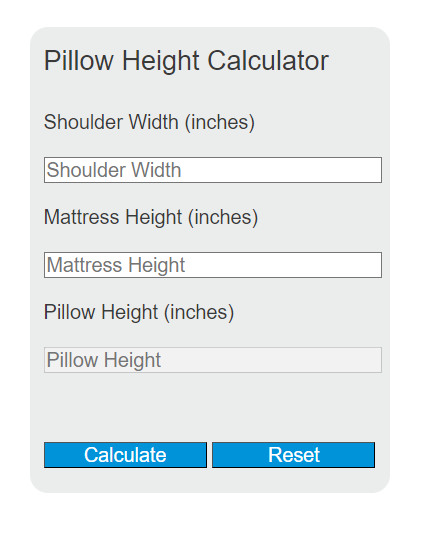
Estimate pillow loft from a measured body gap or sleep profile, account for mattress sink and pillow compression, and compare a practical shopping range.
Related Calculators
- Pillow Yardage Calculator
- Height to Neck Length Calculator
- Torso Length Calculator
- Dryer Capacity Calculator
- All Everyday Life and Education Calculators
Pillow Loft (Height) Formula
This calculator estimates an appropriate pillow loft for side sleeping. In practical terms, pillow height should fill the remaining space between your head/neck and the mattress after your shoulder compresses into the bed. If the mattress allows more shoulder sinkage, the pillow usually needs less height. If the mattress is firmer and allows less sinkage, the pillow usually needs more height.
| Variable | Meaning | How to Think About It |
|---|---|---|
| PH | Pillow height / loft | The support height you want the pillow to provide under the head and neck. |
| SG | Shoulder-to-neck gap | The vertical space that exists when you lie on your side and your head is unsupported. |
| MS | Mattress sinkage at the shoulder | How far the shoulder compresses into the mattress in your normal sleeping position. |
If the calculation produces a negative result, use 0 as the minimum estimate. That simply means the mattress is already filling the space more than expected, so a higher pillow is not needed from this measurement alone.
Why Pillow Height Matters
Pillow loft affects how your head, neck, and upper back are positioned during sleep. A pillow that is too tall can push the head upward and bend the neck sideways. A pillow that is too flat can let the head drop downward toward the mattress. The goal is not maximum thickness; the goal is a loft that matches your body shape, sleeping position, mattress feel, and pillow material.
- Side sleepers usually need the most loft because the shoulder creates a larger gap.
- Back sleepers often need a lower loft because the head rests closer to the mattress.
- Stomach sleepers typically do best with very low loft or no pillow under the head at all.
- This calculator is most useful for side-sleeping estimates.
How to Calculate Pillow Height
- Lie down in your usual side-sleeping posture on your normal mattress.
- Estimate the shoulder-to-neck gap using a ruler, tape measure, or a helper.
- Estimate how much your shoulder sinks into the mattress under normal body weight.
- Enter both values in the calculator using the same unit.
- Use the result as a starting loft estimate, then fine-tune based on pillow firmness and compression.
Example
If your side-sleeping shoulder-to-neck gap is 5.5 inches and your shoulder sinks 1.5 inches into the mattress, the estimated pillow height is:
That means a pillow providing about 4 inches of effective support would be a reasonable starting point.
How to Measure More Accurately
The calculator is only as good as the inputs, so measurement quality matters. These tips can make your estimate more realistic:
- Measure in your real sleep setup. Mattress firmness, toppers, and even sheet tension can change sinkage.
- Use your usual posture. If you curl slightly or place one arm differently under the pillow, the gap can change.
- Measure effective support, not just labeled loft. A pillow may be advertised as 5 inches tall but compress to much less under your head.
- Repeat the measurement more than once. Small errors of even 0.5 inch can noticeably change comfort.
Interpreting the Result
Your result is best treated as an effective support height, not necessarily the exact uncompressed thickness printed on a pillow package. Different fills compress differently:
| Pillow Type | Typical Compression Behavior | Selection Note |
|---|---|---|
| Memory foam | Usually compresses less and holds shape better | The labeled loft is often closer to the support you actually feel. |
| Latex | Responsive with moderate compression | Often feels supportive without needing as much extra height. |
| Polyfill / down alternative | Can compress significantly | You may need a higher stated loft to achieve the calculated support height. |
| Down / feather | Usually compresses the most and can shift during the night | Look at adjustable fill or higher loft if side sleeping. |
| Adjustable-fill pillows | Loft can be customized | Often the easiest option when using a loft estimate from a calculator. |
Factors That Change the Ideal Loft
| Factor | Effect on Needed Pillow Height |
|---|---|
| Broader shoulders | Usually increase the gap and may require more loft. |
| Softer mattress | Usually increases shoulder sinkage and may reduce needed loft. |
| Firmer mattress | Usually reduces sinkage and may increase needed loft. |
| Softer pillow fill | May require choosing a taller pillow to reach the same effective support. |
| Position changes during sleep | May favor a medium, adjustable, or contour pillow instead of a single fixed loft. |
Signs Your Pillow May Be Too High or Too Low
| If the Pillow Is Too High | If the Pillow Is Too Low |
|---|---|
| Chin feels pushed upward or toward the chest | Head tilts downward toward the mattress |
| Side of the neck feels compressed | Neck muscles feel unsupported |
| Shoulder pressure may increase | You may bunch the pillow or place an arm underneath it |
| You feel better after removing some fill or switching lower | You feel better after folding, stacking, or fluffing the pillow higher |
Practical Buying Tips
- Use the calculator result as a baseline, then compare it to the pillow’s compressed support, not just its advertised thickness.
- If you are between two lofts, adjustable-fill pillows are often the safest choice.
- Contour pillows can work well for side sleepers when the higher edge roughly matches the estimated support height.
- If you switch mattresses, you may also need to switch pillow loft because sinkage changes.
- For combination sleepers, choose the loft that best matches the position you spend the most time in.
Frequently Asked Questions
Is pillow height the same as pillow loft?
Yes. In most bedding discussions, height and loft refer to the pillow’s thickness or support depth.
Should I use the exact number from the calculator?
Use it as a strong starting estimate. Real comfort also depends on fill material, firmness, head weight, shoulder width, and how much the pillow compresses overnight.
Why can two pillows with the same listed height feel different?
Because the labeled loft is not the same as effective support. A firmer foam pillow and a soft down pillow may both be listed at the same height but support the head very differently once loaded.
What if my result seems unusually low or high?
Recheck both measurements, especially shoulder sinkage. Very soft mattresses can reduce the loft you need, while very firm mattresses and broader shoulders can increase it.