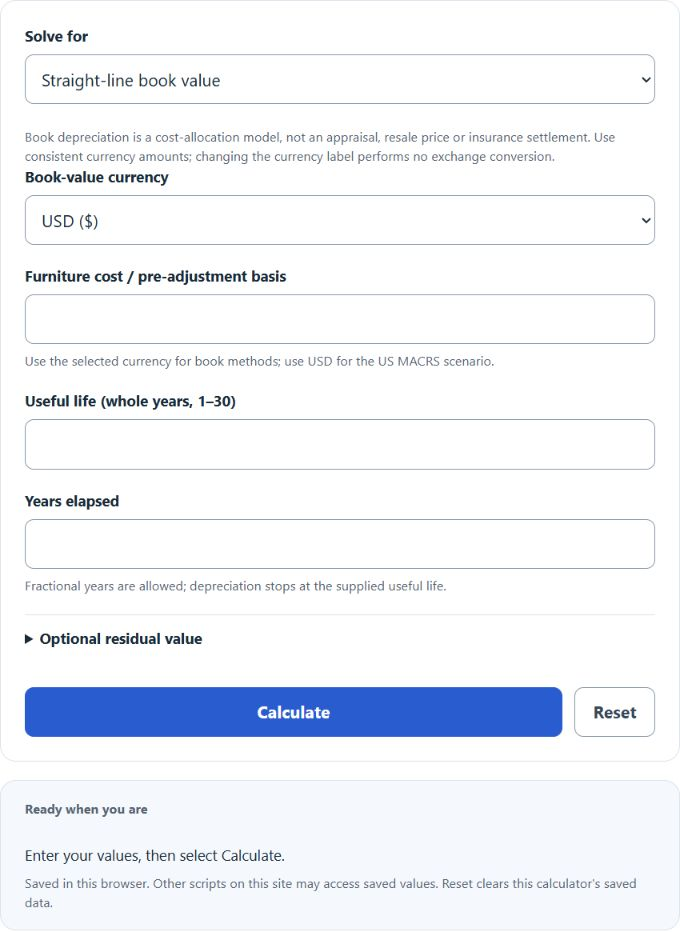
Estimate furniture book depreciation with straight-line or a supplied fixed declining-balance rate, or review a limited US 7-year MACRS table schedule. Book value, tax basis, resale value and insurance payments are different concepts; this calculator does not appraise furniture or determine tax eligibility.
- All Business Calculators
- Appliance Depreciation Calculator
- Car Depreciation Calculator Per Year
- Residual Value Calculator
- Salvage Value Calculator
- Antique Furniture Value Calculator
- Depreciation Calculator Per Year
- Actual Cash Value Calculator
- Reverse Depreciation Calculator
Furniture Depreciation Formula
Straight-line book depreciation allocates cost minus estimated salvage value evenly over the supplied useful life. It does not estimate resale value or an insurance settlement. With cost OP, salvage S, whole-year life L and nonnegative elapsed years A, annual expense D and book value CV are:
Accounting reference: University of North Georgia Press - Principles of Financial Accounting (2018)
- CV is modeled book value, not a market appraisal or insurance claim amount.
- OP is supplied cost. Book currencies USD, EUR and GBP are labels only; there is no exchange conversion.
- D = (OP − S) / L is annual straight-line depreciation in currency units. Optional salvage S uses blank = 0 and must satisfy 0 ≤ S ≤ OP.
- L is an explicitly supplied whole-number life from 1 to 30 years. A is nonnegative elapsed years and may be fractional; depreciation stops at L and value stops at S.
Three Depreciation Frameworks
Book cost allocation, an applicable tax schedule and a market appraisal answer different questions. Not every item qualifies for tax depreciation. Neither book value nor remaining tax basis establishes resale value or an amount payable under an insurance policy.
| Framework | Used For | Method | Illustration at Year 5 |
| Book / Accounting | Modeled cost allocation | Hypothetical $1,000 cost, $300 salvage, 10-year straight-line life | $650 book value |
| IRS Tax (MACRS) | Applicable business tax schedule, subject to eligibility | 7-year GDS, Table A-1 half-year; $1,000 schedule basis | $223.10 remaining tax basis |
| Market / Resale | Separate sale-price assessment | Appraisal or relevant comparable sales | Not calculated |
MACRS is a US tax system for eligible business or income-producing property, not ordinary personal household use. This limited mode assumes the applicable business portion qualifies for 7-year GDS and the half-year convention. The hypothetical $223.10 remaining tax basis is not an estimated sale price.
Inputs and Method Assumptions
Supply documented assumptions; no average depreciation rates, useful lives or resale percentages are inferred. Monetary inputs accept at most two decimal places; cost must be positive and no more than 1,000,000,000 currency units. These are calculator limits, not tax-law thresholds.
| Input | Straight-line | Fixed declining balance | Limited 7-year MACRS | Meaning |
| Cost | Required | Required | Required in USD | Starting cost; not already-reduced remaining basis. |
| Salvage | Optional; blank = 0 | Optional; blank = 0 | Not used | 0 to cost; equal cost gives no book depreciation. |
| Useful life | Whole years, 1–30 | Not used | Fixed table | No factual life default. |
| Elapsed / selected year | Nonnegative; fractions allowed, capped at life | Whole years, 0–30 | Recovery year 1–8 | Full schedules accompany results. |
| Rate | Annual amount (cost − salvage) / life | Supplied 0%–100% | Eight Table A-1 rates | Fixed-rate mode has no straight-line switch. |
| Business use | Not applied | Not applied | Explicit 0%–100% | Constant use assumed; eligibility not determined. |
| Pre-schedule reductions | Not applied | Not applied | Optional; blank = 0 | Initial applicable reductions, not earlier annual MACRS. |
| Currency / scope | USD, EUR or GBP label | USD, EUR or GBP label | USD only | No FX, market appraisal or insurance valuation. |
| Result limit | Salvage floor | Salvage floor | Remaining schedule basis | Actual tax rules require separate review. |
MACRS 7-Year Depreciation Schedule (Business Furniture)
This limited US mode uses the 7-year GDS column of IRS Publication 946 Table A-1 with the half-year convention. Confirm the property class, method and convention separately; a business label does not make every furnishing eligible. The illustration assumes 12-month tax years, constant eligible business use and no early disposal or later basis adjustment. It does not calculate eligibility, ADS, mid-quarter schedules, recapture, tax limits, Section 179 or bonus depreciation. Table A-1 already embodies its applicable declining-balance/straight-line switch; the separate fixed-rate book mode does not switch.
| Recovery Year | MACRS % | Table Amount on $10,000 Schedule Basis | Cumulative % | Remaining Schedule Basis |
| 1 | 14.29% | $1,429 | 14.29% | $8,571 |
| 2 | 24.49% | $2,449 | 38.78% | $6,122 |
| 3 | 17.49% | $1,749 | 56.27% | $4,373 |
| 4 | 12.49% | $1,249 | 68.76% | $3,124 |
| 5 | 8.93% | $893 | 77.69% | $2,231 |
| 6 | 8.92% | $892 | 86.61% | $1,339 |
| 7 | 8.93% | $893 | 95.54% | $446 |
| 8 | 4.46% | $446 | 100% | $0 |
Source: the current IRS Publication 946, Table A-1. Here schedule basis = cost × business-use percentage / 100 − supplied pre-schedule reductions. Do not subtract earlier annual MACRS depreciation again: each table percentage uses the same original schedule basis. Separately established applicable Section 179, special-depreciation or other initial adjustments can reduce that basis; this calculator does not determine them. Reductions cannot exceed the business-use amount; equality or zero business use gives a zero schedule. No salvage is subtracted. Check current eligibility, elections, limits and later adjustments separately.
Example Problem
How to calculate hypothetical straight-line furniture book value?
- First, determine purchase cost.
This hypothetical example uses furniture cost of $1,000.00.
- Next, supply useful life and salvage value.
Assume 10 years and $300.00 salvage. Annual depreciation is ($1,000 − $300) / 10 = $70, equivalent to 7% of original cost only in this example, not an average sofa rate.
- Next, enter elapsed years.
Elapsed time is 6 years, within the assumed 10-year life.
- Finally, calculate modeled book value.
Annual depreciation = ($1,000 − $300) / 10 = $70.
Accumulated depreciation = $70 × 6 = $420.
Book value = $1,000 − $420 = $580.00. This is not a resale or insurance valuation.
FAQ
Does personal furniture depreciate the same way as business furniture for tax purposes?
Ordinary personal household use does not qualify for US tax-depreciation deductions. Eligible business or income-producing use has separate basis, classification and method rules. Book modes are cost-allocation illustrations, not automatic deductions or market/insurance values. Conversion from personal to business use can require basis rules this simplified cost-percentage model does not determine.
Does remaining MACRS basis equal resale value?
No. On a $10,000 schedule basis under the stated Table A-1 assumptions, year-5 cumulative percentages total 77.69%, leaving $2,231. This tax cost-recovery number is not an appraisal and does not establish whether a sale price would be higher or lower.
Can this calculator determine an insurance claim amount?
No. It does not apply policy valuation terms, coverage limits, deductibles, condition assessments or claim adjustments. Book depreciation and MACRS schedules should not be presented as actual-cash-value or replacement-cost settlements; review the applicable policy and valuation evidence separately.
Does this calculator determine Section 179 or bonus depreciation?
No. Those provisions have separate eligibility, elections, timing and limits. Establish applicable amounts using current IRS guidance, then enter only appropriate pre-schedule reductions. Do not also subtract ordinary MACRS deductions from prior recovery years. The output is only the specified table schedule on the resulting original schedule basis.
Does the calculator predict condition-based resale value?
No. It does not model condition, brand, location, demand or comparable transactions and supplies no resale percentage. A separate appraisal addresses that question; hypothetical salvage is an accounting assumption, not a predicted sale price.