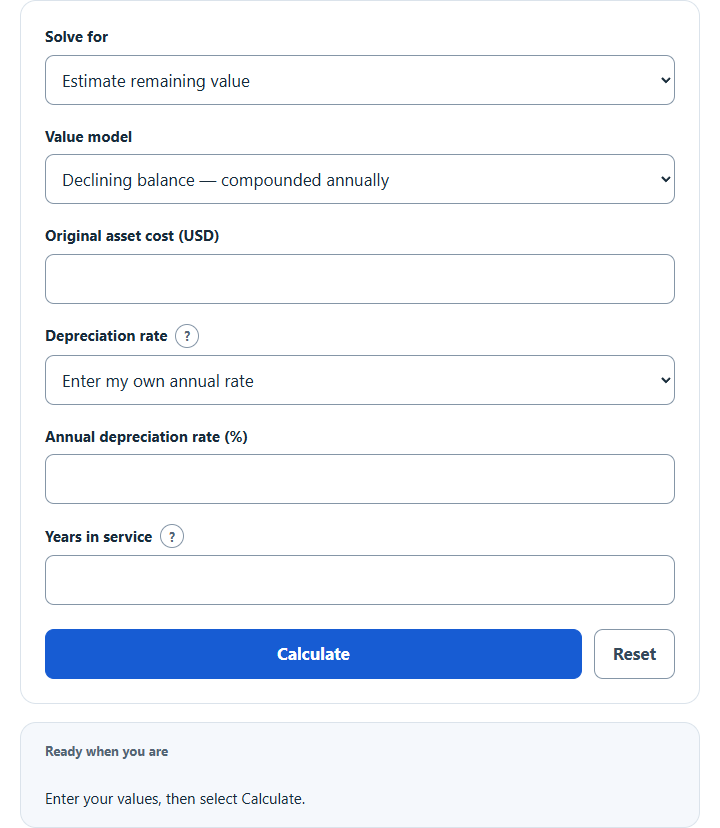
Calculate salvage value from original cost, annual depreciation rate and years, with a typical car rate built in, or solve the rate for a target value.
- All Business Calculators
- Appliance Depreciation Calculator
- Furniture Depreciation Calculator
- Residual Value Calculator
Salvage Value Formula
The original-cost model below estimates a remaining value with a zero floor. The alternate declining-balance model compounds the entered annual rate; neither formula independently determines accounting residual value or market resale proceeds:
- Where V is the modeled remaining value (USD), not an appraised residual or sale price
- OP is the original price ($)
- D is the assumed annual rate (%): a fixed percentage of original cost in the first model, or of the prior modeled value in declining balance
- A is the age of the asset (years)
For the original-cost model, subtract original cost × annual rate × years from original cost and apply a zero floor. For declining balance, multiply cost by (1 − rate)^years. Rates are between 0% and 100%; fractional years use proportional time in the original-cost model and a mathematical power interpolation in declining balance. Reverse-solving a zero original-cost target reports the minimum qualifying rate because higher allowed rates also reach the floor.
Salvage Value Definition
Accounting residual value is an estimate of net disposal proceeds for an asset already in the age and condition expected at the end of its useful life. It is separate from a carrying amount calculated after depreciation and impairment.
This tool instead applies your entered rate and time to original cost. Its mathematical remaining values do not establish residual value, actual market proceeds, impairment or a prescribed tax/accounting method. Under accounting standards, residual value and useful life are separate estimates used when determining depreciation.
How to calculate salvage value?
Example Problem #1:
For an illustrative original-cost model, use a dishwasher cost of $1000.00, 5 years and an assumed annual reduction of 11.5% of original cost. These are example model inputs, not an assessed market depreciation rate.
Select the rate-on-original-cost model to calculate this remaining value. The example does not predict the dishwasher’s sale price.
V = max(0, OP × (1 − D/100 × A))
= 1000 - (11.5/100*1000 * 5)
= $425.00.
Example Problem #2:
For a second original-cost-model example, use a heater cost of $2,000.00, 4 years and an assumed annual reduction of 10% of original cost. The result is a model value, not an estimated selling price.
Using the same original-cost model as Example 1:
V = max(0, OP × (1 − D/100 × A))
= 2000-(10/100*2000*4)
=$1200.00.