Calculate annual percentage depreciation, ending book value, accumulated depreciation, and a year-by-year straight-line or declining-balance schedule.
Related Calculators
- Present Discounted Value Calculator
- Appraisal Hike Percentage Calculator
- Annual Holding Cost Calculator
- P/A Ratio Calculator
- All Business Calculators
Depreciation Formula
Choose straight-line percent of original cost or declining-balance percent of remaining book value. Straight-line subtracts a constant amount each year; declining balance applies a constant rate to the remaining value. The book-value calculation stops at the entered salvage floor. These are estimating models, not tax schedules or market valuations.
To solve for original cost:
To solve for years depreciated:
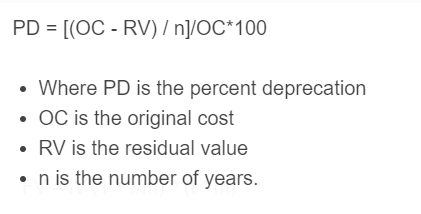
To solve for annual percent depreciation:
- RV = current residual value of the asset
- OC = original cost of the asset
- p = annual percent depreciation
- Y = number of years depreciated
Select book value or annual rate, then enter the fields shown. The rearranged formulas above describe the unfloored straight-line model; this widget does not solve original cost or elapsed years. Declining-balance value is OC × (1 − p/100)^Y, and its inverse rate is 100 × [1 − (RV/OC)^(1/Y)]. Both forward methods apply the salvage floor. A reverse rate assumes that no floor truncated the ending value.
Illustrative Useful-Life and Rate Assumptions
The hypothetical assumptions below illustrate approximately 100 divided by useful life, with zero salvage. They are not verified typical lives, tax recovery periods or recommended accounting estimates. Actual depreciation depends on applicable rules, use, condition and residual value.
| Asset Type | Illustrative Useful Life | Approximate Rate of Original Cost |
|---|---|---|
| Office furniture | 7 to 10 years | 10% to 14% |
| Computers and electronics | 3 to 5 years | 20% to 33% |
| Vehicles | 5 to 8 years | 12.5% to 20% |
| Machinery | 5 to 15 years | 7% to 20% |
| Buildings | 25 to 40 years | 2.5% to 4% |
How to Interpret Depreciation Results
| Result | What It Means |
|---|---|
| Residual value is positive | The asset still has estimated remaining value under the entered depreciation rate and time period. |
| Residual value is close to zero | The asset has nearly fully depreciated based on the inputs. |
| Total depreciation reaches 100% | For straight-line percent of original cost with a zero salvage floor, 20% per year for 5 years reaches zero. Declining-balance rates compound and do not add this way. |
| Total depreciation exceeds 100% | The unfloored straight-line expression would be negative; this calculator stops at the salvage floor. Declining-balance depreciation follows a different exponential formula. |
Example Calculations
Example 1: Calculate residual value
You bought equipment for $10,000. It depreciates by 12% per year for 4 years.
The residual value is $5,200.
Example 2: Calculate percent depreciation
An asset originally cost $8,000 and is now worth $5,600 after 3 years.
The annual depreciation rate is 10% per year.
FAQ
Is this calculator using straight-line depreciation?
Choose straight-line to depreciate the same percentage of original cost each year, or declining balance to apply the rate to remaining book value. Book value is bounded by the entered salvage floor.
What is residual value?
Residual value is the estimated value left after depreciation. In this calculator, it is the current value after applying the annual depreciation percentage for the number of years entered.
Which values are required?
Book-value mode needs original cost, salvage floor (zero allowed), annual rate and whole years. Rate mode needs cost, ending book value and at least one whole year; it assumes no salvage-floor truncation. Up to 200 whole years are supported.