Estimate bedding and surround (embedment) volume from a rectangular full pipe-surround envelope minus pipe displacement, solve external cylinder dimensions, or estimate material mass from volume and an assumed bulk density.
- All Construction Calculators
- Pipe Volume Calculator
- Pipe Stretch Calculator
- Bed Slat Spacing Calculator
Pipe Bedding Formula
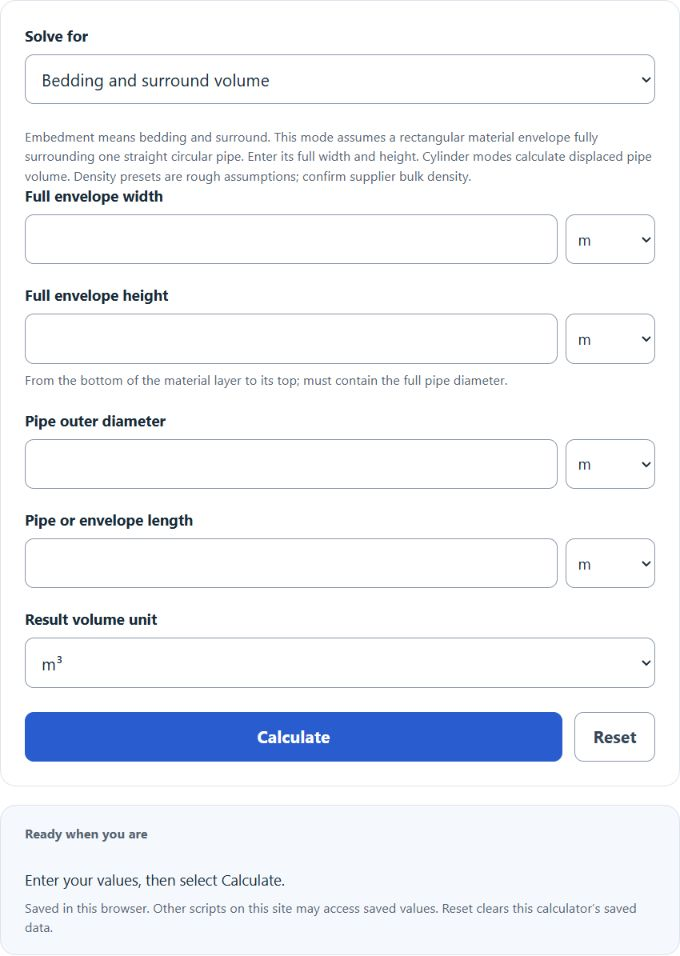
For a rectangular material envelope fully surrounding one circular pipe, net bedding and surround (embedment) quantity is envelope volume minus the pipe’s external displacement. Enter the full envelope width W, height H, pipe outer diameter D and length L. This quantity model does not specify required bedding dimensions or account for waste, fittings, compaction or nonrectangular sections.
Variables:
- V is the estimated bedding material volume (cubic meters); W and H are the full rectangular envelope width and height (meters)
- D is the outer diameter of the pipe (meters)
- L is the length of the pipe (meters)
Calculate the rectangular cross-section W × H, subtract the pipe’s circular area π(D/2)², then multiply by L. W must exceed D and H must contain the full diameter. The retained cylinder modes use Vpipe = π(D/2)²L to calculate displaced pipe volume or its inverse dimensions; that result alone is not bedding quantity. Mass mode uses volume × bulk density. Its material presets are illustrative assumptions; confirm supplier density, moisture and loose/compacted basis. The PPI Drainage Handbook, Chapter 9 distinguishes the bottom bedding layer from full embedment. This full-surround calculation includes the pipe zone rather than estimating the bottom layer alone.
What is a Pipe Bedding?
A pipe bedding is a supportive foundation layer that is laid down before installing underground pipes. It provides a stable base, protects the pipe from damage, and helps distribute the weight of the soil and any load above it. The material used for pipe bedding can vary, but it often includes crushed stone, gravel, or sand. Proper pipe bedding is crucial for the longevity and functionality of the pipe system.
How to Calculate Pipe Bedding?
The following steps calculate the pipe displacement used within the bedding formula. Subtract this from the full rectangular material envelope volume to estimate bedding:
- First, determine the outer diameter of the pipe (D) in meters.
- Next, determine the length of the pipe (L) in meters.
- Next, calculate the radius of the pipe by dividing the outer diameter by 2.
- Next, square the radius of the pipe.
- Next, multiply the squared radius by π (pi).
- Finally, multiply by pipe length to calculate external pipe displacement. Bedding volume is W × H × L minus this pipe displacement, for the stated full-surround rectangular geometry.
Example Problem:
Use the following variables as an example problem to test your knowledge:
Outer diameter of the pipe (D) = 0.5 meters
Length of the pipe (L) = 10 meters; full material envelope W = 1 meter and H = 0.7 meter. Envelope volume = 7 m³, pipe displacement = 1.963495 m³, and estimated bedding = 5.036505 m³ (about 5.04 m³).