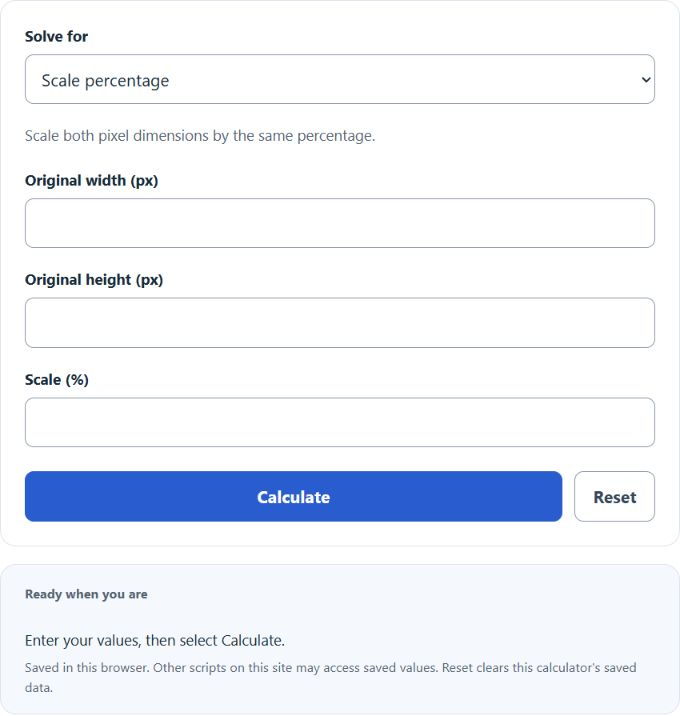
Calculate resized pixel width and height from a scale percentage, target width, or target height. The calculator applies proportional scaling and reports whole-pixel dimensions; it does not modify an image file.
- Pixel to Percentage Calculator
- Pixels to Inches Calculator
- cm to Pixel Calculator
- Resolution Calculator
- DPI Calculator (PPI)
- Pixel Size Calculator
- All Unit Converters
Pixel Resize Formula
The pixel resize calculator finds a new image dimension by multiplying the original dimension by a resize ratio. This is useful when scaling images for websites, social media, print layouts, UI mockups, thumbnails, screenshots, and responsive design. If you apply the same ratio to both width and height, the image keeps its original proportions.
- ND = new dimension after resizing
- OD = original dimension
- R = resize ratio in decimal form
Width and Height Resizing
For a complete image, resize width and height separately. Uniform scaling uses the same ratio for both dimensions.
Applying the same ratio preserves proportions before rounding. Whole-pixel rounding can change the exact aspect ratio, especially for small images. This calculator rounds to the nearest whole pixel and uses a minimum of one pixel per dimension, with any resulting change disclosed.
Solving for Any Variable
The scaling relationship can also be rearranged algebraically when any two of the three values are known. The widget above calculates resized width and height from original pixel dimensions and a percentage or target dimension.
This is helpful when you know the target dimension and need to determine the scaling ratio, or when you know the new dimension and want to recover the original one.
Resize Ratio vs. Percentage
Many image editors describe scaling as a percentage, while calculators often use a decimal ratio. Convert between them before calculating.
| Percentage | Decimal Ratio | Meaning |
|---|---|---|
| 25% | 0.25 | Reduce each dimension to one-fourth |
| 50% | 0.5 | Reduce each dimension by half |
| 75% | 0.75 | Keep three-fourths of each dimension |
| 100% | 1 | No change |
| 150% | 1.5 | Increase each dimension by half |
| 200% | 2 | Double each dimension |
How to Calculate Pixel Resize
- Identify the original dimension in pixels.
- Convert the resize percentage to a decimal if needed.
- Multiply the original dimension by the resize ratio.
- Round to the nearest whole pixel when a design or export workflow requires an integer value.
- Apply the same ratio to width and height if you want to maintain aspect ratio.
Examples
If an image dimension is 800 px and you scale it to 50%, the new dimension is:
If an image dimension is 640 px and you scale it to 150%, the new dimension is:
If a dimension changes from 1200 px to 900 px, the resize ratio used is:
Aspect Ratio and Pixel Area
Linear dimensions scale by the resize ratio, but total pixel area changes faster because both width and height are affected. This matters when estimating image detail, layout fit, render cost, and approximate file-size impact.
- AR = aspect ratio
- W = width
- H = height
- NA = new pixel area
- OA = original pixel area
| Resize Ratio | Linear Size Change | Total Pixel Area Change |
|---|---|---|
| 0.5 | 50% of original width and height | 25% of original area |
| 0.75 | 75% of original width and height | 56.25% of original area |
| 1 | No change | No change |
| 1.5 | 150% of original width and height | 225% of original area |
| 2 | 200% of original width and height | 400% of original area |
When to Use a Pixel Resize Calculator
- Scaling hero images, banners, and blog graphics to fit a page layout
- Preparing thumbnails, avatars, and profile images
- Resizing screenshots for documentation or tutorials
- Adjusting icons and UI assets for different screen densities
- Estimating export dimensions before batch image processing
- Matching target dimensions for CMS uploads, ads, or storefront listings
Common Mistakes
- Entering a percent as a whole number: 50% should be entered as 0.5 if the calculator expects a decimal ratio.
- Changing only one dimension: resizing width without height can distort the image unless distortion is intentional.
- Confusing pixels with DPI or PPI: pixel dimensions describe image size on a grid, while DPI/PPI relates to output density.
- Expecting upscaling to add real detail: enlarging increases pixel count, but it does not recreate original image information.
- Ignoring rounding: some workflows require whole-pixel values, so fractional results may need to be rounded.
Frequently Asked Questions
Does resizing by pixels keep image quality the same?
Reducing size usually preserves visual sharpness well for screen use, but enlarging can soften detail because new pixels must be generated. The result depends on the resizing method used by the software.
How do I keep the image from stretching?
Use the same resize ratio for both width and height. Locking aspect ratio in your editor ensures proportional scaling.
What ratio should I use to cut an image in half?
Use a ratio of 0.5. Apply it to both width and height for a proportional reduction.
What ratio should I use to double an image size?
Use a ratio of 2. Apply it to each dimension if you want the full image to scale uniformly.
Can I calculate width and height separately?
Yes. If you are intentionally stretching or fitting an image into a specific container, width and height can use different ratios. For proportional resizing, use one shared ratio.