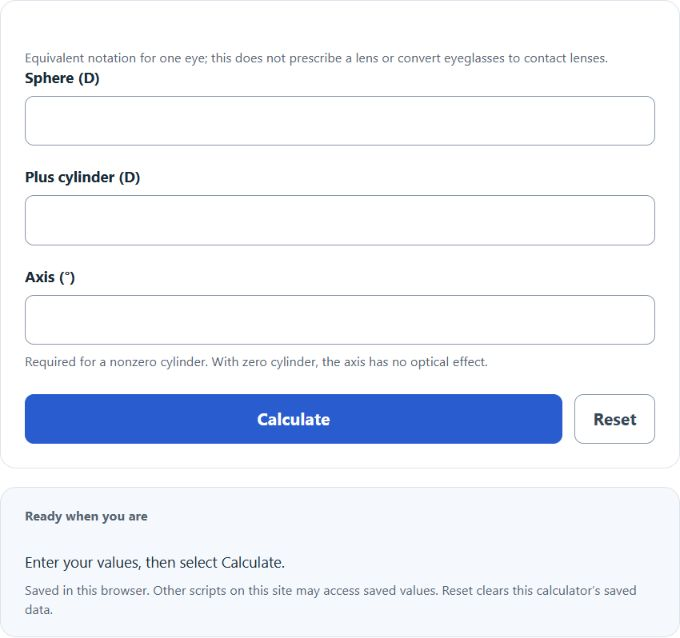
Convert plus cylinder eyeglass prescriptions to minus cylinder notation using sphere, cylinder, and axis values for the transposed result.
- All Medical and Health Unit Converters
- All Health and Medical Calculators
- Contact Lens Vertex Calculator
- Half Cylinder Volume Calculator
Plus To Minus Cyl Formula
The following formulas are used to transpose (convert) a prescription from plus-cylinder notation to minus-cylinder notation:
S− = S+ + C+; C− = −C+; rotate the axis by 90° into 1–180°. With zero cylinder, the axis is not applicable.
Variables:
- S+ is the sphere power in plus-cylinder notation (diopters).
- C+ is the cylinder power in plus-cylinder notation (diopters, typically written as a positive value).
- A+ is the axis in degrees (typically 1–180).
- S–, C–, and A– are the equivalent values in minus-cylinder notation.
To convert from plus-cylinder to minus-cylinder, add the plus-cylinder value to the sphere to get the new sphere, change the sign of the cylinder, and rotate the axis by 90° (keeping the axis within 1–180; if the result exceeds 180, subtract 180). When cylinder is zero, axis is not applicable. This changes notation only; it does not prescribe lenses or convert eyeglasses into contact lenses.
| Sphere (Plus Cyl) | Cylinder (Plus Cyl) | Axis (°) | Sphere (Minus Cyl) | Cylinder (Minus Cyl) | Axis (°) |
|---|---|---|---|---|---|
| +0.00 | +0.50 | 90 | +0.50 | -0.50 | 180 |
| -1.00 | +0.50 | 20 | -0.50 | -0.50 | 110 |
| -2.00 | +1.00 | 45 | -1.00 | -1.00 | 135 |
| -0.50 | +0.75 | 80 | +0.25 | -0.75 | 170 |
| +1.00 | +0.25 | 10 | +1.25 | -0.25 | 100 |
| +2.00 | +1.00 | 120 | +3.00 | -1.00 | 30 |
| -3.00 | +1.50 | 75 | -1.50 | -1.50 | 165 |
| +0.50 | +0.50 | 60 | +1.00 | -0.50 | 150 |
| +1.50 | +0.75 | 150 | +2.25 | -0.75 | 60 |
| -1.50 | +2.00 | 95 | +0.50 | -2.00 | 5 |
| +0.00 | +1.25 | 30 | +1.25 | -1.25 | 120 |
| +2.50 | +0.50 | 135 | +3.00 | -0.50 | 45 |
| -2.50 | +0.25 | 5 | -2.25 | -0.25 | 95 |
| -0.25 | +1.25 | 160 | +1.00 | -1.25 | 70 |
| +3.00 | +0.75 | 110 | +3.75 | -0.75 | 20 |
| -1.25 | +1.00 | 180 | -0.25 | -1.00 | 90 |
| +0.75 | +1.50 | 140 | +2.25 | -1.50 | 50 |
| -0.75 | +0.25 | 70 | -0.50 | -0.25 | 160 |
| +1.25 | +2.00 | 25 | +3.25 | -2.00 | 115 |
| -3.50 | +0.50 | 100 | -3.00 | -0.50 | 10 |
| Formulas: Sphere(minus) = Sphere(plus) + Cylinder(plus); Cylinder(minus) = -Cylinder(plus); Axis(minus) = Axis(plus) + 90; if result > 180, subtract 180 (axis is typically written 1–180). | |||||
What Does “Plus to Minus Cyl” Mean?
A plus-to-minus-cylinder conversion (often called prescription transposition) is a method used in optometry to rewrite an eyeglass or contact lens prescription from plus-cylinder notation to minus-cylinder notation (or vice versa). In plus-cylinder notation, the cylinder value is written as a positive number; in minus-cylinder notation, the cylinder value is written as a negative number. The conversion changes the written form by adding the cylinder to the sphere, changing the sign of the cylinder, and rotating the axis by 90 degrees (keeping the axis within 1–180). This conversion does not change the optical power of the prescription—it only represents the same two principal meridian powers in a different format.
How to Calculate Plus To Minus Cyl?
The following steps outline how to calculate the Plus To Minus Cyl.
- Start with the prescription in plus-cylinder form: Sphere (S+), Cylinder (C+), and Axis (A+).
- Calculate the new sphere: S– = S+ + C+.
- Change the sign of the cylinder: C– = -C+.
- Rotate the axis by 90°: A– = A+ + 90; if the result is greater than 180, subtract 180 (axis is typically written 1–180).
- Review the converted notation: cylinder is negative, or zero for a sphere-only (DS) prescription. Confirm lens orders with an eye-care professional.
Example Problem:
Use the following values as an example problem to test your knowledge.
Sphere (plus cyl) = +2.00
Cylinder (plus cyl) = +1.00
Axis (plus cyl) = 120°
Converted (minus cyl): Sphere = +3.00, Cylinder = -1.00, Axis = 30°