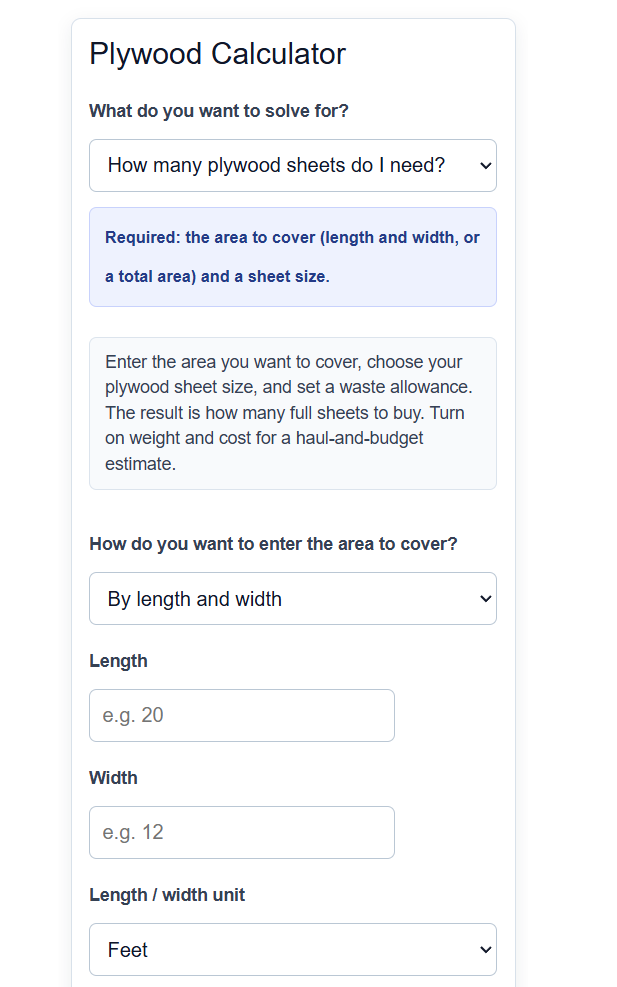
Calculate plywood sheets for a coverage area or repeated parts using standard or custom sheet sizes, waste, kerf, grain direction, yield, and cost.
Plywood Formula
To find the number of plywood sheets you need, divide the area you want to cover (increased by your waste allowance) by the area of a single sheet, then round up to the next whole sheet:
N = ceil( A * (1 + W) / S )
To find the area a set number of sheets will cover, multiply the sheet count by the area of one sheet:
Coverage = N * S
Total material cost and approximate weight follow from the sheet count:
Cost = N * C
Weight = N * S * t * d
- N = number of plywood sheets (always rounded up to a whole sheet)
- A = total area you need to cover, in square feet
- W = waste or overage allowance, written as a decimal (10% = 0.10)
- S = area of one plywood sheet (a standard 4 ft by 8 ft sheet is 32 sq ft)
- C = cost per sheet
- t = sheet thickness in inches
- d = weight factor, about 2.5 lb per square foot for each inch of thickness
The solve-for selector controls which formula runs. Choose "How many plywood sheets do I need?" to enter an area and get a sheet count, or "How much area will my sheets cover?" to enter a sheet count and get the coverage. You can describe the area either as length by width or as a single total area figure. The waste allowance pads the area before dividing so angled cuts and offcuts do not leave you short. The optional cost and thickness inputs add a price estimate and a weight estimate to the result.
Plywood Sheet Sizes and Coverage
Plywood is sold in a few standard sheet sizes. The coverage of one sheet is simply its length times its width.
| Sheet size | Area per sheet | Common use |
|---|---|---|
| 4 ft by 8 ft | 32 sq ft | Standard sheet for floors, walls, sheathing |
| 4 ft by 10 ft | 40 sq ft | Taller walls with fewer seams |
| 4 ft by 12 ft | 48 sq ft | Long runs, large floors and ceilings |
The table below lists the waste allowance to add for common project types. Cuts that follow angles or produce many small pieces waste more material, so they need a higher percentage.
| Project type | Suggested waste |
|---|---|
| Simple floors and walls | 10% |
| Roof, gable, and hip surfaces | 15% |
| Cabinetry and complex cuts | 20% |
Example Problems
Example 1: How many sheets do you need?
You are sheathing a floor that measures 12 ft by 14 ft, which is 168 sq ft. You use standard 4 ft by 8 ft sheets (32 sq ft) and add a 10% waste allowance.
Padded area: 168 * 1.10 = 184.8 sq ft. Divide by sheet area: 184.8 / 32 = 5.78. Round up: you need 6 sheets.
Example 2: How much will your sheets cover?
You already have 8 standard 4 ft by 8 ft sheets. Coverage: 8 * 32 = 256 sq ft. At a cost of $45 per sheet, the material total is 8 * 45 = $360.
Frequently Asked Questions
How many square feet does a 4x8 sheet of plywood cover?
A standard 4 ft by 8 ft sheet covers 32 square feet. To get a rough sheet count for a project, divide the total area by 32 and round up. Add a waste allowance first if the job involves angled or detailed cuts.
How much waste should I add?
Use about 10% for simple rectangular floors and walls, 15% for roof surfaces with angled cuts, and 20% for cabinetry or any job with many small pieces. The extra material covers offcuts and mistakes so you do not run short partway through.
How much does a sheet of plywood weigh?
Plywood weighs roughly 2.5 lb per square foot for each inch of thickness. A standard 4 ft by 8 ft sheet works out to about 40 lb at 1/2 inch and about 60 lb at 3/4 inch, though the exact weight depends on the wood species and moisture content.