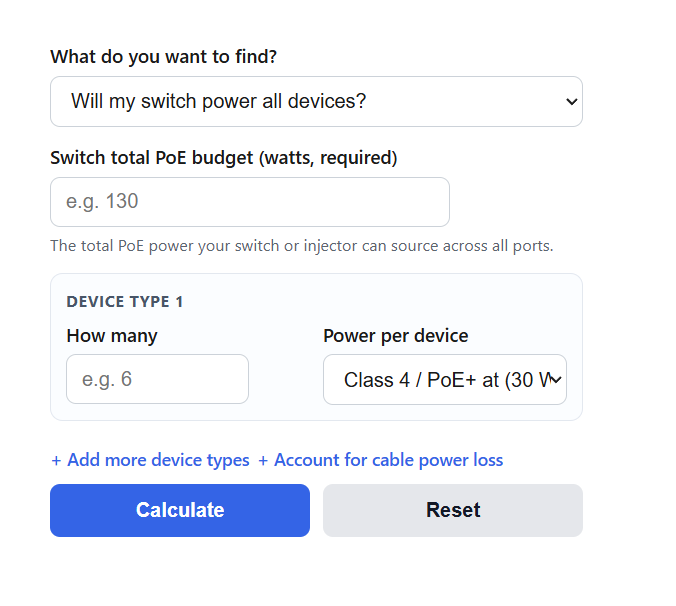
Calculate your PoE power budget in watts, check whether a switch can power all your devices, and estimate cable power loss and voltage drop.
PoE Power Budget Formula
The calculator works in three modes. The first sums the power your devices draw and compares it to the budget of your switch or injector:
Ptotal = sum(ni * Wi) Headroom = Pswitch - Ptotal
The second mode sizes a switch by adding a safety margin to the measured load:
Prec = Ptotal * (1 + H/100)
The third mode estimates how much power a cable run wastes as heat and what voltage is left at the device:
Ploss = I^2 * Rloop I = W / V Vpd = V - I * Rloop
- Ptotal: total power the switch must source, in watts.
- ni: number of devices of type i.
- Wi: switch-side (PSE) watts allocated to one device of type i.
- Pswitch: the total PoE budget printed on your switch or injector, in watts.
- Headroom: watts left over after the devices are powered.
- Prec: recommended switch budget once a margin is added.
- H: safety headroom, as a percent.
- Ploss: power lost in the cable, in watts.
- I: current on the run, in amps.
- W: power the device draws, in watts.
- V: supply voltage at the switch, in volts.
- Rloop: round-trip resistance of the run. It equals the cable resistance per meter times the length, halved when all four pairs carry current.
- Vpd: voltage remaining at the powered device.
The budget check tells you whether your switch can run every device at once. The sizing mode turns a device list into a switch rating to shop for. The cable loss mode shows why a long run can starve a device even when the switch has plenty of spare power: current squared times resistance is dissipated as heat before it reaches the far end, and the voltage that arrives has to stay above the standard’s minimum for the device to power up.
PoE Standards and Cable Loss Reference
Switches reserve power per port based on the IEEE class a device negotiates. The switch-side (PSE) watts are what you budget against; the device-side (PD) watts are what actually reaches the device before cable loss.
| Standard | Class | PSE watts (budget) | PD watts (device) |
|---|---|---|---|
| 802.3af (PoE) | 0 to 3 | 15.4 | 12.95 |
| 802.3at (PoE+) | 4 | 30.0 | 25.5 |
| 802.3bt Type 3 | 5 to 6 | 45 to 60 | 40 to 51 |
| 802.3bt Type 4 | 7 to 8 | 75 to 90 | 62 to 71.3 |
Most budget calculators stop at that table. The run itself also burns power, and it grows with the square of the current, so a long Cat5e link to a PoE+ camera can lose several watts. The table below shows the estimated loss for a 25.5 W PoE+ device on a 48 V, two-pair link, which is the piece competitors leave out.
| Run length | Cat5e loss | Cat6 loss |
|---|---|---|
| 30 m (98 ft) | 1.1 W | 0.8 W |
| 60 m (197 ft) | 2.1 W | 1.5 W |
| 90 m (295 ft) | 3.2 W | 2.3 W |
Multiply the per-run figure by the number of long runs to see how much extra your switch has to source. This is why the budget check has an optional cable-loss setting: on a rack full of distant devices, the wasted watts can be the difference between fitting and tripping the budget.
Example Problems
Example 1: Budget check. You have a switch with a 130 W PoE budget feeding six PoE+ access points at 30 W each. The total is 6 times 30, or 180 W. The headroom is 130 minus 180, or negative 50 W, so the switch is 50 W short. You either move two access points to a second switch or buy a switch with a larger budget.
Example 2: Cable loss. A 25.5 W PoE+ camera sits at the end of a 90 m Cat5e run fed at 48 V over two pairs. The current is 25.5 divided by 48, or 0.53 A. The loop resistance is 0.125 times 90, or 11.25 ohms. The loss is 0.53 squared times 11.25, about 3.2 W, and the voltage at the camera is 48 minus 0.53 times 11.25, about 42 V. That stays above the 37 V minimum, so the camera powers up.
FAQ
What is a PoE power budget? It is the total wattage a switch or injector can deliver across all of its PoE ports at once, not the amount available to any single port. A switch might advertise 30 W per port yet only have a 130 W total budget, which caps how many high-power devices you can run before ports stop delivering power.
Should I add headroom to the budget? Yes. Devices draw a brief inrush spike when they power on, real cable runs waste a few watts, and you often add hardware later. Sizing a switch to 20 to 30 percent above the measured load keeps ports from cutting out under peak draw.
Do I budget the device watts or the class watts? Budget the switch-side class watts, because that is what the switch reserves when a device negotiates its class. A device labeled 25.5 W is a Class 4 device, and the switch sets aside 30 W for it. Using the lower device figure will make your plan look like it fits when it does not.