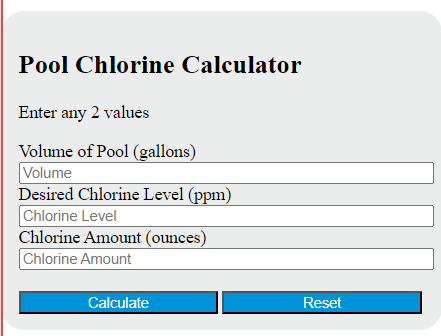
Calculate liquid or granular chlorine needed to raise free chlorine, reverse-calculate the achieved ppm, or estimate pool volume from common pool shapes.
Related Calculators
- Pool Occupancy Calculator
- Water Softener Hardness Calculator
- Pool Turnover Rate Calculator
- Calcium Saturation Index Calculator
- Acid Demand Calculator
- Water Volume Calculator
- Pool Gallons Calculator
- All Everyday Life and Education Calculators
Pool Chlorine Formula
This calculator estimates how much chlorine is needed to raise a pool’s free chlorine level by a chosen amount. The result is expressed as pure chlorine (Cl2 equivalent) by weight, which makes it useful for comparing different chlorine products on a common basis.
- Choz = chlorine required, in ounces by weight as pure chlorine equivalent
- Vgal = pool volume, in US gallons
- Cppm = desired increase in free chlorine, in ppm
The formula works because a 1 ppm increase in water is approximately the same as adding 1 milligram per liter. After converting pool volume into liters and chlorine mass into ounces, the gallon-based shortcut above is obtained.
Equivalent Unit Forms
If you prefer metric units, the same relationship can be written in other forms:
| Pool Volume Units | Chlorine Output Units | Formula |
|---|---|---|
| US gallons | ounces | Choz = (Vgal × Cₚₚₘ) / (7500) |
| liters | grams | Chg = (VL × Cₚₚₘ) / (1000) |
| cubic meters | kilograms | Chkg = (Vm³ × Cₚₚₘ) / (1000) |
How to Calculate Pool Chlorine
- Determine the total pool volume.
- Find the chlorine increase you want, not the final target. For example, if the pool is at 1 ppm and you want 3 ppm, the desired increase is 2 ppm.
- Insert the pool volume and desired increase into the formula.
- Read the result as pure chlorine equivalent.
- If you are using a commercial chlorine product, convert the pure chlorine requirement into the actual amount of product to add.
Converting the Result to a Real Product Amount
Most pool products are not 100% chlorine. Granules, tablets, and liquid chlorine contain a certain available chlorine percentage, so the amount of product added must be larger than the calculator’s pure chlorine result.
- P = actual product amount needed
- Ch = pure chlorine equivalent from the calculator
- f = available chlorine fraction written as a decimal
Examples of decimal conversion:
- 65% available chlorine = 0.65
- 73% available chlorine = 0.73
- 90% available chlorine = 0.90
| Product Strength | Use This Conversion |
|---|---|
| 65% available chlorine | P = (Ch) / (0.65) |
| 73% available chlorine | P = (Ch) / (0.73) |
| 90% available chlorine | P = (Ch) / (0.90) |
For liquid chlorine or bleach, the exact conversion to gallons or liters depends on both the labeled strength and the solution density. The calculator is still useful because it tells you the chlorine demand first, which you can then match to the product label dosing instructions.
Example Calculation
Suppose a pool contains 15,000 gallons of water and you want to raise free chlorine by 2 ppm.
The pool needs 4 ounces of pure chlorine equivalent.
If the product being used contains 65% available chlorine by weight:
That means you would need about 6.15 ounces of that product by weight to supply the same chlorine increase.
Practical Notes
- Use the increase, not the goal. The formula is based on how many ppm you want to add.
- Measure volume carefully. A small error in pool volume causes the chlorine dose to be off by the same percentage.
- Circulate after dosing. Run the pump long enough for the chlorine to disperse before retesting.
- Test again after addition. Sunlight, bather load, and contaminants can consume chlorine, so measured results may differ slightly from the calculated estimate.
- Keep pH and stabilizer in mind. This calculator estimates chlorine quantity only; overall sanitation performance also depends on broader water balance.
Common Input Mistakes
- Selecting gallons when the pool volume is actually in liters
- Entering the desired final chlorine level instead of the amount to increase
- Assuming the calculator output is the same as the weight of a packaged product
- Ignoring product strength when converting from pure chlorine equivalent
Used correctly, this calculator gives a fast and consistent way to estimate chlorine demand for routine maintenance, corrective dosing, and side-by-side comparison of different pool chlorine products.