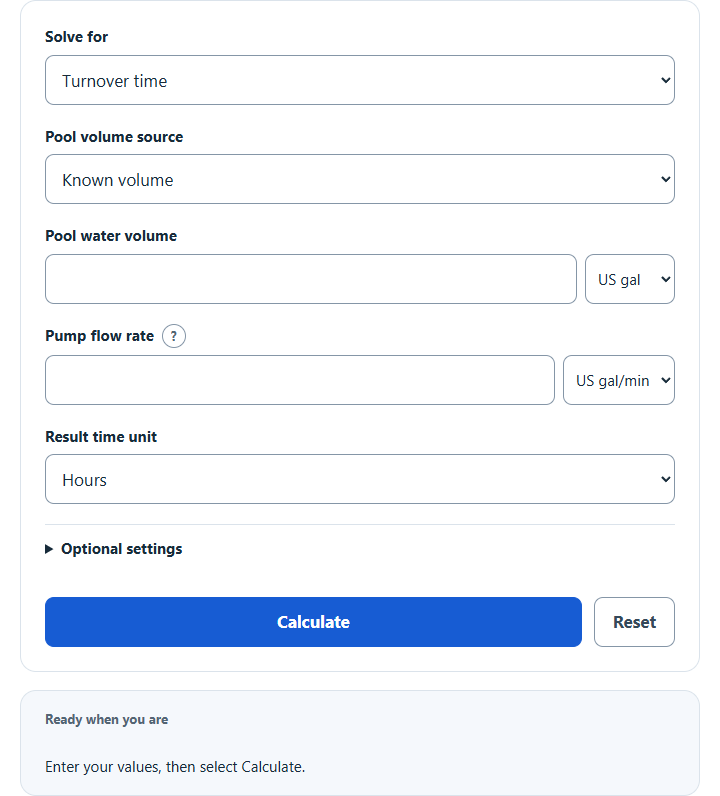
Calculate pool turnover time from pool volume and pump flow rate, or the pump GPM needed for a target turnover time, in gallons or litres.
Related Calculators
- Pool Heat Time Calculator
- Water Drip Leak Calculator
- Pool Chlorine Calculator
- Water Flow Rate Calculator
- GPM Gallons/min Calculator
- Water Volume Calculator
- All Everyday Life and Education Calculators
Calculator Functions
| Function | What it does | What it requires |
|---|---|---|
| Turnover time | Finds how long the pump takes to move one pool volume through the filter | Requires the pool water volume, or the pool’s dimensions, and the pump flow rate |
| Pump flow rate (GPM) for a turnover time | Finds the flow rate needed to turn the pool over in a chosen time | Requires the pool water volume, or the pool’s dimensions, and the target turnover time |
| Pool volume from flow and time | Finds the volume of water that a known flow moves in a known time | Requires the pump flow rate and the turnover time |
Volume can be entered in US gallons, liters or cubic meters, and flow in US gal/min, US gal/h, L/min, L/h or m³/h. Every result lists the volume, the flow, the hours for one turnover and the number of turnovers in 24 hours of continuous running. An optional daily pump runtime adds the turnovers completed in that many hours. The turnover time field starts at 8 hours.
Pool Turnover Rate Formulas
| T | Turnover time (hours) |
| G | Volume of water in the pool (US gallons) |
| FR | Flow rate through the filter (US gallons per minute) |
Turnover time is the total volume of water divided by the recirculation flow through the filtration system [1]. The 60 turns gallons per minute into gallons per hour.
Turnover time
The main formula applies directly. A 30,000 gallon pool with a flow of 100 gallons per minute turns over in 30,000 ÷ (100 × 60) = 5 hours, which is 4.8 turnovers in a day of continuous running. A 15,000 gallon pool at 40 gallons per minute takes 6.25 hours, so a pump that runs 10 hours a day completes 10 ÷ 6.25 = 1.6 turnovers.
When the volume is estimated from dimensions, the plan area in square feet is multiplied by the average depth in feet and by 7.48052 gallons per cubic foot. The area is length × width for a rectangle, π × D² ÷ 4 for a circle and π × length × width ÷ 4 for an ellipse. A 16 ft × 32 ft pool with an average depth of 4.5 ft holds 2,304 ft³, or 17,235 gallons, and turns over in 5.75 hours at 50 gallons per minute.
Pump flow rate (GPM) for a turnover time
This is the main formula solved for flow. A 20,000 gallon pool needs 20,000 ÷ (8 × 60) = 41.67 gallons per minute to turn over in 8 hours. In metric units, 75,000 liters in 6 hours needs 12.5 m³/h.
Pool volume from flow and time
This is the main formula solved for volume. A flow of 50 gallons per minute for 8 hours moves 50 × 8 × 60 = 24,000 gallons, so that is the largest pool this flow turns over in 8 hours.
Maximum turnover times for public pools
The CDC’s Model Aquatic Health Code sets these design limits for public aquatic venues, as of its 2024 edition [1]. The code is voluntary guidance for the agencies that regulate public aquatic facilities, so the local health code is the one that applies. It is written for public facilities and not for private home pools.
| Type of pool | Maximum turnover time |
|---|---|
| Interactive water play | 0.5 hours |
| Spas | 0.5 hours |
| Wading pools, plunge pools, runout slides | 1 hour |
| Activity pools, lazy rivers, wave pools | 2 hours |
| Diving pools | 8 hours |
| All other pools | 6 hours |
Limits of This Estimate
- A turnover is one pool volume through the filter. Filtered water mixes with the rest of the pool as it returns, so one turnover does not mean every drop has been filtered or disinfected.
- The flow has to be the rate that actually passes through the filter, read from a flow meter or the pump curve at the system’s real resistance. Water sent to slides or features by a separate pump does not count toward turnover [1].
- A volume worked out from dimensions assumes straight walls and one average depth. Sloped floors, steps, benches and curved walls change it.
- The result is arithmetic. It does not choose a safe running schedule, size equipment or show that a pool meets a health code.
Sources
- Centers for Disease Control and Prevention, 2024 Model Aquatic Health Code (5th edition), Sections 4.7.1.10 and 4.7.5.2: how turnover time is calculated, the maximum turnover times by type of pool and the exclusion of unfiltered water