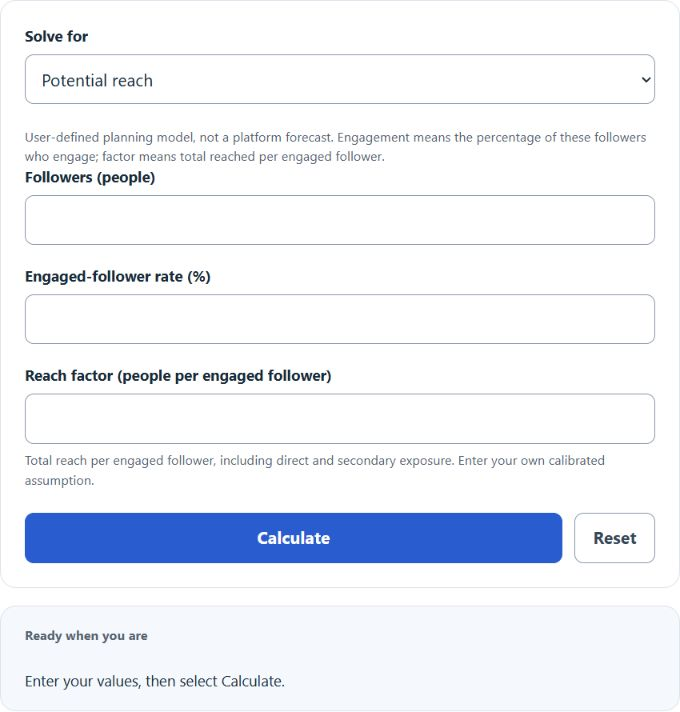
Calculate potential reach, followers, engagement rate, or share factor from the other three inputs for online social media campaigns.
Related Calculators
- Closing Ratio Calculator
- Calls Rate Calculator
- Cost Per Session Calculator
- Maximum Revenue Calculator
- All Business Calculators
Potential Reach Formula
Potential reach is a planning estimate for how many people a social media post may reach based on your follower count, expected engagement rate, and the amount of secondary exposure created through shares or amplification. It is most useful for forecasting campaign performance, comparing content ideas, and setting realistic distribution targets before publishing.
| Variable | Meaning | How to Use It |
|---|---|---|
| PR | Potential reach | The estimated number of people who may see the post. |
| F | Followers | Use your current follower count or the size of the audience segment you are targeting. |
| ER | Engagement rate | Use the percentage of the specified followers who engage in the same measurement period, not an engagement-per-impression rate. Enter 4.5 for 4.5%. |
| SF | Share/amplification factor | Total reached per engaged follower, including direct and secondary exposure. Supply a calibrated assumption; the model does not derive it from shares. |
How to Calculate Potential Reach
- Determine the number of followers included in the estimate.
- Estimate the engagement rate based on recent post performance.
- Choose a calibrated factor for total reach per engaged follower, including direct and secondary exposure.
- Convert the engagement rate from a percentage to a decimal by dividing by 100.
- Multiply followers by the engagement rate and then by the share factor.
This means the model first estimates how many followers engage, then scales that engagement by how much additional visibility each engaged follower creates.
Equivalent Forms
If you know three values and want to solve for the fourth, the same relationship can be rearranged as follows:
Examples
Example 1: A page has 25,000 followers, expects a 4.8% engagement rate, and estimates a share factor of 1.6.
The estimated potential reach is 1,920 people.
Example 2: A campaign target is 10,000 people reached, with an expected engagement rate of 3.2% and a share factor of 2.5. The required follower count is:
Under those assumptions, the model requires 125,000 followers (fractional follower solutions round up) to support that projected reach.
How to Estimate the Share Factor
The share factor is usually the hardest input to estimate because it depends on how often followers repost, tag others, or otherwise extend the content beyond the original audience. A practical way to choose it is to use past campaign data and back into a reasonable average.
If you have several older posts, calculate a share factor for each one and average the results. Use comparable audiences, content and measurement periods; the inferred factor is a scenario assumption, not a validated prediction.
- SF = 1.0: One modeled person reached per engaged follower; an illustrative factor, not a universal benchmark.
- SF = 1.2 to 1.8: 1.2 to 1.8 modeled people reached per engaged follower; illustrative values, not a validated range.
- SF = 2.0+: At least two modeled people reached per engaged follower; an illustrative assumption, not proof of sharing.
If you are uncertain, model three scenarios: conservative, expected, and aggressive. That gives a more useful planning range than relying on a single estimate.
Potential Reach vs. Actual Reach vs. Impressions
| Metric | What It Represents | Best Use |
|---|---|---|
| Potential Reach | A forecast based on assumptions about followers, engagement, and amplification. | Planning and benchmarking before a post goes live. |
| Actual Reach | The number of accounts or people the platform reports as having seen the post. | Performance review after publishing. |
| Impressions | Total displays of the post, including repeated views by the same person. | Measuring visibility volume rather than unique exposure. |
Because this calculator is a simplified model, the result should be treated as an estimate rather than a precise platform metric. Real distribution can be higher or lower depending on feed ranking, timing, audience overlap, creative quality, post format, and platform behavior.
Common Input Mistakes
- Entering engagement rate as a decimal instead of a percentage.
- Using total followers when only a niche segment is likely to engage.
- Applying the same share factor across every platform and content type.
- Assuming potential reach always equals unique people; overlap can reduce unique exposure.
- Ignoring seasonal or campaign-specific changes in engagement rate.
Practical Ways to Improve Potential Reach
- Increase engagement rate with stronger hooks, clearer calls to action, and better timing.
- Raise the share factor by creating content designed for reposting, tagging, and discussion.
- Segment content by audience interest so a larger share of followers is likely to engage.
- Track results by content type to find the formats that produce the strongest amplification.
- Use historical analytics to update your assumptions regularly instead of keeping static inputs.
Frequently Asked Questions
Can potential reach be greater than the follower count?
Yes, when (ER / 100) × SF exceeds 1. A factor above 1 alone is not sufficient; the model does not determine which viewers are followers.
Is this the same as viral reach?
No. Viral outcomes typically involve nonlinear distribution and platform recommendation effects. This calculator provides a simple estimate, not a viral prediction model.
What engagement rate should I use?
Use the percentage of the same follower audience who engage during a comparable period. Platform engagement rates may use impressions or actions instead, so check the denominator and deduplicate people before using them here.
Why does the result change so much with small input changes?
Because all three inputs multiply together, even a modest increase in engagement rate or share factor can materially change the final estimate.