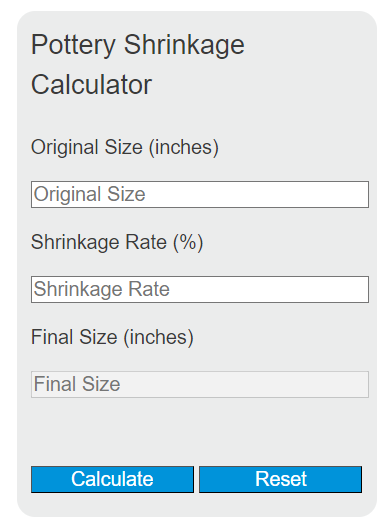
Calculate fired pottery size, wet build size, or measured clay shrinkage with compounded drying/firing stages, volume change, and mm/cm/in conversion.
Related Calculators
- Plastic Shrinkage Calculator
- Fabric Shrinkage Calculator
- Steel Shrinkage Calculator
- Casting Shrinkage Calculator
- Mold Shrinkage Calculator
- Shrink Percentage Calculator
- All Everyday Life and Education Calculators
Pottery Shrinkage Formula
Pottery shrinkage is the reduction in a clay piece’s dimensions as it dries and is fired. For calculator use, this is normally treated as linear shrinkage, meaning the same percentage is applied to any single measured dimension such as height, width, diameter, or length.
- FS = final size after shrinkage
- OS = original size before shrinkage
- SR = shrinkage rate as a percentage
This formula works with any unit of length as long as you stay consistent. If you enter inches, the result is in inches. If you enter centimeters, the result is in centimeters.
Rearranged Formulas
If you know the final fired dimension you want and need to determine the required starting size, rearrange the formula as follows:
If you measured an original size and a final fired size and want to calculate the actual shrinkage rate of your clay body:
How to Use the Pottery Shrinkage Calculator
- Enter the original size of the pottery piece.
- Enter the shrinkage rate as a percent.
- Calculate to find the final size after drying and firing.
- For multi-dimensional pieces, apply the same process separately to height, diameter, width, or opening size.
This is especially useful when planning:
- finished mug height and rim diameter
- bowl opening width
- lid-to-jar fit
- tile and slab dimensions
- mold or template sizing
Example
If a piece starts at 12 inches and the clay shrinks by 10%, the final size is:
If you want a final fired size of 8 inches and expect 12% shrinkage, the starting size should be:
Quick Shrinkage Multipliers
Instead of calculating from scratch each time, you can multiply the original size by a simple decimal factor.
| Shrinkage Rate | Multiplier | Interpretation |
|---|---|---|
| 5% | 0.95 | The fired piece keeps 95% of its original dimension. |
| 8% | 0.92 | Useful for lower-shrinkage clay bodies. |
| 10% | 0.90 | A simple planning benchmark for many studio situations. |
| 12% | 0.88 | Commonly used when planning tighter finished tolerances. |
| 15% | 0.85 | Large enough to noticeably affect lids, feet, and openings. |
| 18% | 0.82 | Requires substantial oversizing at the forming stage. |
How to Measure Shrinkage Accurately
The most reliable shrinkage rate is the one measured from your own clay, thickness, and firing schedule. Manufacturer averages are helpful, but actual studio results can vary.
- Make a simple test bar or strip from the clay body you will use.
- Mark a known wet length, such as 100 mm.
- Let it dry completely and fire it exactly as you would your finished ware.
- Measure the final fired length.
- Use the measured change to calculate your real shrinkage percentage.
If a 100 mm test bar ends at 87 mm after firing, the total shrinkage is 13%.
Total Shrinkage Across Drying and Firing
Some potters track shrinkage in stages. If drying shrinkage and firing shrinkage are measured one after the other, the percentages should be combined multiplicatively rather than added directly.
To express the result as a percentage:
This matters because a clay body that shrinks during drying and then shrinks again during firing can end up smaller than a simple percentage sum would suggest.
Why Pottery Shrinkage Matters
- Functional fit: Lids, stoppers, gallery rims, and nesting forms need predictable clearances.
- Target dimensions: If you sell standard sizes, shrinkage determines the correct forming size.
- Molds and templates: Slump molds, press molds, and cutting guides should be sized for the final fired result.
- Capacity planning: Small dimensional losses can noticeably reduce internal volume.
- Consistency: Repeating successful forms becomes easier when shrinkage is built into the design stage.
3D Planning Note
The calculator uses a single linear dimension, but if shrinkage is reasonably uniform in all directions, internal or external volume changes more dramatically than length alone.
This is useful when estimating the final capacity of jars, cups, bowls, and other containers.
Common Mistakes to Avoid
- Using one unit for the input and mentally interpreting the result in another.
- Assuming all clay bodies shrink at the same rate.
- Ignoring differences caused by wall thickness, drying speed, and firing temperature.
- Applying one average shrinkage rate to parts that behave differently, such as handles versus thick bodies.
- Forgetting that fit-critical pieces usually need a test tile or test bar before final production.
Practical Design Tip
When dimensions are critical, design from the desired fired size backward. Decide the final measurement first, estimate or test the shrinkage rate, and then calculate the required wet or green size. That approach is usually more reliable than forming by eye and hoping the final firing lands on the correct measurement.