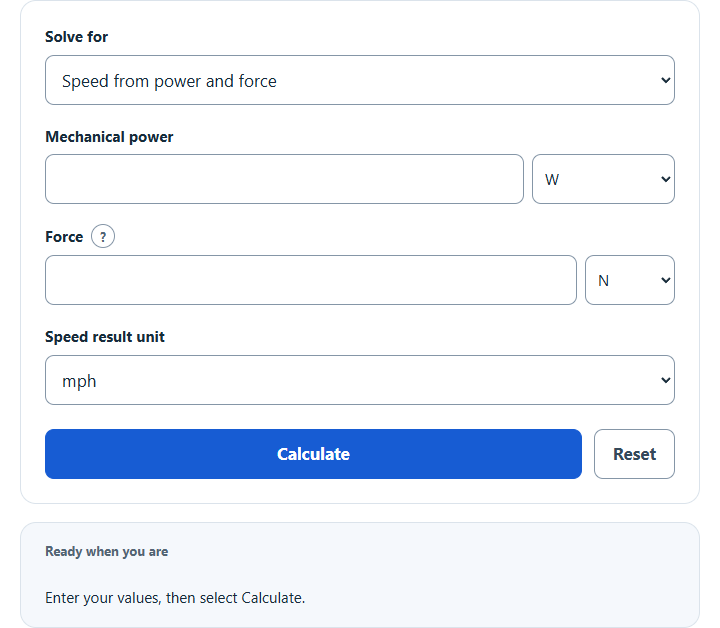
Calculate speed from power and force with v = P ÷ F, or solve for power or force, using watts, horsepower, newtons, pounds-force, mph and km/h.
Power to Speed Formula
The following formula gives the speed when positive mechanical power and force act parallel to the motion. In one-dimensional signed form it gives velocity; in general, power is the vector dot product of force and velocity.
- Where V is the speed (distance / time)
- P is the power (work / time)
- F is the force
To calculate the speed from power, divide the power by the force.
| Power (kW) | Velocity (m/s) | Velocity (km/h) |
|---|---|---|
| 0.5 | 1.0 | 3.6 |
| 0.75 | 1.5 | 5.4 |
| 1 | 2.0 | 7.2 |
| 1.5 | 3.0 | 10.8 |
| 2 | 4.0 | 14.4 |
| 2.5 | 5.0 | 18.0 |
| 3 | 6.0 | 21.6 |
| 4 | 8.0 | 28.8 |
| 5 | 10.0 | 36.0 |
| 7.5 | 15.0 | 54.0 |
| 10 | 20.0 | 72.0 |
| 12 | 24.0 | 86.4 |
| 15 | 30.0 | 108.0 |
| 20 | 40.0 | 144.0 |
| 25 | 50.0 | 180.0 |
| 30 | 60.0 | 216.0 |
| 40 | 80.0 | 288.0 |
| 50 | 100.0 | 360.0 |
| 75 | 150.0 | 540.0 |
| 100 | 200.0 | 720.0 |
| Formula: v = P ÷ F. Here, F = 500 N constant. Units: P in kW (1 kW = 1000 W), v in m/s; km/h = m/s × 3.6. | ||
How can power be converted into speed?
Power is the rate of doing work. For motion and force along the same axis, signed velocity equals power divided by the nonzero force component. Speed is the magnitude of that velocity; power alone does not determine speed.
How to calculate speed from power?
The following example problem outlines the steps required to calculate speed from power.
First, determine the power of the object. In this example, the power is 100 N*m/s.
Next, determine the force acting on the object. In this problem, the force is measured to be 10 N.
Finally, calculate the velocity using the formula above:
V = P / F
V = 100 / 10
V = 10 m/ s