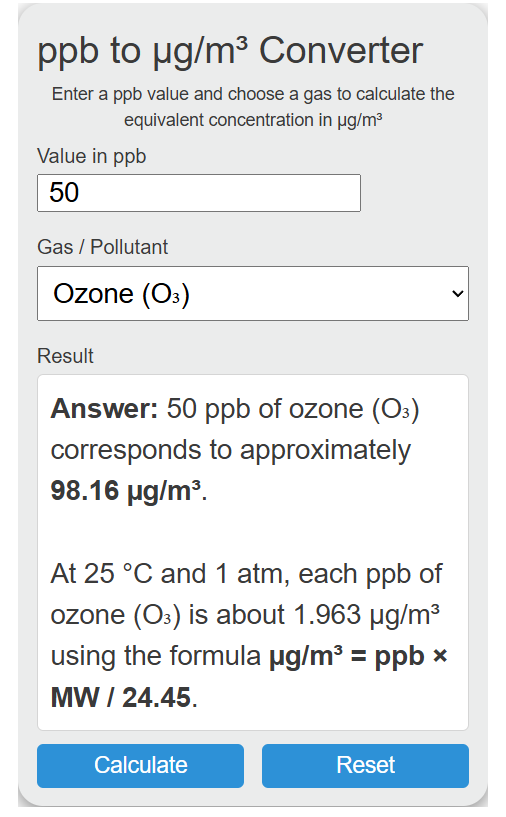
Convert ppb to µg/m³ or reverse the calculation for common gases using molecular weight, temperature, and pressure, with standard-condition defaults.
Quick overview: ppb to µg/m³
At 25 °C and 1 atm, converting parts per billion (ppb) to micrograms per cubic meter (µg/m³) uses the molar volume of air (24.45 L/mol) and the pollutant’s molecular weight (MW): µg/m³ = ppb × MW / 24.45.
- For ozone (O₃, MW = 48): 50 ppb ≈ 98.2 µg/m³
- For NO₂ (MW = 46): 40 ppb ≈ 75.3 µg/m³
- For SO₂ (MW = 64.1): 20 ppb ≈ 52.4 µg/m³
- For CO (MW = 28): 1 ppm (1000 ppb) ≈ 1145 µg/m³
The calculator applies this relationship automatically when you enter a ppb value and choose a gas, assuming standard temperature and pressure.
- mg/L To ppb Calculator
- ppb to ug/l Converter
- ppb to ng/ml Converter
- Parts Per Trillion Calculator
- ug/l to ng/ml Converter
- All Unit Converters
ppb to µg/m³ Formula
The following formulas are used to convert between parts per billion (ppb) and micrograms per cubic meter (µg/m³) for gases at 25 °C and 1 atmosphere.
Variables:
- µg/m³ is the concentration in micrograms per cubic meter
- ppb is the concentration in parts per billion
- MW is the molecular weight of the gas in grams per mole
- 24.45 is the molar volume of an ideal gas in liters per mole at 25 °C and 1 atm
To calculate µg/m³ from ppb, multiply the ppb value by the molecular weight of the gas and divide by 24.45.
What is ppb to µg/m³ Conversion?
This page describes how to convert parts per billion (ppb), a volume mixing ratio, into micrograms per cubic meter (µg/m³), a mass-per-volume concentration, for common air pollutants. ppb tells you how many pollutant molecules there are per billion air molecules, whereas µg/m³ specifies the actual mass of pollutant in a cubic meter of air.
For gases measured at 25 °C and 1 atmosphere, one mole of air occupies about 24.45 liters. Combining this molar volume with the gas’s molecular weight (MW, g/mol) gives the link between a mixing ratio in ppb and a mass concentration in µg/m³.
A higher molecular weight produces a larger µg/m³ value for the same ppb level. For example, 50 ppb of ozone (MW = 48) corresponds to about 98.2 µg/m³, while 50 ppb of carbon monoxide (MW = 28) is about 57.3 µg/m³.
How to Convert ppb to µg/m³?
The following steps outline how to convert ppb to µg/m³.
- First, determine the concentration in ppb.
- Next, determine the molecular weight (MW) of the pollutant in grams per mole.
- Use the formula µg/m³ = ppb × MW / 24.45.
- After inserting the values and calculating the result, check your answer with the calculator above.
Example Problem:
Use the following variables as an example problem to test your knowledge.
ppb = 50
Molecular Weight (Ozone) = 48 g/mol
µg/m³ = 50 × 48 / 24.45 = 98.2
ppb to µg/m³ Conversion Table
The table below shows example conversions for a 50 ppb concentration of several gases using the relationship µg/m³ = ppb × MW / 24.45 at 25 °C and 1 atm.
| Pollutant | Molecular Weight (g/mol) | 50 ppb in µg/m³ |
|---|---|---|
| Ozone (O₃) | 48.0 | 98.2 µg/m³ |
| Nitrogen Dioxide (NO₂) | 46.0 | 94.1 µg/m³ |
| Sulfur Dioxide (SO₂) | 64.1 | 131.1 µg/m³ |
| Carbon Monoxide (CO) | 28.0 | 57.3 µg/m³ |
| Carbon Dioxide (CO₂) | 44.0 | 90.0 µg/m³ |
| Benzene (C₆H₆) | 78.1 | 159.7 µg/m³ |
| Formaldehyde (CH₂O) | 30.0 | 61.4 µg/m³ |
In monitoring and guideline documents, concentrations may be reported either in ppb or in µg/m³. Knowing how molecular weight and standard conditions enter the calculation lets you translate between these units and compare values from different sources consistently.