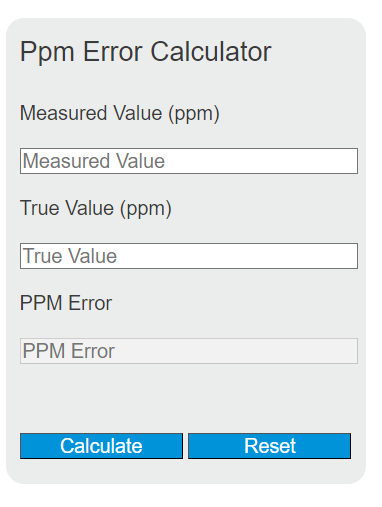
Calculate signed and absolute PPM error, convert it to PPB or percent, reverse-solve a measured value, and check an allowed tolerance window.
PPM Error Formula
PPM error measures how far a measured value is from a true or accepted value, scaled to parts per million. It is a relative error metric, which makes it useful when differences are small and a percent value would be less precise.
If you only care about the size of the deviation and not whether the measurement is high or low, use the absolute form:
Variable Definitions
- Measured Value — the observed or recorded value from your instrument, test, or calculation.
- True Value — the accepted, target, calibrated, or reference value used for comparison.
- PPM Error — the signed relative error expressed on a million-part scale.
A positive result means the measured value is above the true value. A negative result means the measured value is below the true value. A result of zero means the measurement matches the reference exactly.
How to Calculate PPM Error
- Identify the measured value.
- Identify the true or reference value.
- Subtract the true value from the measured value.
- Divide that difference by the true value.
- Multiply the result by 1,000,000 to convert the relative error to ppm.
The true value cannot be zero, because the formula divides by the true value.
How to Interpret the Result
| Result Type | Meaning |
|---|---|
| Positive ppm error | The measurement is higher than the reference value. |
| Negative ppm error | The measurement is lower than the reference value. |
| Zero ppm error | No difference exists between measured and true values. |
| Small magnitude | Indicates a measurement that is very close to the target. |
| Large magnitude | Indicates a larger relative deviation and lower accuracy. |
Even if your inputs are already expressed in ppm concentration, the calculator output is still a relative error expressed on the ppm scale. In other words, it is describing measurement accuracy, not simply the arithmetic difference between two ppm readings.
Example Calculation
If the measured value is 1005 ppm and the true value is 1000 ppm, the error is:
This means the measurement is 5,000 ppm high relative to the true value.
Helpful Conversions
PPM error is closely related to fractional and percentage error. These conversions are often useful when comparing specifications, tolerances, or calibration data.
Common Uses for PPM Error
- Sensor and instrument calibration
- Analytical chemistry and concentration testing
- Gas analysis and environmental monitoring
- Manufacturing tolerances and quality control
- Frequency accuracy and oscillator stability
- Laboratory verification and process validation
Common Mistakes to Avoid
- Mixing units: the measured and true values must be in the same units before using the formula.
- Ignoring the sign: negative results are valid and simply show the measured value is low.
- Confusing signed and absolute error: signed error shows direction; absolute error shows only magnitude.
- Using a true value of zero: division by zero makes the calculation undefined.
- Rounding too early: small relative differences can change noticeably when intermediate values are rounded.
Practical Notes
- If you are evaluating accuracy against a specification limit, absolute ppm error is often the more useful value.
- If you are checking measurement bias or drift direction, keep the signed ppm error.
- Very small absolute differences can still produce large ppm error when the true value is small.