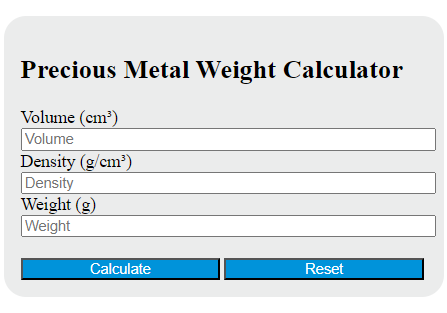
Estimate precious-metal weight from geometry or casting density ratios with metric, troy, and avoirdupois units, purity or karat, and optional pure-metal value.
Precious Metal Weight Formula
The calculator estimates precious metal weight from two physical properties: volume and density. This is useful for bullion, raw material, scrap, cast pieces, and any solid item where the metal type and approximate volume are known.
Where:
- W = weight of the metal
- V = volume of the metal
- D = density of the metal
If you need to solve for a different variable, rearrange the equation as follows:
In practical terms, a denser metal produces more weight for the same amount of space. That is why a gold object and a silver object with identical volume will not weigh the same.
Common Precious Metal Density Reference Values
Use the density that best matches the actual material. These values are common reference points for nearly pure metals; alloys, porosity, embedded stones, hollow construction, and plated surfaces will change the real result.
| Metal | Approximate Density | Typical Use Case |
|---|---|---|
| Gold | 19.32 g/cm³ | Fine gold and high-purity bullion reference |
| Silver | 10.49 g/cm³ | Fine silver reference |
| Platinum | 21.45 g/cm³ | Platinum bars, casting stock, and high-purity pieces |
| Palladium | 12.02 g/cm³ | Palladium bullion and industrial stock |
Important: jewelry is often an alloy rather than a pure metal. For example, 14K or 18K gold will usually have a lower density than pure 24K gold, so using the pure-gold density may overestimate weight if the piece is not pure.
How to Use the Precious Metal Weight Calculator
- Choose the unit set you want to work in for volume, density, and weight.
- Enter any two known values.
- Let the calculator solve for the missing variable.
- Verify that the density matches the actual metal or alloy you are evaluating.
- For pricing, convert the final result into the same weight unit used by the buyer, refinery, or market quote.
For manual calculations, the most important rule is unit consistency. If volume is entered in cm³ and density is entered in g/cm³, the result will be in grams. If volume is in ft³ and density is in lb/ft³, the result will be in pounds.
Finding Volume Before Using the Calculator
If you only know the dimensions of the item, calculate its volume first and then apply the weight formula.
Rectangular bar or ingot
Cylindrical rod, wire, or round bar
Sphere or shot pellet
For irregular but solid pieces, volume can sometimes be estimated by water displacement if the object is water-safe and contains no components that would trap air or absorb moisture. That approach is less reliable for hollow jewelry, stone-set items, or pieces with internal voids.
Example
Suppose you have a solid gold piece with a measured volume of 10 cm³ and you want to estimate its weight using the density of pure gold.
The estimated weight is 193.2 grams.
If you want the result in troy ounces, convert grams to troy ounces:
That same piece would weigh about 6.21 troy ounces.
Weight Units That Matter in Precious Metals
- Grams are common for jewelry, lab work, and small bullion pieces.
- Kilograms are common for larger bars and industrial inventories.
- Troy ounces are the standard trading unit for most precious metal markets.
- Avoirdupois ounces are regular household ounces and are not the same as troy ounces.
A troy ounce contains 31.1034768 grams, while a standard ounce contains 28.349523125 grams. Mixing those two units can create a significant valuation error.
Accuracy Tips
- Use the density of the actual alloy, not just the base metal name.
- Do not treat plated, filled, or layered items as if they were solid precious metal.
- Remove the effect of gemstones, clasps, inserts, springs, cores, or hollow sections whenever possible.
- For minted bullion and manufactured bars, compare the result with the published weight as a reasonableness check.
- For scrap lots, use this calculator as an estimate first and verify with an actual scale before pricing or settlement.
When This Calculator Is Most Useful
- Estimating the mass of a cast or machined precious metal part from its dimensions
- Checking whether a bar, bead, rod, or raw piece is in the expected weight range
- Converting between volume-based design measurements and target metal weight
- Cross-checking appraisal, refining, and fabrication estimates
- Planning material needs before pouring, rolling, or machining precious metals
Frequently Asked Questions
Is “weight” the same as “mass” here?
In everyday bullion and jewelry use, the term weight is commonly used even when the value being measured is technically mass. For calculator purposes, it is the amount of material expressed in grams, kilograms, pounds, or ounces.
Why can two rings of the same size weigh very different amounts?
The difference usually comes from density and construction. A platinum ring is much denser than a silver ring of the same outer size, and a hollow ring weighs less than a solid one even if the dimensions look similar.
Can this calculator determine purity?
No. It estimates weight from volume and density, or solves for density if weight and volume are known. Density can help identify whether a piece is in the expected range, but it does not replace assay, hallmark verification, or metallurgical testing.