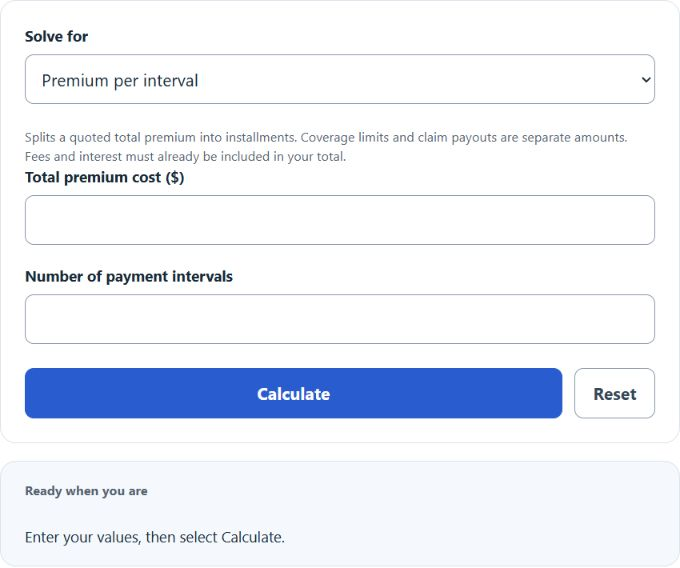
Calculate insurance premium payouts by finding the total premium cost, number of payment intervals, or premium per interval from two known values.
Premium Payouts Formula
The following equation is used to calculate the Premium Payouts.
- Where PP is the premium payout ($/interval)
- PC is the total premium cost ($)
- I is the number of payment intervals
To calculate the premium payouts, divide the total premium cost by the number of payment intervals.
What is a Premium Payout?
Definition:
Here, premium payout means the premium installment paid by the customer. The premium is the price of coverage, not the coverage limit or an insurance claim payment. This calculator divides a quoted premium total and does not price insurance.
How to Calculate Premium Payouts?
Example Problem:
The following example outlines the steps and information needed to calculate the Premium Payouts.
First, determine the total premium cost. In this example, the total cost for coverage is $1,200.
Next, determine the number of payment intervals. In this example, there are 4 payment intervals in a year.
Finally, calculate the premium payout using the formula above:
PP = PC / I
PP = $1,200 / 4
PP = $300 per interval
FAQ
What factors can affect premium payouts?
Numerous factors can influence premium payouts, including the level of coverage, type of plan or policy, payment interval (monthly, quarterly, annually), and the risk profile of the policyholder or subscriber. Changes in market conditions and administrative fees may also impact the total premium cost.
Is it better to pay premiums annually or in installments?
While paying premiums annually can sometimes result in discounts or reduced administrative fees, breaking them into smaller intervals may help with cash flow and budgeting. It’s important to compare the total cost over a year or longer term to see which payment structure is more cost-effective.
How does a Premium Payouts Calculator help in budgeting?
A Premium Payouts Calculator provides clarity on the required amounts per interval, helping individuals or businesses plan and manage their finances effectively. The result is an arithmetic estimate; billing fees, interest, cent rounding and a different final installment may affect the actual payment schedule.