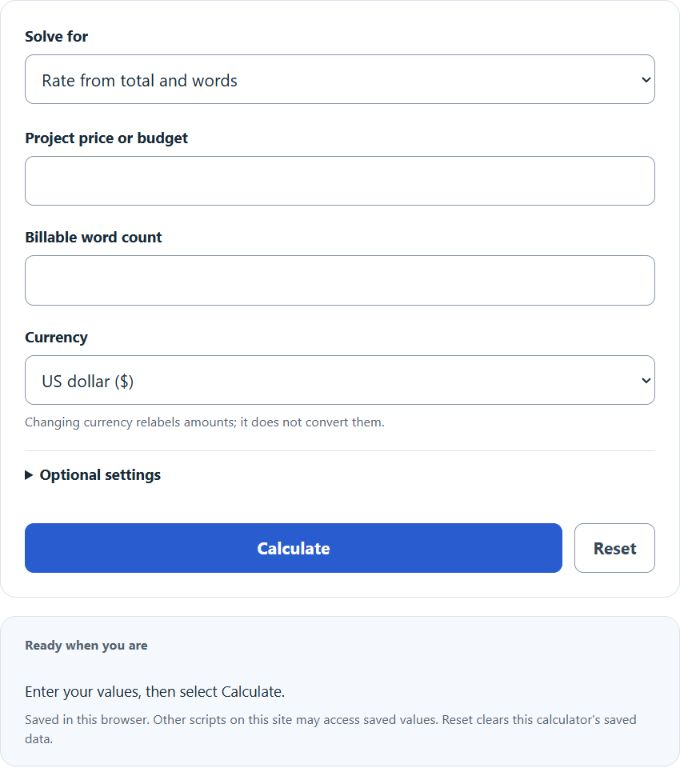
Calculate price per word, total project cost, or affordable word count with cents conversion, scope buffer, and effective hourly economics.
Related Calculators
- Shop Rate Calculator
- Service Price Calculator
- Charge Out Rate Calculator
- Art Commission Calculator
- All Business Calculators
Price Per Word Formula
The price per word measures how much each word costs in a writing, editing, or translation project. It is useful for comparing freelancer quotes, estimating article budgets, setting internal content rates, and checking whether a flat project fee is cost-effective once the final word count is known.
- PPW = price per word
- TP = total price of the project
- WC = total word count
If you know any two of the three values, you can solve for the third. That makes this calculator useful for pricing new projects, auditing invoices, and converting between flat-fee and per-word pricing.
How to Calculate Price Per Word
- Determine the full project price.
- Determine the final word count for the deliverable.
- Divide the total price by the total number of words.
- Express the result in dollars per word or cents per word.
This metric is most helpful when the scope is closely tied to length, such as blog posts, articles, product descriptions, landing pages, ebooks, editing passes, and translation work.
Example Calculations
Finding the rate from a flat fee: A 3,000-word article costs $150.
The effective rate is $0.05 per word, which is the same as 5 cents per word.
Finding the total project price: A client agrees to pay $0.12 per word for 2,500 words.
The base project price is $300, before any optional scope or revision buffer.
Finding the number of words a budget can cover: A budget is $400 and the rate is $0.08 per word.
The budget covers 5,000 whole words with no scope buffer. A positive buffer reserves part of that budget before solving the affordable count.
Quick Rate Conversion Table
| Rate | 500 Words | 1,000 Words | 2,000 Words | 5,000 Words |
|---|---|---|---|---|
| $0.03/word | $15 | $30 | $60 | $150 |
| $0.05/word | $25 | $50 | $100 | $250 |
| $0.10/word | $50 | $100 | $200 | $500 |
| $0.15/word | $75 | $150 | $300 | $750 |
| $0.25/word | $125 | $250 | $500 | $1,250 |
What Affects Price Per Word?
- Research depth: Simple rewrites usually cost less than original research, interviews, or data-heavy content.
- Subject complexity: Technical, legal, medical, or highly specialized topics typically require more expertise and time.
- Turnaround speed: Rush deadlines often increase the effective per-word rate.
- Revision scope: Multiple revision rounds can materially change the true cost.
- Content type: Sales copy, long-form thought leadership, SEO articles, and editing passes may all justify different pricing.
- Deliverables included: Outlines, keyword research, metadata, formatting, sourcing, and image selection add value beyond raw word count.
How to Use This Metric Correctly
- Compare projects using the same definition of word count, such as submitted draft words, final approved words, source words, or translated target words.
- Make sure the quoted fee includes the same services on both sides of a comparison.
- Convert all quotes to the same unit, either dollars per word or cents per word.
- Use the final word count for the most accurate post-project analysis.
- For retainers or bundled packages, divide the total monthly fee by the total monthly words delivered to find the blended rate.
Price Per Word vs. Other Pricing Models
| Pricing Model | Best For | Main Advantage | Main Limitation |
|---|---|---|---|
| Per Word | Articles, blogs, product descriptions, translation, editing | Easy to compare and budget by length | May not capture strategy, research, or complexity well |
| Per Project | Landing pages, ebooks, campaigns, custom content packages | Simple fixed pricing for the client | Can hide the true effective rate if scope changes |
| Hourly | Consulting, revisions, strategy, open-ended work | Useful when time varies more than word count | Harder to predict final cost upfront |
Common Mistakes
- Using estimated words instead of the actual delivered count.
- Ignoring whether revisions, research, or formatting are included.
- Comparing a premium expert rate to a basic drafting rate without adjusting for scope.
- Confusing $0.05 per word with 5 words per dollar.
- Forgetting to convert cents to dollars consistently when budgeting.
Frequently Asked Questions
Is a lower price per word always better?
Not necessarily. A lower rate may exclude research, revisions, strategy, fact-checking, or subject-matter expertise. Compare the full deliverable, not just the number.
Can this calculator be used for editing or translation?
Yes. The same approach works any time the fee is tied to the number of words processed or delivered.
Should I bill by draft word count or final word count?
Use whichever method is defined in the agreement. The key is consistency. Both sides should know exactly what counts as a billable word before the work begins.
Why convert a flat fee into a per-word rate?
It helps you compare projects of different sizes, spot underpriced work, estimate future assignments, and negotiate with more clarity.