Calculate liquid propane volume from weight, weight from gallons or liters, and tank-gauge quantities using an explicit density and heating-value basis.
Understanding Propane Volume
The propane volume calculator finds the missing relationship between propane mass, density, and volume. Enter any two values to solve for the third. The most important input is density: propane density changes with temperature and whether the propane is measured as a liquid or as a vapor.
Core Formula
Rearranged forms:
| Variable | Meaning | Common Units |
|---|---|---|
| PV | Propane volume | m³, ft³, L, gal |
| PM | Propane mass | kg, lb |
| PD | Propane density | kg/m³, lb/ft³ |
How to Use the Calculator
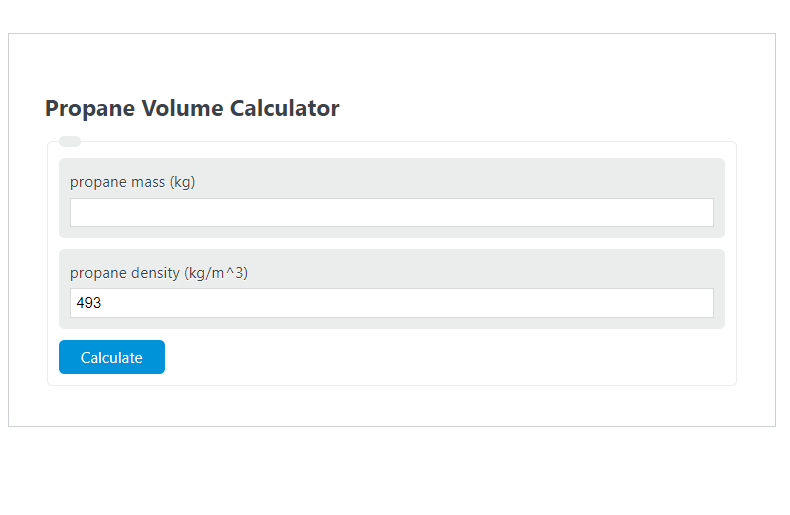
- Enter any two known values: mass and density, mass and volume, or density and volume.
- Make sure the units are compatible. For example, kg should pair with kg/m³, and lb should pair with lb/ft³.
- Choose the output volume unit you want: m³, ft³, liters, or gallons.
- If the result looks unrealistic, verify that you used the correct density for liquid propane versus propane vapor.
Example 1: Find Propane Volume
If propane mass is 500 kg and propane density is 493 kg/m³:
This is about 1,014 liters.
Example 2: Find Propane Mass
If propane volume is 2.5 m³ and propane density is 493 kg/m³:
Quick Unit Reference
| From | To | Factor |
|---|---|---|
| m³ | liters | 1000 |
| m³ | US gallons | 264.172 |
| ft³ | liters | 28.3168 |
| ft³ | US gallons | 7.48052 |
When Density Matters Most
| Situation | Best Input Choice |
|---|---|
| Propane stored as liquid in a tank | Use liquid propane density for the expected temperature |
| Propane vapor in a pipe or vessel | Use vapor density at the actual pressure and temperature |
| Unknown operating conditions | Do not assume a single density value without checking the state and temperature |
Common Mistakes
- Mixing metric and imperial units in the same calculation.
- Using vapor density when the propane is actually stored as a liquid.
- Assuming tank size and propane volume are automatically the same thing.
- Ignoring temperature effects on density.
- Rounding density too aggressively before calculating large volumes.
Practical Notes
This calculator returns the volume of propane represented by the values you enter. That is different from a tank's labeled size or usable fill amount. In storage applications, always use a density value that matches the actual condition of the propane and the units shown in the calculator.