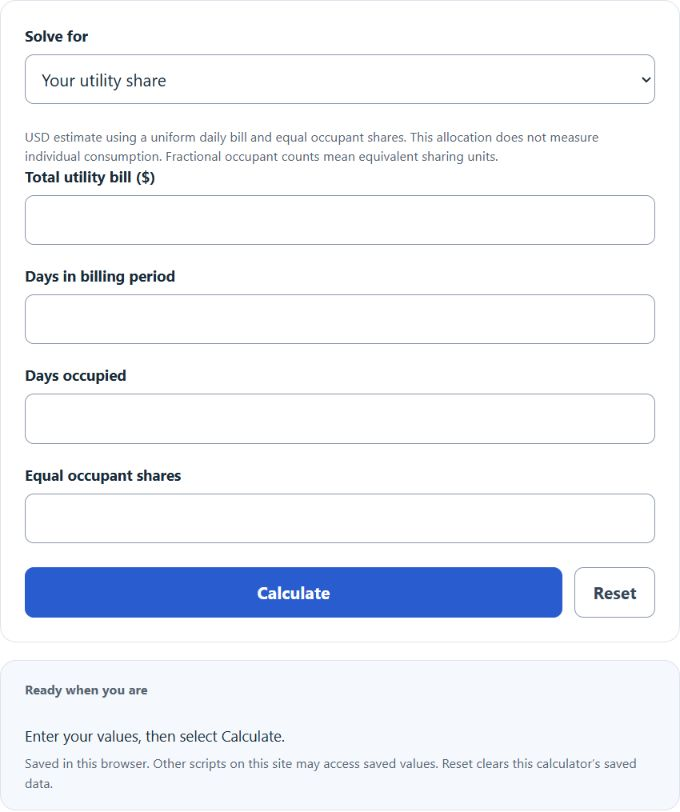
Calculate prorated utility costs from total bill, billing days, days occupied, and occupants to find your share or solve for one missing value.
Prorated Utilities Formula
The following equation is used to calculate the Prorated Utilities.
- Where PU is the prorated utilities cost ($)
- TB is the total bill amount ($)
- ND is the total number of days in the billing period
- DU is the days occupied; N is the number of equal occupant shares (1 for a single occupant)
To estimate one occupant’s share, multiply the bill by occupied days divided by billing days, then divide by the equal occupant count. This assumes uniform cost per day and a constant sharing count; it does not measure individual consumption.
What are prorated utilities?
Definition:
Prorated utilities refer to dividing the total utility cost among individuals or parties based on how long each has used the service within a billing cycle. Whether this is an appropriate allocation depends on the agreement, fixed charges and actual usage.
How to Calculate Prorated Utilities?
Example Problem:
The following example outlines the steps and information needed to calculate the Prorated Utilities.
First, determine the total number of days in the billing cycle. In this example, the billing cycle is 30 days.
Next, determine how many days the individual used the service. The individual used it for 10 days before moving out. This example uses one occupant share (N = 1).
Then, determine the total bill for the billing period. The total bill is $120.
Finally, calculate the prorated utilities using the formula above:
PU = ( TB / ND ) * DU / N
PU = ( $120 / 30 ) * 10 / 1
PU = $40
FAQ
What factors can affect prorated utilities?
Several factors can influence prorated utilities, including varying utility rates, seasonal usage patterns, different billing cycles, and differences in how each individual uses resources (such as water, electricity, and gas).
How do partial months get calculated?
Partial months are usually calculated by applying a daily rate to the exact number of days the service was used. This is often done by dividing the monthly bill by the total days in the billing cycle and then multiplying by the days of usage.
Are shared utility bills always cheaper than individually paid services?
Not necessarily. While shared utility bills can lower individual costs through divided expenses, the total usage can be higher if multiple people contribute to larger overall consumption. Proper usage habits and efficient appliances can still help lower costs even when splitting bills.