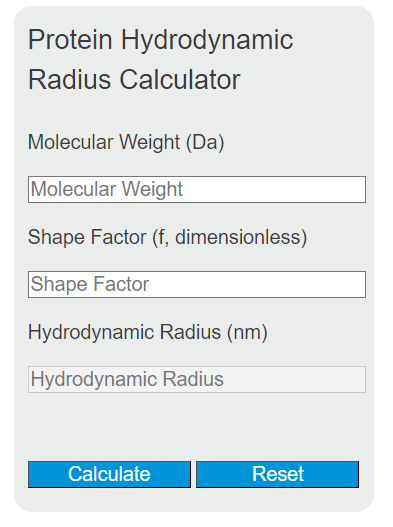
Calculate protein hydrodynamic radius from molecular weight and shape factor, or solve the missing value using Da, kDa, nm, Å, or μm units.
Related Calculators
- Fold Change Calculator
- Base Pair To Kda Calculator
- Percent Inhibition Calculator
- 10 Fold Dilution Calculator
- All Biology Calculators
Protein Hydrodynamic Radius Formula
The protein hydrodynamic radius is the radius of an equivalent hard sphere that would diffuse through solution at the same rate as the actual protein. This calculator estimates that radius from molecular weight and frictional ratio, using a typical protein partial specific volume of 0.73 mL/g.
When the default partial specific volume is assumed and molecular weight is entered in Daltons, the equation can be simplified into a practical shortcut for nanometer output:
Variable Definitions
- Hydrodynamic radius is the estimated radius of the protein in solution, typically reported in nanometers, angstroms, or micrometers.
- Molecular weight is the mass of the protein or protein complex. Use the mass of the actual species present in solution, including tags or oligomeric assembly when relevant.
- Frictional ratio describes how much the real molecule deviates from an ideal sphere. A value near 1 indicates a compact spherical particle, while larger values indicate a more elongated, flexible, or highly hydrated structure.
- Partial specific volume represents the volume occupied per unit mass of protein. This calculator uses a common protein approximation of 0.73 mL/g.
- Avogadro’s constant converts molar mass into the volume of a single molecule.
Rearranged Forms
Because the calculator can solve for a missing variable when any two values are known, the same relationship can be rearranged as follows.
How to Calculate Protein Hydrodynamic Radius
- Enter the protein molecular weight in Daltons or kilodaltons.
- Select a frictional ratio that reflects the expected shape of the protein in solution.
- Apply the hydrodynamic radius formula.
- Read the result in the desired unit. One nanometer corresponds to ten angstroms or one-thousandth of a micrometer.
The estimate is especially useful when you want a quick size approximation from mass and shape, rather than a direct measurement from solution diffusion data.
Example Calculation
For a protein with molecular weight of 50,000 Da and a frictional ratio of 1.5:
This means the protein behaves in solution like a hydrated sphere with a radius of about 3.66 nanometers.
How to Interpret the Result
- Larger radius means slower diffusion. A protein with a larger hydrodynamic radius generally moves more slowly through solution.
- Shape matters linearly. If the frictional ratio increases by 10%, the estimated hydrodynamic radius also increases by 10%.
- Mass matters by a cube-root relationship. Increasing molecular weight does increase radius, but not proportionally. Very large changes in mass produce more modest changes in radius.
- Compact proteins have smaller radii than extended ones of the same mass. Two proteins with similar molecular weights can have noticeably different hydrodynamic radii if one is folded compactly and the other is elongated or partially disordered.
Choosing a Reasonable Frictional Ratio
- Near 1.0: idealized spherical particles.
- About 1.1 to 1.4: many compact globular proteins.
- Above 1.4: elongated, flexible, asymmetric, or strongly hydrated proteins.
- Much larger than 2: highly extended or unusual structures, where simple approximations become less reliable.
If you are unsure which value to use, start with a compact-protein estimate and then test how sensitive the result is to higher shape factors.
Connection to Diffusion Measurements
When a diffusion coefficient is available from experiment, hydrodynamic radius is more directly related to solution behavior through the Stokes-Einstein relation:
In that form, the radius depends on temperature, solvent viscosity, and the measured diffusion coefficient. The calculator on this page is a convenient approximation when those measurements are not available.
Practical Notes and Limitations
- Use the molecular weight of the full species in solution, not just the theoretical monomer sequence if the protein forms dimers, trimers, or larger complexes.
- Affinity tags, glycosylation, cofactors, and bound ligands can all affect the effective size.
- The built-in partial specific volume assumption works well for many proteins, but unusual composition or strong hydration can shift the true radius.
- This estimate is most reliable for soluble proteins under near-native conditions and should be treated as an approximation rather than an exact experimental value.