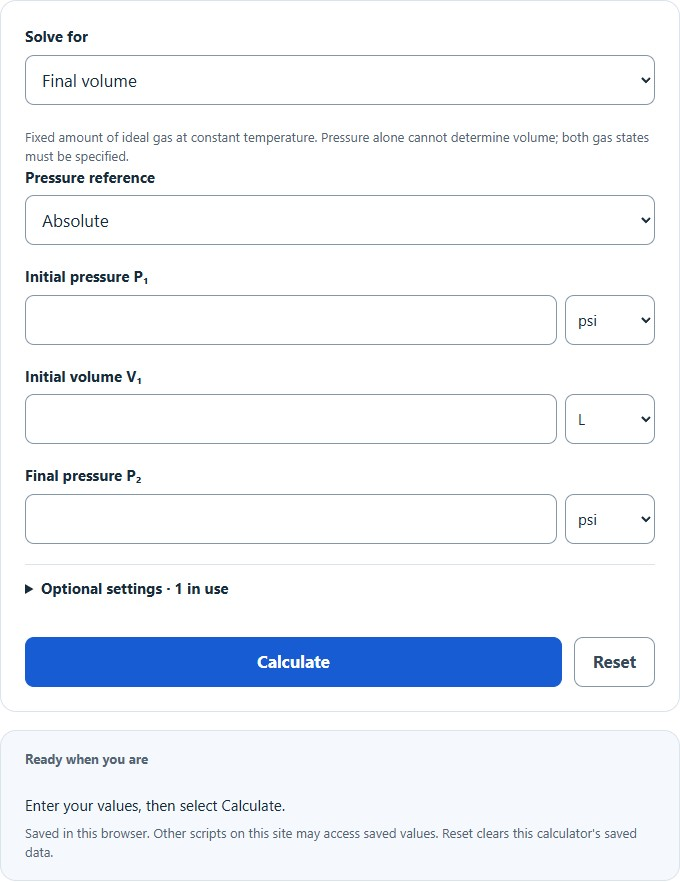
Calculate gas volume from PSI with Boyle’s law, or solve for initial or final pressure and volume using absolute or gauge pressure and common units.
- All Unit Converters
- All Volume Calculators
- PSI to Force Calculator
- Flat Bag Volume Calculator
- GPM ↔ PSI Calculator
Volume from PSI Formula
For a fixed amount of ideal gas at constant temperature, Boyle’s law relates two equilibrium states. Use absolute pressures in the following formula; PSI alone does not determine volume.
- Where V is the Volume from PSI (ft3)
- P1 is the initial absolute pressure (psia)
- P2 is the final absolute pressure (psia)
- V1 is the initial volume (ft3)
To calculate volume from psi, multiply the initial pressure by the initial volume, then divide by the final pressure.
| Absolute pressure (psia) | Volume (ft³) | Volume (m³) | Volume (L) |
|---|---|---|---|
| 1 | 100.000 | 2.832 | 2831.680 |
| 2 | 50.000 | 1.416 | 1415.840 |
| 3 | 33.333 | 0.944 | 943.893 |
| 4 | 25.000 | 0.708 | 707.920 |
| 5 | 20.000 | 0.566 | 566.336 |
| 10 | 10.000 | 0.283 | 283.168 |
| 15 | 6.667 | 0.189 | 188.779 |
| 20 | 5.000 | 0.142 | 141.584 |
| 25 | 4.000 | 0.113 | 113.267 |
| 30 | 3.333 | 0.094 | 94.389 |
| 35 | 2.857 | 0.081 | 80.905 |
| 40 | 2.500 | 0.071 | 70.792 |
| 45 | 2.222 | 0.063 | 62.926 |
| 50 | 2.000 | 0.057 | 56.634 |
| 60 | 1.667 | 0.047 | 47.195 |
| 75 | 1.333 | 0.038 | 37.756 |
| 80 | 1.250 | 0.035 | 35.396 |
| 90 | 1.111 | 0.031 | 31.463 |
| 100 | 1.000 | 0.028 | 28.317 |
| 150 | 0.667 | 0.019 | 18.878 |
| * Rounded to 3 decimals. Assumes a fixed ideal-gas amount and constant temperature, with PabsV = 100 psi·ft³ (V = C / Pabs). This is one example state constant, not a universal pressure-to-volume conversion. Unit refs: 1 ft³ = 0.0283168 m³ = 28.3168 L. | |||
How to Calculate Volume from PSI?
The following examples use absolute pressure, a fixed amount of ideal gas and constant temperature. Gauge pressure must first be converted by adding the atmospheric reference.
Example Problem #1
- First, determine the initial psi.
- The initial psi is given as 4.
- Next, determine the final psi.
- The final psi is calculated as 2.
- Next, determine the initial volume (ft3).
- The initial volume (ft3) is found to be 10.
- Finally, calculate the Volume from PSI using the formula above:
V = P1 * V1 / P2
Inserting the values from above yields:
V = 4 * 10 / 2 = 20 (ft3)
Example Problem #2
The variables needed for this problem are provided below:
initial psi = 7
final psi = 6
initial volume (ft3) = 10
Entering these values and solving gives:
V = 7 * 10/ 6 ≈ 11.67 (ft3)