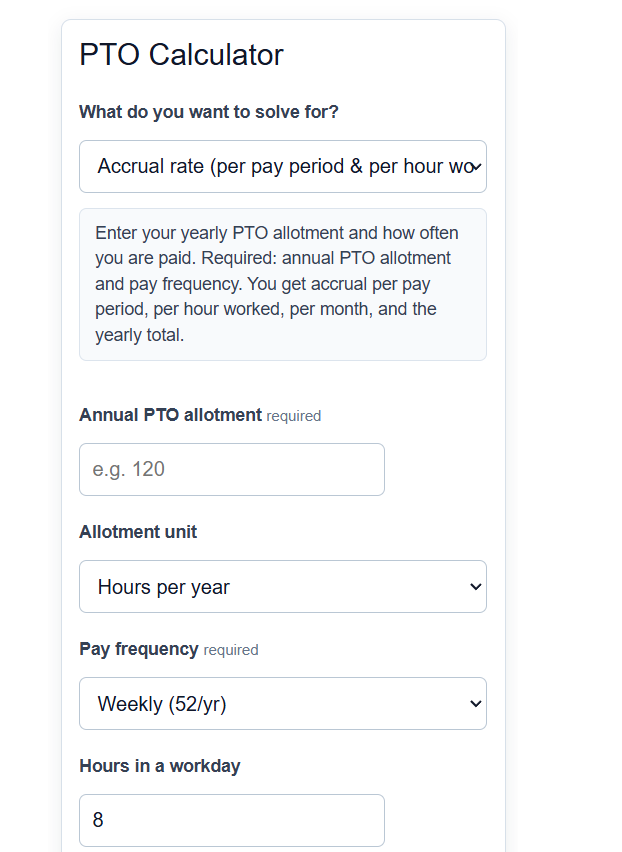
Calculate your PTO accrual rate per pay period and per hour worked, project your paid time off balance by a future date, and convert PTO hours to days.
PTO Formula
This calculator works in three modes. Each mode uses its own formula.
Accrual rate per pay period:
Accrual per Period = Annual PTO Hours / Pay Periods per Year
Accrual per hour worked:
Accrual per Hour = Annual PTO Hours / (Hours per Week * 52)
Projected future balance:
Ending Balance = Current Balance + (Accrual per Period * Periods) - Planned PTO
Hours and days conversion:
Days = PTO Hours / Hours per Workday
Where:
- Annual PTO Hours is the paid time off you earn in a full year, in hours. If your policy is set in days, multiply days by your hours per workday.
- Pay Periods per Year is 52 for weekly, 26 for biweekly, 24 for semimonthly, and 12 for monthly pay.
- Hours per Week is your full-time schedule, normally 40, used to find the rate earned for each hour you work.
- Current Balance is the PTO hours you have available right now.
- Accrual per Period is the PTO hours added each pay period.
- Periods is the number of pay periods between now and your target date.
- Planned PTO is any time off you intend to use before the target date.
- Hours per Workday is the length of one workday, normally 8, used to switch between hours and days.
The accrual rate mode turns a yearly allotment into the amount that lands in your account each pay period, each month, and for every hour you work. The balance mode adds future accrual to your current balance, subtracts any planned time off, and applies an optional cap so your projection does not exceed your plan limit. The conversion mode moves a figure between hours and days so you can compare a policy quoted in days against a balance tracked in hours.
Typical PTO Accrual by Pay Frequency
The table below shows the accrual per pay period for common annual allotments. Divide annual hours by the number of pay periods to read any row.
| Annual PTO | Weekly (52) | Biweekly (26) | Semimonthly (24) | Monthly (12) |
|---|---|---|---|---|
| 80 hrs (10 days) | 1.54 hrs | 3.08 hrs | 3.33 hrs | 6.67 hrs |
| 120 hrs (15 days) | 2.31 hrs | 4.62 hrs | 5.00 hrs | 10.00 hrs |
| 160 hrs (20 days) | 3.08 hrs | 6.15 hrs | 6.67 hrs | 13.33 hrs |
| 200 hrs (25 days) | 3.85 hrs | 7.69 hrs | 8.33 hrs | 16.67 hrs |
The hours to days figures assume an 8-hour workday. If your workday is a different length, change the hours per workday input so the day totals match your policy.
Example Problems
Example 1: Accrual rate. Your employer gives you 120 hours of PTO per year and pays you biweekly, so there are 26 pay periods in the year. The accrual per pay period is 120 / 26 = 4.62 hours. Working a 40-hour week, you put in 40 * 52 = 2,080 hours per year, so you earn 120 / 2,080 = 0.0577 hours of PTO for every hour worked.
Example 2: Projected balance. You currently have 40 hours of PTO and accrue 4.62 hours each biweekly pay period. You want your balance in 12 pay periods, and you plan to use 16 hours of PTO in that time. You will accrue 4.62 * 12 = 55.44 hours, bringing the balance to 40 + 55.44 = 95.44 hours. After subtracting the 16 planned hours, your projected ending balance is 79.44 hours.
FAQ
How do I find my accrual rate per pay period? Divide your annual PTO hours by the number of pay periods in your year. Weekly pay has 52 periods, biweekly has 26, semimonthly has 24, and monthly has 12. For example, 96 hours paid biweekly is 96 / 26 = 3.69 hours per period.
What is the difference between hours and days of PTO? Days are converted to hours using the length of your workday. With an 8-hour day, 5 days of PTO equals 40 hours. If your standard day is 7.5 hours, the same 5 days equals 37.5 hours, so always convert with your own workday length.
Why does my projected balance stop growing? Many policies set an accrual cap, which is the maximum PTO you can hold at one time. Once you reach the cap, no new PTO is added until you use some. If you enter a cap in the advanced options, the projection stops accruing at that limit.