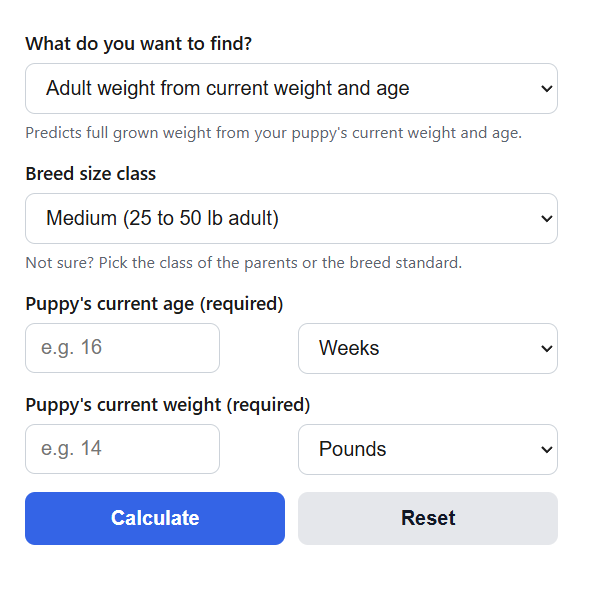
Calculate your puppy’s adult weight from its current weight and age, with growth curves for toy, small, medium, large, and giant breeds.
Puppy Adult Weight Formula
AW = CW / (G / 100)
- AW is the predicted adult weight (lb)
- CW is the puppy’s current weight (lb)
- G is the percent of adult weight a puppy of that breed size class has typically reached at its current age (%)
The percentage G comes from a growth curve table for the puppy’s size class, shown below. A medium breed puppy at 16 weeks has typically reached about 50% of its adult weight, so a 14 lb puppy at that age projects to roughly 28 lb full grown.
The calculator also runs two other modes built on the same curve. Future weight projection first solves for AW, then applies the growth percentage at the later age:
W(t) = AW * G(t) / 100
The reverse mode works from a known adult weight, such as the average of the parents, and returns what the puppy should weigh right now: expected weight = AW * G / 100. This is useful as a growth check between vet visits.
For comparison, the calculator also displays the simple linear shortcut, AW = (CW / age in weeks) * 52. This shortcut ignores the fact that growth slows sharply after 6 months, so it tends to overestimate small breeds and can misjudge giant breeds. The curve-based result should be treated as the primary answer.
Growth Percentage by Age and Size Class
This table shows the approximate percent of adult weight reached at each age, which is the G value the calculator interpolates between. Size classes are defined by adult weight: Toy under 12 lb, Small 12 to 25 lb, Medium 25 to 50 lb, Large 50 to 100 lb, Giant over 100 lb.
| Age | Toy | Small | Medium | Large | Giant |
|---|---|---|---|---|---|
| 8 weeks | 40% | 33% | 27% | 22% | 17% |
| 12 weeks | 55% | 50% | 42% | 35% | 28% |
| 16 weeks | 70% | 65% | 50% | 47% | 38% |
| 6 months | 90% | 87% | 75% | 70% | 57% |
| 10 months | 100% | 99% | 95% | 92% | 82% |
| 12 months | 100% | 100% | 100% | 97% | 90% |
| 18 months | 100% | 100% | 100% | 100% | 100% |
The second table translates the same curves into growth milestones. It answers the question most owners actually have: at what age is most of the growing done, and when can you stop expecting the food bill to climb.
| Milestone | Toy | Small | Medium | Large | Giant |
|---|---|---|---|---|---|
| Half of adult weight | ~11 wk | ~12 wk | ~16 wk | ~17 wk | ~22 wk |
| Three quarters grown | ~4.5 mo | ~5 mo | ~6 mo | ~7 mo | ~9 mo |
| 90% grown | ~6 mo | ~7 mo | ~8.5 mo | ~10 mo | ~12 mo |
| Full grown | 8-10 mo | 10-12 mo | ~12 mo | 12-15 mo | 18-24 mo |
Example Problems
Example 1: Predict adult weight. A medium breed puppy weighs 14 lb at 16 weeks. From the table, a medium puppy at 16 weeks has reached about 50% of adult weight, so G = 50. AW = 14 / (50 / 100) = 28 lb. The likely range at plus or minus 12% is about 24.6 to 31.4 lb.
Example 2: Check a puppy against its expected adult weight. A large breed puppy’s parents average 60 lb, and the puppy is now 26 weeks old. A large breed at 26 weeks has typically reached 70% of adult weight, so the expected current weight is 60 * 0.70 = 42 lb. If the puppy weighs 36 lb, it is about 14% under the expected track, which is worth mentioning at the next vet visit; if it weighs 44 lb, it is within the normal band.
FAQ
How accurate is a puppy adult weight prediction? Curve-based predictions are typically within 10 to 15% of the true adult weight when the size class is correct and the puppy is at least 8 weeks old. Accuracy improves with age because more of the growth is already on the scale. Predictions are least reliable for mixed breeds whose adult size class is uncertain, which is why the calculator flags results that land outside the size class you selected.
Why does breed size class matter so much? Small dogs finish growing much earlier than large ones. At 16 weeks a toy breed has already reached about 70% of adult weight, while a giant breed is at about 38%. Using the wrong class can therefore change the prediction by a factor of nearly two. If you do not know the breed, estimate the class from the parents’ sizes, or run the calculation for two neighboring classes to bracket the answer.
Can I use paw size to predict adult weight? Paw size is a weak predictor. Large paws on a young puppy hint that growth remains, but paw proportions vary widely between breeds and even between littermates. Weight-at-age against a growth curve, the method this calculator uses, is the approach supported by veterinary growth chart data and is considerably more reliable than paw size, skin looseness, or other folk indicators.