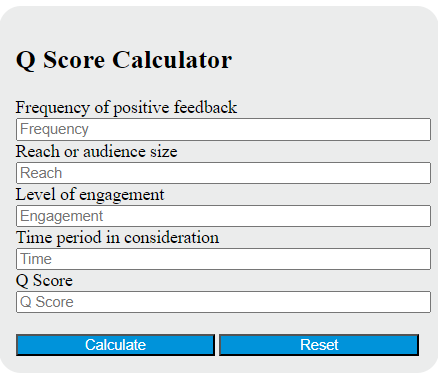
Calculate Q Score from favorite responses and familiar respondents to find a brand appeal percentage out of 100 for market research.
Related Calculators
- Earned Media Value Calculator
- CPS (cost per sale) Calculator
- Annual Sales Calculator
- Price Impact Calculator
- All Business Calculators
Q Score Formula
The Q Score measures positive appeal among people who are already familiar with a subject. In this calculator, the score is expressed as the percentage of familiar respondents who selected “one of my favorites.”
| Variable | Meaning |
|---|---|
| Q | Q Score, or positive appeal score on a 0 to 100 scale |
| F | Number of respondents who say the subject is “one of my favorites” |
| R | Number of respondents who are familiar with the subject |
A higher Q Score means a larger share of familiar respondents view the subject very positively. A lower Q Score means fewer familiar respondents selected it as a favorite.
How to Calculate a Q Score
- Count how many respondents selected the subject as “one of my favorites.”
- Count how many respondents said they were familiar with the subject.
- Divide the favorite count by the familiar count.
- Convert that result to a percentage.
This calculator performs those steps automatically once you enter the two required values.
Example Calculation
If 200 respondents call a subject one of their favorites and 1,000 respondents are familiar with it, the score is:
That result means 20% of the familiar audience rated the subject as a favorite.
How to Interpret the Result
The Q Score is an appeal metric, not a pure awareness metric. Two subjects can have very different levels of public recognition but still be compared on favorability among the people who know them.
- High familiarity + high Q Score: broadly known and strongly liked.
- High familiarity + low Q Score: well known, but relatively weak favorite status.
- Low familiarity + high Q Score: strongly liked within a smaller known audience.
- Low familiarity + low Q Score: limited reach and limited favorite appeal.
Because the score depends only on familiar respondents, it is often most useful when paired with a separate familiarity or awareness percentage.
Important Input Rules
- R must be greater than 0. If nobody is familiar with the subject, the score cannot be calculated.
- F cannot exceed R. The number of favorite responses must be less than or equal to the number of familiar respondents.
- Use matching survey groups. Both values should come from the same sample and time period.
- Use weighted data if your survey is weighted. Enter the weighted counts or percentages consistently.
Reverse Formula
If you already know the Q Score and the number of familiar respondents, you can estimate the number of favorite responses with:
If you know the Q Score and the number of favorite responses, you can rearrange the relationship to estimate the familiar count:
Common Uses of a Q Score
- Comparing audience appeal for celebrities, athletes, characters, brands, or shows
- Evaluating sponsorship fit and endorsement potential
- Tracking perception changes before and after campaigns
- Benchmarking multiple subjects within the same survey
- Measuring brand strength inside a known target audience
Common Mistakes
- Confusing familiarity with favorability
- Comparing scores from different survey methods without adjustment
- Using total respondents instead of familiar respondents in the denominator
- Drawing strong conclusions from very small sample sizes
- Ignoring segmentation by age, region, gender, or customer type
Q Score FAQ
What does a Q Score actually represent?
A Q Score represents the percentage of familiar respondents who identify the subject as a favorite.
Is a higher Q Score always better?
Generally yes for positive appeal, but context matters. A niche subject may have a high score with low familiarity, while a mass-market subject may have a lower score but much broader reach.
Can I compare Q Scores across different audiences?
Yes, but only carefully. Scores are most meaningful when the question wording, sampling method, and audience definition are consistent.
Can the result exceed 100?
No. Since favorite responses cannot be greater than familiar responses, the score ranges from 0 to 100.