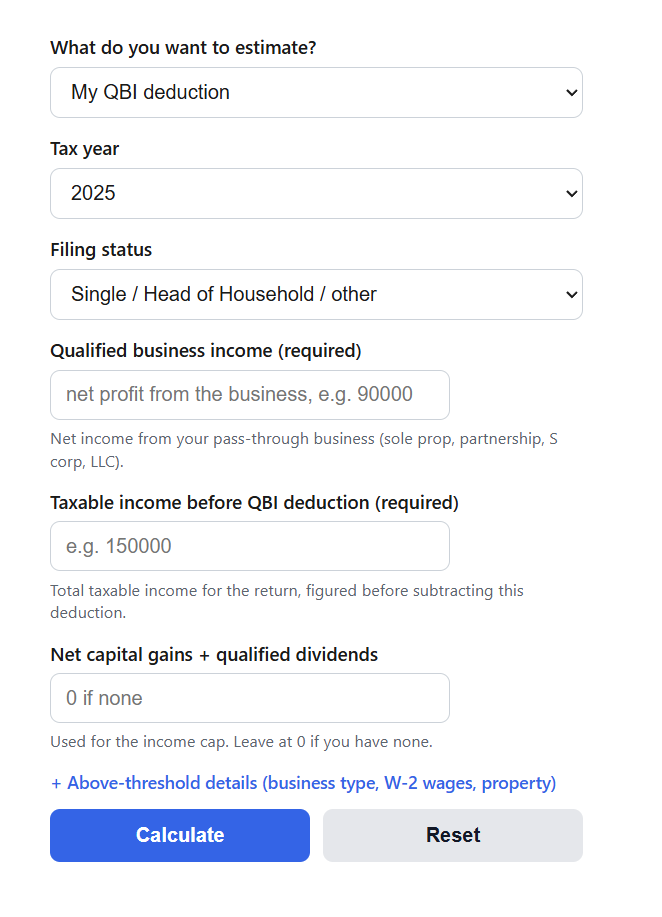
Calculate your Section 199A QBI deduction from your business and taxable income, including the W-2 wage limit, SSTB phase-out, and your estimated tax savings.
QBI Deduction Formula
The qualified business income (QBI) deduction, also called the Section 199A deduction, is worth up to 20% of your qualified business income. Which formula applies depends on your taxable income and whether your business is a specified service trade or business (SSTB).
When your taxable income is at or below the threshold for your filing status, the deduction is the smaller of two amounts:
QBID = min(0.20 * QBI, 0.20 * (TI - NCG))
When your taxable income is above the upper limit and the business is not an SSTB, a wage and property cap applies:
QBID = min(0.20 * QBI, max(0.50 * W2, 0.25 * W2 + 0.025 * UBIA))
Inside the phase-in range, the amount by which 20% of QBI exceeds the wage and property cap is reduced in proportion to how far your income has moved through the range:
Reduction = (0.20 * QBI - Cap) * (TI - Threshold) / Range
Variables:
- QBID is the qualified business income deduction in dollars
- QBI is your net qualified business income
- TI is taxable income figured before the QBI deduction
- NCG is net capital gains plus qualified dividends
- W2 is the W-2 wages the business paid
- UBIA is the unadjusted basis immediately after acquisition of qualified property (its original cost)
- Cap is the greater of 50% of W-2 wages or 25% of W-2 wages plus 2.5% of UBIA
- Threshold and Range are the income threshold and phase-in width for your filing status and year
The 20% rate is applied to your business income to get the starting deduction. The taxable income limit, 20% of taxable income minus net capital gains, limits the regular deduction. The separate 2026 minimum for confirmed qualifying active QBI is considered after that regular calculation. The wage and property cap only matters once income passes the threshold, and it rewards businesses that pay W-2 wages or own depreciable property. For an SSTB in the phase-in range, your QBI, wages, and property are first multiplied by the applicable percentage (the share of the range you have not yet used up), and then the wage cap is applied to those reduced figures.
QBI Income Thresholds for 2025 and 2026
The threshold sets where the wage cap and SSTB rules begin, and the upper limit is where they are fully applied. The One Big Beautiful Bill Act widened the phase-in ranges starting in 2026 and added a minimum deduction, so the two years do not match. This side-by-side view is the difference most single-year tables miss.
| Filing status | Year | Threshold (full 20% below) | Phase-in range | Upper limit |
|---|---|---|---|---|
| Single / HoH / other | 2025 | $197,300 | $50,000 | $247,300 |
| Single / HoH / other | 2026 | $201,750 | $75,000 | $276,750 |
| Married filing separately | 2026 | $201,775 | $75,000 | $276,775 |
| Married filing jointly | 2025 | $394,600 | $100,000 | $494,600 |
| Married filing jointly | 2026 | $403,500 | $150,000 | $553,500 |
Starting in 2026, section 199A(i) provides a $400 minimum for taxpayers with at least $1,000 of aggregate QBI from qualified trades or businesses in which they materially participate. This is not automatic for passive income or excluded service-business income. Select the minimum only after confirming that separate eligibility test. The next table shows how the rules change across the three income bands.
| Income band | Regular business (non-SSTB) | Service business (SSTB) |
|---|---|---|
| At or below threshold | Full 20% of QBI, income cap only | Full 20% of QBI, income cap only |
| Inside phase-in range | Wage and property cap phases in | QBI, wages, and property cut by applicable percent, then cap applies |
| Above upper limit | Lesser of 20% of QBI or the wage and property cap | No deduction ($0) |
Example Problems
Example 1: Income below the threshold.
For tax year 2025, you are single with $80,000 of qualified business income and $120,000 of taxable income before the deduction, with no capital gains. Because $120,000 is below the $197,300 threshold, you take the full 20%: 0.20 times $80,000 is $16,000. The income cap of 0.20 times $120,000 is $24,000, which is higher, so it does not reduce anything. Your QBI deduction is $16,000.
Example 2: Income above the upper limit for a non-SSTB.
For tax year 2025, you are single with $180,000 of QBI, $260,000 of taxable income, W-2 wages of $40,000, and no qualified property. Since $260,000 is above the $247,300 upper limit, the wage cap applies in full. Twenty percent of QBI is $36,000. The wage cap is the greater of 50% of wages ($20,000) or 25% of wages plus 2.5% of property ($10,000), which is $20,000. You take the smaller of $36,000 and $20,000, so your QBI deduction is $20,000.
Frequently Asked Questions
What counts as qualified business income?
QBI is the net income from a pass-through business such as a sole proprietorship, partnership, S corporation, or LLC that operates a trade or business in the United States. It does not include wages you pay yourself, guaranteed payments, most capital gains, dividends, or interest income. If a business runs a loss, the loss carries forward and reduces your QBI in the next year.
Who does not qualify for the full QBI deduction?
Owners of specified service trades or businesses, including health, law, accounting, consulting, financial services, and athletics, lose the deduction once taxable income rises above the upper limit. Non-service businesses can still take a deduction above the limit, but it is capped by the W-2 wage and property test. Below the threshold, both types get the full 20% regardless of service status.
Do I file Form 8995 or Form 8995-A?
Form 8995 generally applies at or below the applicable income threshold when its other conditions are met; specified agricultural or horticultural cooperative patrons use Form 8995-A. Above the threshold, use Form 8995-A. Qualified REIT/PTP income alone does not automatically require Form 8995-A. Confirm the applicable form instructions.
Rules reviewed October 20, 2026. 2026 income thresholds follow IRS Revenue Procedure 2025-32, section 4.26. The minimum follows 26 USC 199A(i). No unannounced future-year limits are assumed.