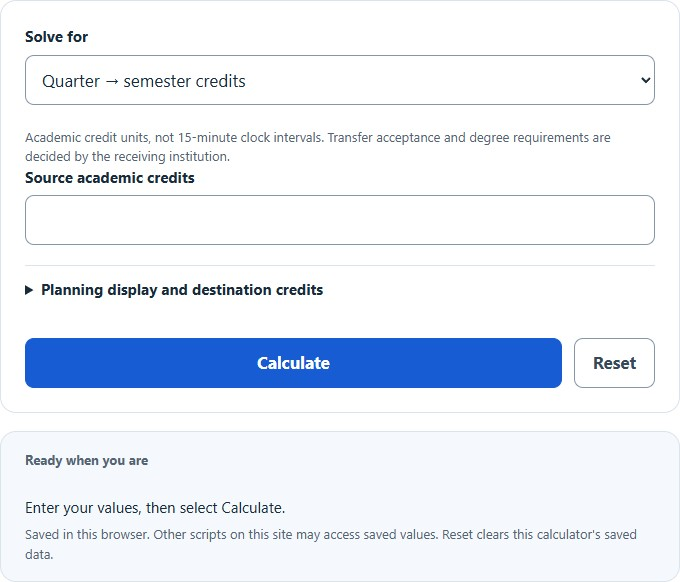
Convert quarter and semester credit hours in either direction, compare exact and rounded equivalents, and combine transfer credits with a destination-program target.
Quarter Hour To Credit Hours Formula
The calculator uses a fixed 1.5-to-1 ratio between quarter hours and semester credit hours. This is a common U.S. academic-credit estimate, not a guarantee of transfer acceptance. Academic quarter hours are credit units, not 15-minute clock intervals.
- Quarter Hours: credit value of a course taken on a quarter calendar (about 10 weeks per term).
- Semester Credits: credit value of a course taken on a semester calendar (about 15 weeks per term).
- 1.5: the common quarter-credits-per-semester-credit ratio; actual term lengths and institutional credit policies vary.
Assumptions: this is a credit-volume estimate, not an evaluation of grades, course content or degree applicability. Receiving schools set course equivalency and rounding policies. Confirm accepted credits and degree requirements with the receiving registrar.
Calculator modes:
- Quarter → Semester: divides your quarter hours by 1.5.
- Course List: sums all quarter values you enter, then divides the total by 1.5 to give a transfer estimate.
- Semester → Quarter: multiplies your semester credits by 1.5 to give the equivalent quarter hours.
Common Conversion Values
Use these tables to spot-check the common ratio. Decimal values are rounded; course, year, degree and enrollment labels are illustrations, not transfer or enrollment determinations.
| Quarter Hours | Semester Credits | Typical Course |
|---|---|---|
| 1 | 0.67 | 1-credit lab |
| 2 | 1.33 | Short seminar |
| 3 | 2.00 | Elective |
| 4 | 2.67 | Standard lecture |
| 5 | 3.33 | Lecture + lab |
| 45 (1 yr) | 30.00 | Full academic year |
| 180 (degree) | 120.00 | Bachelor’s total |
| Semester Credits | Quarter Hours |
|---|---|
| 1 | 1.5 |
| 2 | 3.0 |
| 3 | 4.5 |
| 4 | 6.0 |
| 12 (full-time) | 18.0 |
| 120 (degree) | 180.0 |
Examples and FAQ
Example 1: Single course transfer. You took a 4-quarter-hour biology class. 4 / 1.5 = 2.67 semester credits. The displayed 2.67 is rounded from 2⅔; the receiving school decides the recorded credit and course equivalency.
Example 2: Full term of courses. A quarter schedule of 5, 4, 4, and 3 quarter hours totals 16 quarter hours. 16 / 1.5 = 10.67 semester credits. The 10.67 value is rounded; it does not by itself establish full-time semester enrollment status.
Example 3: Reverse check. Your new program requires 60 semester credits. 60 × 1.5 = 90 quarter hours needed if you finish at a quarter-system school.
Why 1.5? For the common conversion, one semester credit corresponds to 1.5 quarter credits. A course carrying the same number of quarter credits therefore converts to two-thirds as many semester credits. Credit reflects work across the academic term; term lengths alone do not determine whether two courses are equivalent.
Will my GPA change? The conversion only changes credit values. Letter grades transfer separately, and many schools do not import the GPA from a previous institution at all.
Can credits get lost in conversion? Recorded totals can differ because of institutional rounding, course equivalencies or transfer limits. A 2-quarter-credit course is 1⅓ semester credits under the common ratio; do not assume a particular rounding loss without the receiving school’s policy.
Does this work for graduate programs? The common ratio can provide an estimate, but the graduate program determines accepted courses, credit and degree applicability. Confirm individual course equivalencies with the department.