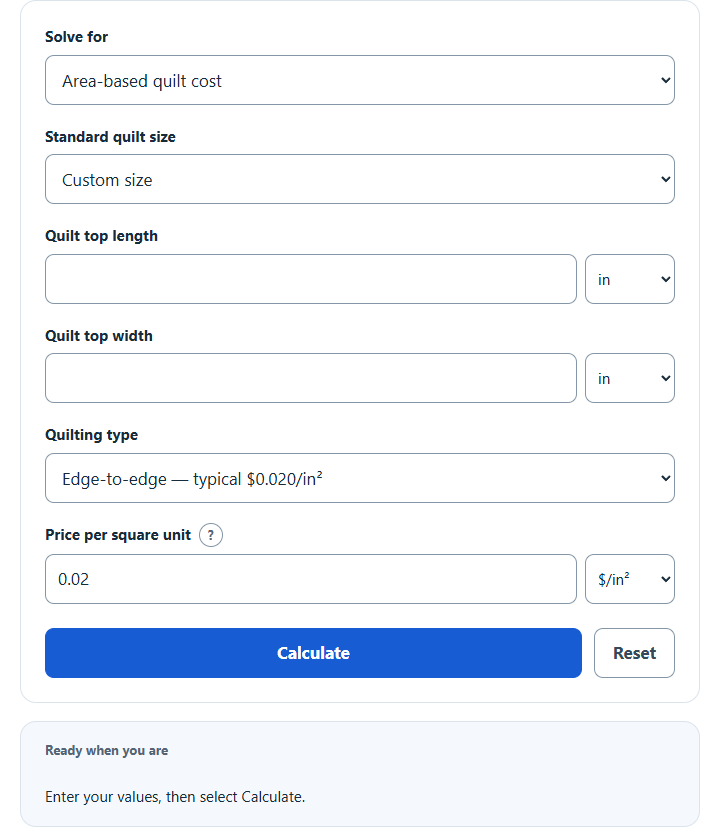
Estimate quilt cost from its size and a per-square-inch quilting rate (about $0.02/in² for edge-to-edge), or work out backing, binding and batting yardage.
- Every Day Life And Education Calculators
- Cost Per Square Inch Calculator
- Cost Per Square Foot Calculator
- Fabric Consumption Calculator
- Quilt Backing Calculator
- Fabric Shrinkage Calculator
- Bias Tape Binding Calculator
- GSM (Grams Per Square Meter) Calculator
Quilt Cost Formula
The following formula calculates a flat area-based price in $. It does not independently include labor, materials, minimum charges, tax or shipping unless the entered rate already covers them. Selected length and square-price units are converted automatically.
- Where QC is the area-based quilt cost ($)
- L is the length of the quilt (inches)
- W is the width of the quilt (inches)
- CSI is the cost per square inch of quilt ($/in^2)
The area-based price is length × width × price per square inch after unit conversion. In Materials & yardage, full-length backing and batting panels run along the quilt length. Binding uses perimeter plus 10 inches and rounded-up whole strips; the bias option adds a rough 33% yardage allowance. Seam loss, shrinkage, print matching and purchase rounding are excluded. Preset sizes, usable widths and legacy prices are illustrative planning values; confirm actual requirements and prices.
How Much Does It Cost to Make a Quilt?
Select Total cost to make to estimate fabric for the top, backing, batting, binding and quilting in one calculation. Enter your quilt dimensions, the top fabric yardage from your pattern and your prices per yard. Open Yardage settings and extra labor to check the backing and batting widths, overhang and binding settings. Enter an hourly rate and hours for work like piecing or attaching binding if the quilting rate does not already cover it.
Estimated total = top fabric cost + backing cost + batting cost + binding fabric cost + quilting cost + additional labor. Each material costs its yardage × its price per yard. Quilting costs the quilt top area × your rate, and additional labor costs hours × hourly rate. A blank material price gives a subtotal. Enter 0 for a material you want to count at no cost. For quilting you will do yourself, set the area rate to 0 and enter your own hours and labor rate if you want to value your time.
For example, a 36 × 54 in quilt costs $38.88 to quilt at $0.02/in². If the material costs shown in your breakdown add up to $72 and you add 2 hours of piecing at $20/hour, the estimated total is $150.88. Use your actual prices and check for minimum fees, extra supplies, tax and shipping before setting a budget. Round the estimated yardages up to the amounts you will actually buy when you budget for fabric.
How is a quilt cost determined?
The cost of a quilt is a function of the skill of the quilter, the cost of the material used to make the quilt, and the total time needed to finish the quilt.
The longer it takes to finish the quilt, the more it will cost. Similarly, if special materials are used for the quilt, the cost will also go up.
How to calculate the cost of a quilt?
Example Problem:
The following example outlines how to estimate the cost of a quilt.
First, determine the length of the quilt. In this example, the quilt is measured to be 50 inches long.
Next, determine the width of the quilt. In this case, the width is measured to be 25 inches.
Next, determine the cost per square inch of the quilt. This quilt is being sold at a cost of $0.50 per square inch.
Finally, calculate the cost of the quilt using the formula above:
QC = L * W * CSI
QC =50 * 25 * .50
QC = $625.00