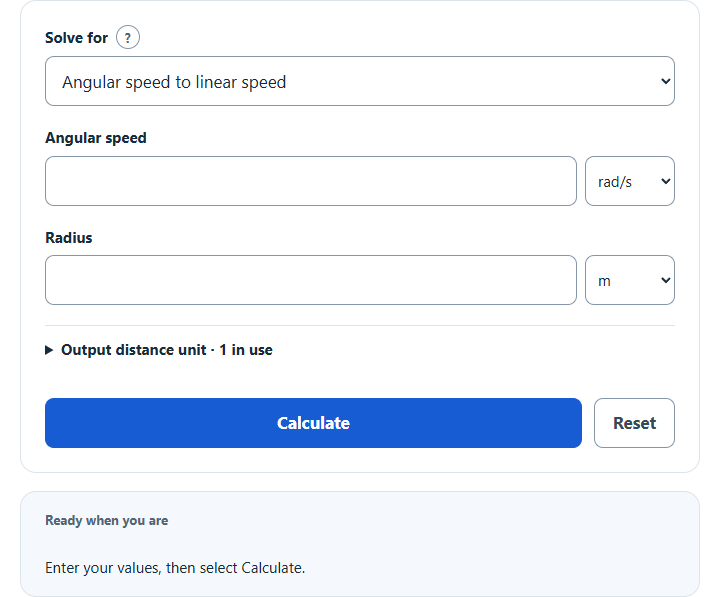
Convert rad/s to m/s from angular speed (rad/s or rpm) and radius, convert m/s back to rad/s, or find the radius from both speeds.
Calculator Functions
| Function | What it does | What it requires |
|---|---|---|
| Angular speed to linear speed | Converts rad/s or rpm to the speed in m/s of a point at a given radius | Requires the angular speed and the radius |
| Linear speed to angular speed | Converts a speed in m/s to rad/s at a given radius | Requires the tangential speed and the radius |
| Radius from both speeds | Finds the radius at which a given angular speed produces a given linear speed | Requires the angular speed and the tangential speed |
Angular speed can be entered in rad/s or rpm, radius in m, cm, mm, ft or in, and tangential speed in the same distance units per second. One optional setting, Output distance unit, changes every distance-based result. Each result also lists the rotational speed in rpm, the distance covered per revolution, the rotation period and the centripetal acceleration.
Radians per Second to Meters per Second Formulas
| v | Linear (tangential) speed (m/s) |
| ω | Angular speed (rad/s) |
| r | Radius: distance from the axis of rotation (m) |
Rad/s describes how fast something turns and m/s describes how fast a point on it travels, so the conversion needs a radius. A point twice as far from the axis moves twice as fast at the same rad/s.
Angular speed to linear speed
A wheel turning at 10 rad/s moves a point 2 m from its axis at 10 × 2 = 20 m/s. An angular speed given in rpm is first converted with ω = rpm × 2π ÷ 60 [2], so 100 rpm is 10.472 rad/s, and at a 0.5 m radius that is 5.236 m/s.
How to Convert Rad/s to M/s
Multiply the angular speed in rad/s by the radius in meters. The radian has no dimension, so rad/s × m comes out directly in m/s. With a radius in centimeters, millimeters, feet or inches, convert it to meters first (1 ft = 0.3048 m and 1 in = 0.0254 m [2]).
10 Rad/s to M/s
10 rad/s is 10 m/s at a radius of 1 m, 5 m/s at 0.5 m and 1 m/s at 0.1 m. The table gives the linear speed for other angular speeds at the same three radii.
| Angular speed | r = 0.1 m | r = 0.5 m | r = 1 m |
|---|---|---|---|
| 1 rad/s | 0.1 m/s | 0.5 m/s | 1 m/s |
| 5 rad/s | 0.5 m/s | 2.5 m/s | 5 m/s |
| 10 rad/s | 1 m/s | 5 m/s | 10 m/s |
| 15 rad/s | 1.5 m/s | 7.5 m/s | 15 m/s |
| 20 rad/s | 2 m/s | 10 m/s | 20 m/s |
| 50 rad/s | 5 m/s | 25 m/s | 50 m/s |
| 100 rad/s | 10 m/s | 50 m/s | 100 m/s |
Linear speed to angular speed
This is the m/s to rad/s direction. A point moving at 20 m/s on a 0.5 m radius turns at 20 ÷ 0.5 = 40 rad/s, which is 381.97 rpm.
Radius from both speeds
A point that moves at 20 m/s while the body turns at 10 rad/s sits 20 ÷ 10 = 2 m from the axis.
Period and Centripetal Acceleration
For steady rotation the period is T = 2π ÷ ω and the centripetal acceleration is ω² × r [1]. At 10 rad/s and 2 m these are 0.628 s per turn and 200 m/s². For angular acceleration in rad/s² rather than speed, the Tangential Acceleration Calculator converts rad/s² to m/s² at a given radius.
Limits of This Estimate
- The speed is that of one point at the entered radius on a rigid body turning about a fixed axis. Points at other radii move at other speeds.
- Speeds are magnitudes without direction, and the period and centripetal acceleration assume the angular speed stays constant.
- A radius or angular speed of zero gives a linear speed of zero, and the two reverse functions need a value above zero to divide by.
Sources
- MIT OpenCourseWare, 8.01SC Classical Mechanics, Chapter 6: Circular Motion: tangential speed, period and centripetal acceleration in circular motion
- NIST, Guide for the Use of the International System of Units (SP 811), Appendix B.8: rpm to rad/s and the exact foot and inch conversions