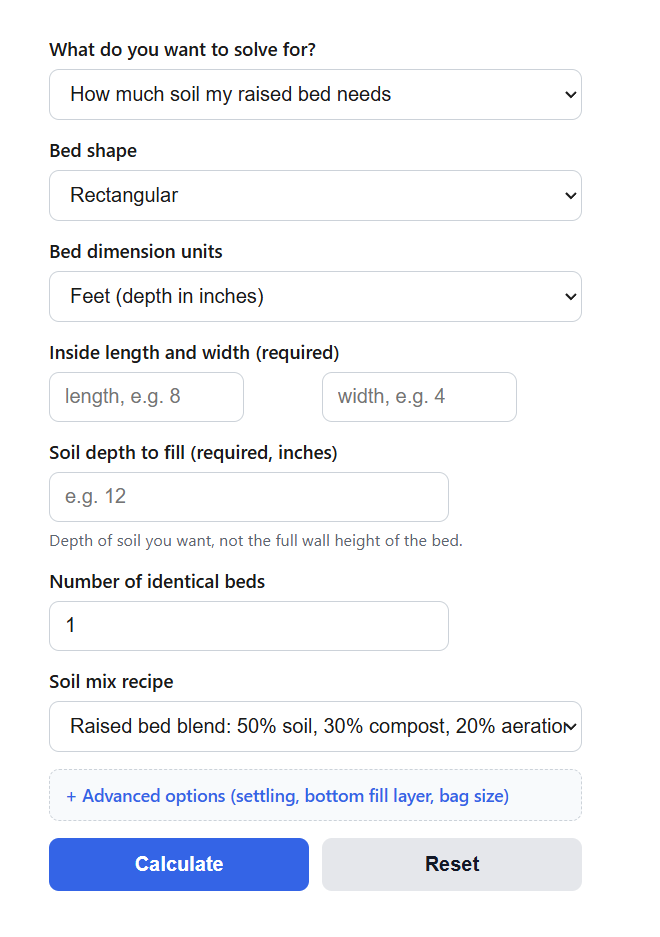
Calculate exactly how much soil your raised bed needs in cubic feet, cubic yards, and bags, with soil mix breakdowns and a fill depth checker.
Raised Bed Soil Formula
V = L * W * (D / 12)
CY = V / 27
- V is the soil volume in cubic feet (cu ft)
- L is the inside length of the bed in feet (ft)
- W is the inside width of the bed in feet (ft)
- D is the soil depth in inches (in)
- CY is the soil volume in cubic yards (cu yd)
For a round bed, the volume uses the circle area instead: V = 3.1416 * (d/2)^2 * (D/12), where d is the inside diameter in feet. The calculator multiplies the result by the number of identical beds and can add a 10 to 15 percent settling allowance, since loose soil compacts after the first few waterings.
If you enable a bottom fill layer, the calculator subtracts that layer from the total depth, so the soil mix is only computed for the depth above the logs or wood chips. The reverse mode flips the formula to solve for depth instead of volume:
D = (V / (L * W)) * 12
This tells you how deep the soil you already own will fill the bed, which is useful when you have leftover bags and want to know if they are worth spreading or if you need to buy more.
Soil Volumes, Bag Counts, and Bottom Fill Savings
The first table shows how much soil common bed sizes hold at a 12 inch fill depth. Bag counts assume 1.5 cubic foot bags, the most common size for bagged raised bed soil.
| Bed size | Soil at 12 in deep | Cubic yards | 1.5 cu ft bags |
|---|---|---|---|
| 2 ft x 4 ft | 8 cu ft | 0.30 | 6 |
| 4 ft x 4 ft | 16 cu ft | 0.59 | 11 |
| 4 ft x 8 ft | 32 cu ft | 1.19 | 22 |
| 4 ft x 12 ft | 48 cu ft | 1.78 | 32 |
| 4 ft round | 12.57 cu ft | 0.47 | 9 |
Tall beds do not need to be filled with soil mix from top to bottom. A base layer of logs, branches, or wood chips works well under 10 to 12 inches of growing mix and breaks down into organic matter over time. The second table shows how much purchased soil a bottom fill layer saves in a standard 4 ft x 8 ft bed, something most soil calculators do not account for.
| Total fill depth | Bottom fill layer | Soil mix needed | Soil saved |
|---|---|---|---|
| 18 in | 6 in of branches | 32 cu ft | 16 cu ft (33%) |
| 24 in | 10 in of logs | 37.3 cu ft | 26.7 cu ft (42%) |
| 30 in | 16 in of logs | 37.3 cu ft | 42.7 cu ft (53%) |
Keep at least 10 to 12 inches of soil mix above the fill layer for most vegetables, and expect the bed to sink slightly each year as the woody material decomposes. Top it off with compost each season.
Example Problems
Example 1: How much soil for a 4 ft x 8 ft bed?
You want to fill a 4 ft x 8 ft raised bed 12 inches deep. First, convert the depth to feet: 12 / 12 = 1 ft. Then multiply: V = 8 * 4 * 1 = 32 cubic feet. Divide by 27 to get cubic yards: 32 / 27 = 1.19 cu yd. In 1.5 cubic foot bags, that is 32 / 1.5 = 21.3, rounded up to 22 bags. Using the 50/30/20 raised bed blend, you would buy 16 cu ft of garden soil, 9.6 cu ft of compost, and 6.4 cu ft of aeration material.
Example 2: How deep will 20 bags fill the same bed?
You already have 20 bags of 1.5 cubic foot soil, which is 20 * 1.5 = 30 cubic feet. The bed area is 8 * 4 = 32 square feet. Depth = (30 / 32) * 12 = 11.25, or about 11.3 inches. That is deep enough for most vegetables, including tomatoes and peppers, so you do not need to buy more unless you are growing deep-rooted crops like carrots or parsnips.
FAQ
How many bags of soil do I need for a raised bed?
Divide the total cubic feet by the bag volume and round up. Bags are sold by volume, not weight: a typical 40 lb bag holds about 0.75 cubic feet, and larger bags hold 1, 1.5, or 2 cubic feet. One cubic yard equals 27 one-cubic-foot bags or 18 bags of 1.5 cubic feet. Once your total passes about 2 cubic yards, bulk delivery by the cubic yard is usually much cheaper than buying bags.
What is the best soil mix for a raised bed?
A blend of roughly 50 percent quality garden soil, 30 percent compost, and 20 percent aeration material such as perlite, coarse sand, or coco coir works well for most beds. Two other proven recipes are the classic 60/30/10 topsoil, compost, and perlite blend, and Mel’s Mix from square foot gardening, which uses equal thirds of compost, peat moss or coir, and coarse vermiculite. Avoid filling a bed with 100 percent topsoil, since it compacts and drains poorly above ground.
Should I account for soil settling?
Yes. Loose soil and compost settle 10 to 15 percent after the first few waterings, so a bed filled exactly to your target depth will sit noticeably lower within a month. Either order about 10 percent extra, which the calculator can add automatically as a settling allowance, or plan to top the bed off with compost after the first season. Compost-heavy mixes settle the most.