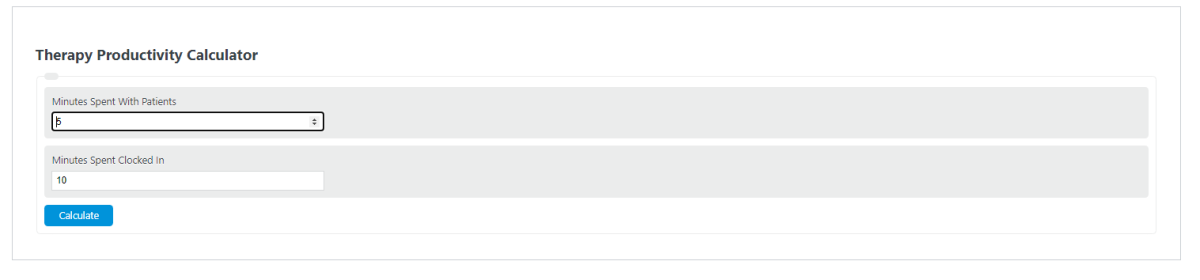
Calculate productivity from billable and total time, clock-in/out shifts, unpaid breaks, or revenue per employee from company revenue.
Customize This Calculator
Build your own version. Describe what you want changed, added, or compared.
- All Health and Medical Calculators
- Labor Productivity Calculator
- Multifactor Productivity Calculator
- Healthcare Productivity Calculator
- Billable Hours Calculator
- Therapy Minutes to Units Converter
Therapy Productivity Formula
Therapy productivity measures the percentage of a clinician's paid work time spent delivering direct, billable patient care. The core formula applies across PT, OT, and SLP settings:
P = (Billable Minutes / Total Minutes Clocked) x 100
A therapist who clocks in for 480 minutes (8 hours) and bills 360 minutes of direct patient care operates at 75% productivity. The remaining 120 minutes -- 25% of the day -- covers documentation, care coordination, travel between patients, meetings, and breaks.
Productivity Benchmarks by Clinical Setting
Productivity expectations vary dramatically depending on where a therapist works. The numbers below reflect industry-reported ranges as of 2025. Skilled nursing facilities (SNFs) and short-stay rehab programs historically set the highest bars, while school-based and acute care settings allow more non-billable time for assessments, team conferences, and complex discharge planning.
| Clinical Setting | Typical Range | Common Target | Notes |
|---|---|---|---|
| Skilled Nursing Facility (SNF) | 85-95% | 90-92% | Highest prevalence of formal productivity standards (97% of clinicians report having one) |
| Outpatient Clinic | 75-90% | 80-85% | Scheduling efficiency and no-show rates are primary variables |
| Acute Care Hospital | 60-75% | 65-70% | Patient availability, medical complexity, and interdisciplinary rounds reduce billable time |
| Home Health | 55-75% | 65% | Travel time between homes is the biggest non-billable component |
| Inpatient Rehab Facility (IRF) | 75-85% | 80% | Patients must receive minimum 3 hours/day of therapy under CMS rules |
| School-Based | 50-75% | 65-70% | IEP meetings, consultations, and screenings consume significant non-billable time; only 13% of school clinicians report formal productivity standards |
Discipline-Specific Productivity Standards
While productivity formulas are identical across rehabilitation disciplines, the expected percentages and how billable time is defined differ between physical therapy, occupational therapy, and speech-language pathology.
Physical Therapy (PT): Outpatient PT clinics generally target 80-85% productivity. The American Physical Therapy Association (APTA) supports productivity standards that balance patient experience and outcomes, respect clinical judgment, adhere to the APTA Code of Ethics, and consider the economics of care delivery. APTA does not endorse a single benchmark number, instead emphasizing that standards should improve rather than degrade the work experience of providers.
Occupational Therapy (OT): OT productivity mirrors PT in most settings: 80-90% in outpatient, 75-85% in hospital-based practice, and 70-80% in school-based settings. The key difference is that OT evaluations -- particularly for Activities of Daily Living (ADL) assessments and home modification recommendations -- tend to require longer non-billable preparation and follow-up documentation than PT evaluations.
Speech-Language Pathology (SLP): SLP productivity standards are typically 5-10 percentage points lower than PT/OT in the same setting. The American Speech-Language-Hearing Association (ASHA) explicitly states that productivity standards, payer policies, or other administrative mandates cannot overshadow medical necessity or clinician ethics. SLP billable time in SNFs received a distinct payment component under PDPM, with reimbursement tied to patient characteristics rather than minutes delivered.
Billable vs Non-Billable Time in Therapy
Productivity calculations hinge on how an organization defines "billable." Understanding what falls on each side of that line directly affects a therapist's reported percentage and, often, their compensation or performance reviews.
| Billable (Direct Patient Care) | Non-Billable (Indirect/Administrative) |
|---|---|
| Hands-on treatment sessions | Clinical documentation and note writing |
| Patient evaluations and re-evaluations | Care coordination calls with physicians, nurses, case managers |
| Group therapy (billed per patient) | Travel between patient locations (home health, school-based) |
| Supervised therapeutic exercises | Team meetings, rounds, and discharge planning conferences |
| Patient/family education during treatment | Equipment setup, room turnover, and supply management |
| Concurrent documentation (if done during treatment) | IEP meetings, screenings, and prior authorizations |
| Telehealth sessions | Mandatory training, in-services, and mentoring |
One common source of productivity variability is concurrent documentation -- writing notes during a treatment session. Some organizations count this as billable time (since the therapist is still with the patient), while others flag it as a documentation activity. This single policy difference can swing a therapist's reported productivity by 5-10 percentage points.
What an 8-Hour Day Looks Like at Different Productivity Levels
The practical difference between a 75% and a 92% productivity target becomes obvious when you map it onto a standard 480-minute workday. The table below shows how much non-billable time a therapist has available for documentation, coordination, breaks, and professional development at each level.
| Productivity % | Billable Minutes | Non-Billable Minutes | What That Means |
|---|---|---|---|
| 65% | 312 | 168 | Nearly 3 hours for documentation, coordination, and travel. Typical of acute care and home health. |
| 75% | 360 | 120 | 2 hours for non-patient tasks. Considered sustainable in most outpatient settings. |
| 85% | 408 | 72 | Just over 1 hour for everything else. High end of sustainable outpatient targets. |
| 90% | 432 | 48 | Under 50 minutes for documentation, lunch, and coordination. Common SNF target. |
| 95% | 456 | 24 | Only 24 minutes for all non-patient activity. Widely criticized as unsustainable. |
At 95% productivity, a therapist has roughly 24 minutes in an entire 8-hour shift for documentation, bathroom breaks, care coordination, and professional development combined. Research published in the Archives of Rehabilitation Research and Clinical Translation found that approximately 89% of surveyed clinicians agreed that high productivity requirements negatively impact patient care.
PDPM and the Shift Away from Volume-Based Therapy
The Patient-Driven Payment Model (PDPM), implemented by CMS on October 1, 2019, fundamentally changed how skilled nursing facilities are reimbursed for therapy services. Under the previous Resource Utilization Group (RUG) system, SNFs were paid more when therapists provided more minutes of treatment, creating a direct financial incentive to maximize therapy volume regardless of clinical need. PDPM replaced this with a patient-characteristics-based model that pays a per diem rate determined by diagnosis, functional status, and cognitive level rather than the number of therapy minutes delivered.
The impact was immediate and measurable. Research published in JAMA Network Open found that average therapy minutes dropped from approximately 97 to 81 minutes per patient per day after PDPM took effect. SNFs also reduced therapy staffing, with an average decline of 80 therapy staffing minutes across the average patient stay. Despite this reduction in therapy volume, subsequent hospitalization risk and discharge functional scores did not significantly change, suggesting that some pre-PDPM therapy volume was driven by reimbursement rather than clinical necessity.
However, PDPM did not eliminate productivity pressures. While the old system incentivized maximum therapy time, some SNFs under PDPM now mandate providing as little therapy as possible to maximize profit margins on the fixed per diem. Therapists in these settings report a new kind of productivity pressure: treating more patients in shorter sessions rather than fewer patients in longer sessions.
Productivity, Burnout, and Patient Outcomes
The relationship between productivity targets and clinician wellbeing is well-documented. A national cross-sectional survey found that nearly 50% of U.S. physical therapists reported experiencing burnout, a figure the APTA called "startling but not surprising." High productivity requirements are a significant contributing factor: when therapists are given less than 30 minutes per day for administrative duties and professional development, the cumulative effect is chronic stress and declining job satisfaction.
The downstream effects extend to patient care. Burnout in healthcare professionals is associated with higher rates of medical errors, lower patient satisfaction scores, increased healthcare-acquired infection rates, and elevated mortality rates. The APTA's 2025 report on administrative burden found that documentation and compliance tasks pull significant time and attention away from direct patient interaction, creating a cycle where higher productivity demands produce more rushed documentation, which produces more compliance issues, which produces more administrative burden.
Both APTA and ASHA have taken formal positions against productivity standards that compromise clinical judgment. APTA's policy, last updated in 2024, explicitly states that productivity standards should consider the economics of care delivery while improving the work experience of providers. ASHA's position is even more direct: productivity standards, payer policies, or other administrative mandates cannot overshadow medical necessity or clinician ethics.
FAQ
What is a good therapy productivity percentage?
It depends entirely on the clinical setting. In outpatient clinics, 75-85% is considered sustainable and allows adequate time for documentation, coordination, and breaks. Skilled nursing facilities commonly target 90-92%, though this level leaves under 50 minutes per 8-hour shift for all non-billable activities. Acute care settings typically target 65-70% because patient availability and medical complexity reduce schedulable treatment time. There is no single "good" number across all settings.
How is therapy productivity different from general workforce productivity?
General workforce productivity is typically measured as output per unit of input (revenue per employee, units produced per hour). Therapy productivity specifically measures the ratio of billable direct patient care time to total paid time. This distinction matters because much of a therapist's essential work -- documentation, care coordination, discharge planning, family education outside of treatment -- is non-billable but clinically necessary. A therapist at 95% productivity is not "more productive" in a meaningful sense; they simply have almost no time for required non-clinical duties.
What changed about therapy productivity after PDPM?
Before PDPM (October 2019), skilled nursing facilities were reimbursed based on therapy minutes delivered, creating incentives to maximize volume. After PDPM, reimbursement shifted to patient characteristics (diagnosis, function, cognition). Average therapy minutes per patient per day dropped from about 97 to 81 nationally. However, productivity pressures shifted rather than disappeared: some facilities now push therapists to see more patients in shorter sessions to maximize the fixed per diem payment across more residents.
Can high productivity requirements lead to ethical concerns?
Yes. Research published in the Archives of Rehabilitation Research and Clinical Translation found that approximately 89% of surveyed clinicians agreed that high productivity requirements negatively impact patient care. Both APTA and ASHA have issued formal policy statements asserting that productivity mandates cannot override clinical judgment or ethical obligations. Specific concerns include pressure to bill for services not fully rendered, rushing evaluations, cutting treatment sessions short, and inadequate documentation that fails to capture clinical reasoning.
What is the Rule of 8 in therapy productivity?
The Rule of 8 is a scheduling framework used in SNFs and rehabilitation settings where an 8-hour shift is divided into 15-minute billing units. Under CMS billing rules, one billable unit equals 8 to 22 minutes of treatment, and additional units follow the "8-minute rule": a service must be provided for at least 8 minutes to bill one unit, but the total treatment time determines how many units can be billed across all CPT codes combined. Therapists use this rule to plan patient loads and predict their daily productivity percentage.