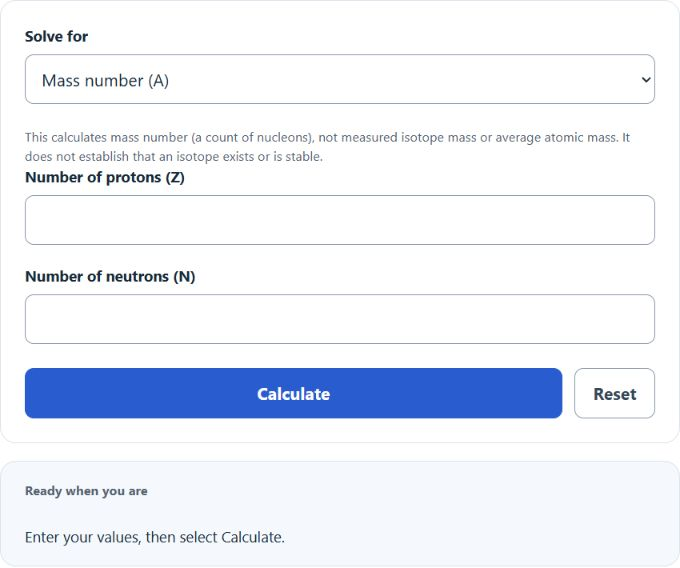
Calculate mass number, protons, or neutrons from the other two values using the atomic number and mass number relationship for an atom.
- All Mass Calculators
- Isotope Mass Calculator
- Theoretical Mass Calculator
- All Chemistry Calculators
- Neutron to Proton Ratio Calculator
Relative Mass Formula
For this calculator, the relative mass of an isotope is found by adding the number of protons and neutrons in its nucleus. In standard chemistry terminology, this value is usually called the mass number. It is a whole-number description of one specific isotope, not the weighted average atomic mass shown on the periodic table.
- RM = relative mass of the isotope
- P = number of protons
- N = number of neutrons
If you know any two values, the equation can be rearranged to solve for the third:
How to Calculate Relative Mass
Select the value to solve, enter the two known counts, then select Calculate. An atom must have at least one proton.
- Identify the isotope’s number of protons. This determines the element.
- Identify the isotope’s number of neutrons. This determines which isotope of that element you have.
- Add the two values together to get the isotope’s relative mass.
This calculator requires whole-number inputs because protons and neutrons are countable particles. Negative values or decimals do not represent valid isotope counts.
What the Result Means
The mass-number output counts protons and neutrons in the nucleus. It is dimensionless, not an exact isotope mass in atomic mass units. The reverse modes return a proton or neutron count; none of the modes establishes isotope existence or stability.
| Quantity | Meaning |
|---|---|
| Protons | Define the element itself |
| Neutrons | Change the isotope and affect nuclear stability |
| Relative Mass | Total of protons and neutrons for one isotope |
| Average Atomic Mass | Weighted average of naturally occurring isotopes; usually a decimal |
Important distinction: if you look up chlorine on the periodic table, its atomic mass is about 35.45, but an individual chlorine isotope still has a whole-number relative mass such as 35 or 37. This calculator is for the single-isotope value, not the periodic-table average.
Examples
Example 1: An isotope has 6 protons and 8 neutrons.
The isotope’s relative mass is 14. Because it has 6 protons, it is a carbon isotope, specifically carbon-14.
Example 2: An isotope has a relative mass of 23 and 11 protons.
The isotope has 12 neutrons. With 11 protons, the element is sodium, so this isotope is sodium-23.
Example 3: An isotope has a relative mass of 37 and 20 neutrons.
The isotope has 17 protons, which makes it chlorine-37.
Quick Isotope Reference
| Isotope | Protons | Neutrons | Relative Mass |
|---|---|---|---|
| Hydrogen-1 | 1 | 0 | 1 |
| Carbon-12 | 6 | 6 | 12 |
| Carbon-14 | 6 | 8 | 14 |
| Oxygen-16 | 8 | 8 | 16 |
| Sodium-23 | 11 | 12 | 23 |
Why Electrons Are Not Included
Electrons have mass but are excluded from mass number because mass number counts nucleons. Actual isotope mass also reflects particle masses and binding energy; it is not exactly the nucleon count.
Common Mistakes
- Confusing atomic number with relative mass: atomic number equals protons only, while relative mass equals protons plus neutrons.
- Using the periodic-table decimal mass: that number is an average across isotopes, not the mass number of one isotope.
- Changing protons instead of neutrons: changing protons changes the element; changing neutrons changes the isotope.
- Entering decimals: proton and neutron counts should be whole numbers.
Frequently Asked Questions
Does a higher relative mass always mean a different element?
Not necessarily. If the number of protons stays the same and only neutrons change, it is still the same element but a different isotope.
Can two isotopes of the same element have different relative masses?
Yes. Isotopes share the same proton count but differ in neutron count, so their relative masses are different.
Why is the answer usually a whole number?
Because the calculation adds the count of protons and neutrons, both of which are whole-number quantities.