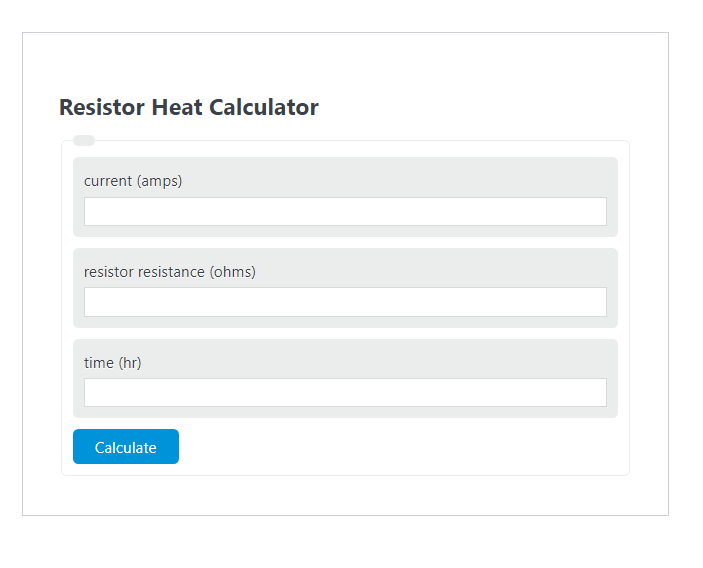
Calculate resistor heat energy, current, resistance, or time with I²Rt, plus power, wattage margin, temperature-rise estimates, and unit conversions.
Understanding Resistor Heat
When current passes through a resistor, electrical energy is converted into heat. This calculator estimates the total heat energy dissipated over a selected time interval and expresses the result in watt-hours (Wh) or kilowatt-hours (kWh). That makes it useful for estimating energy loss, checking long-duration resistor loading, and understanding how quickly a resistor turns electrical power into heat.
Core Equations
| Quantity | Formula | Meaning |
|---|---|---|
| Instantaneous power |
P = I² × R |
Rate of heat generation in watts |
| Total resistor heat |
RH = P × t = I² × R × t |
Total energy dissipated over time |
For manual checks, use current in amps, resistance in ohms, and time in hours if you want the result in Wh. If time is entered in seconds or minutes, convert it to hours before checking the arithmetic by hand.
What Each Input Does
| Input | Typical units | Effect on result |
|---|---|---|
| Current | A, mA, kA | Squared effect: doubling current increases heat by 4×. |
| Resistance | Ω, kΩ, MΩ | Linear effect: doubling resistance doubles heat. |
| Time | s, min, hr | Linear effect: doubling time doubles total heat. |
| Heat output | Wh, kWh | Total energy converted to heat during the interval. |
Rearranged Forms
Because the calculator can solve for a missing variable, these algebraic rearrangements are useful when you know any three values:
| Solve for | Formula |
|---|---|
| Heat |
RH = I² × R × t |
| Current |
I = √(RH / (R × t)) |
| Resistance |
R = RH / (I² × t) |
| Time |
t = RH / (I² × R) |
How to Use the Calculator
- Enter any three known values.
- Select the correct units for each field.
- Calculate the missing variable.
- Interpret the result as energy dissipated as heat over the selected time period.
If you are checking whether a resistor is being overstressed, look at both the total heat energy and the instantaneous power. A resistor can accumulate a modest amount of total energy over time yet still run too hot if its wattage capability is too low for the continuous power level.
Example
For a resistor carrying 10 A with a resistance of 5 Ω for 6 hours:
The resistor dissipates 500 W continuously and produces 3000 Wh of heat energy over the full interval, which is the same as 3 kWh.
Useful Unit Conversions
| Conversion | Formula |
|---|---|
| Minutes or seconds to hours |
tₕᵣ = tₘᵢₙ / 60 = tₛ / 3600 |
| Wh to kWh |
kWh = Wh / 1000 |
| Wh to joules |
J = Wh × 3600 |
The Wh-to-joule conversion is especially helpful if you need the result in SI energy units for physics or engineering calculations.
Practical Interpretation
- Wh and kWh are energy units, so they tell you how much heat was produced in total.
- Watts are a power unit, so they tell you how fast the resistor is heating at any moment.
- This calculator estimates heat energy, not the resistor’s final surface temperature.
- Actual operating temperature depends on the part’s wattage rating, package, mounting method, airflow, heat sinking, and ambient temperature.
- If current is not constant, calculate each time segment separately and add the heat values together.
Common Input Mistakes
- Using seconds or minutes in a hand calculation without first converting time to hours.
- Confusing power with energy; watts and watt-hours are not the same thing.
- Entering the wrong resistance value for the specific resistor being analyzed.
- Forgetting that current has the strongest effect because it is squared in the equation.