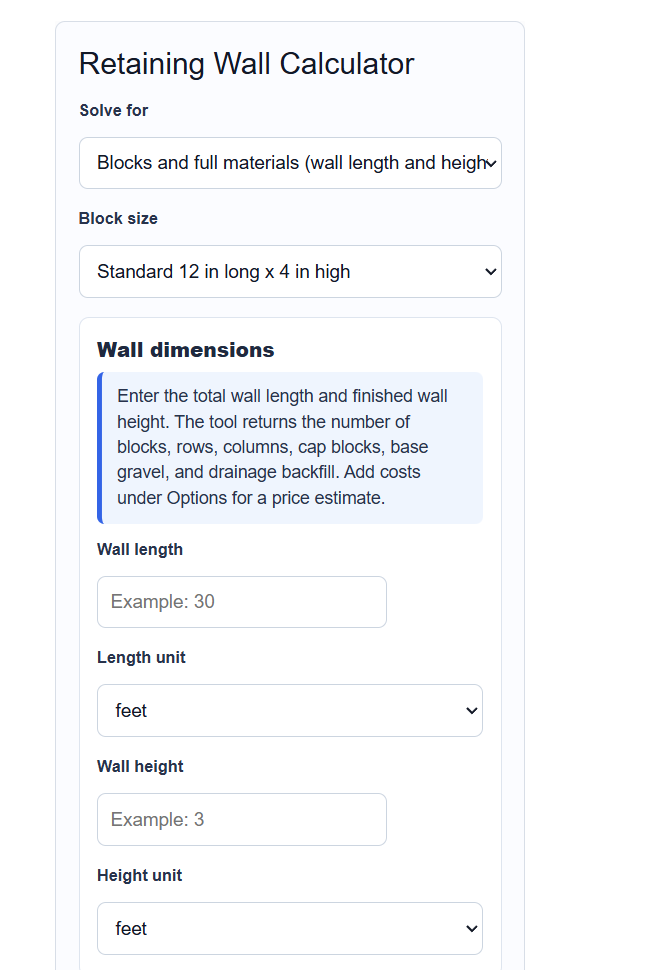
Calculate how many blocks, cap units, and cubic yards of base and drainage gravel your retaining wall needs, plus the total material cost.
Retaining Wall Formula
The number of wall blocks comes from the wall area divided by the face area of one block, plus an allowance for breakage and cuts:
B = (L / bl) * (H / bh) * (1 + W)
A single cap row, when used, is counted along the length only:
C = L / cl
Base gravel under the wall is a volume, converted to cubic yards:
Vbase = (L * Wb * Db) / 27
Drainage backfill behind the wall is the wall face area times the backfill thickness:
Vback = (L * H * T) / 27
- B = number of wall blocks
- C = number of cap blocks
- L = wall length
- H = wall height
- bl = block length (face), bh = block height (course height)
- cl = cap block length
- W = waste/breakage fraction (for example 0.05 for 5%)
- Wb = base width, Db = base (gravel) depth
- T = drainage backfill thickness
- Vbase, Vback = gravel volume in cubic yards (dividing by 27 converts cubic feet to cubic yards)
Dividing the wall length by the block length gives the number of blocks in one course, and dividing the wall height by the block height gives the number of courses. Multiplying those two values gives the raw block count, which the waste factor then increases to cover cuts and damaged units. The base gravel and drainage gravel are handled as separate volumes because they use different dimensions: the base runs along the footing under the wall, while the backfill sits against the full height of the wall face. The cost outputs multiply each quantity by its unit price.
Typical Block Sizes and Gravel Depths
These are common reference values for segmental retaining wall blocks and the gravel layers around them. Confirm the exact face size with your block supplier, since it varies by product line.
| Block face (length x height) | Blocks per square foot of wall | Typical use |
|---|---|---|
| 12 in x 4 in | 3.0 | Garden and small walls |
| 16 in x 6 in | 1.5 | Mid-size walls |
| 18 in x 6 in | 1.33 | Large structural walls |
| Layer | Typical depth | Purpose |
|---|---|---|
| Base gravel (leveling pad) | 6 in to 8 in | Stable, compacted footing |
| Base width | 2x block depth | Spreads the wall load |
| Drainage backfill | 12 in | Drains water away from the wall |
Example Problems
Example 1. A wall is 40 ft long and 3 ft high using 16 in by 6 in blocks (block length 1.333 ft, block height 0.5 ft) with a 5% waste allowance.
Blocks in one course = 40 / 1.333 = 30. Number of courses = 3 / 0.5 = 6. Raw blocks = 30 x 6 = 180. With waste: 180 x 1.05 = 189 blocks. If a cap row is added, cap blocks = 40 / 1.333 = 30.
Example 2. The same 40 ft wall sits on a base 1.5 ft wide and 0.5 ft deep, with 1 ft of drainage gravel behind the 3 ft face.
Base gravel = (40 x 1.5 x 0.5) / 27 = 1.11 cubic yards. Drainage gravel = (40 x 3 x 1) / 27 = 4.44 cubic yards. Total gravel = about 5.6 cubic yards before compaction allowance.
FAQ
How much extra should I order for waste?
A waste allowance of 5% to 10% is typical. Straight walls with simple ends can use the lower end, while walls with curves, corners, or stepped sections need more cut blocks and should use the higher end.
Do I count the cap row in the block total?
No. Cap blocks are usually a different unit and are counted separately as a single row along the wall length. The calculator keeps them apart so you can price them on their own.
Why is gravel given in cubic yards?
Bulk gravel is sold by the cubic yard. The volume is figured in cubic feet from your measurements, then divided by 27 to convert to cubic yards. Add a compaction allowance because gravel loses volume once it is tamped down.