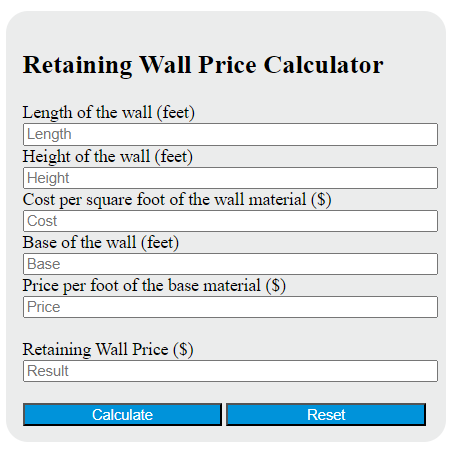
Estimate retaining wall price from wall length, height, cost per area, and base item length and unit price, or solve for any missing value.
- Seawall Cost Calculator
- All Construction Calculators
- Wall Angle Calculator
- Retaining Wall Calculator
Retaining Wall Price Formula
The retaining wall price calculator estimates total project cost when the wall itself is priced by face area and an additional item is priced by linear length. This is useful for budgeting retaining walls where the main wall cost is quoted in square feet or square meters, while items such as footing, drain pipe, capstone, or other edge components are quoted per linear foot or per linear meter.
In this model, the first term calculates the cost of the visible wall face, and the second term adds any length-based component that should be priced separately.
Variable Definitions
| Variable | Meaning | Typical Unit |
|---|---|---|
| RWP | Total retaining wall price | Dollars |
| L | Wall length | ft, m, yd, in, cm |
| H | Wall height | ft, m, yd, in, cm |
| C | Cost per unit area of the wall face | $/ft², $/m², $/yd² |
| B | Length of the separately priced base item | ft, m, yd, in, cm |
| P | Price per unit length of that base item | $/ft, $/m, $/yd, $/in, $/cm |
How to Calculate Retaining Wall Price
- Measure the length of the wall.
- Measure the height of the wall.
- Determine the cost per unit area for the wall face.
- Measure any separate linear component you want to include.
- Determine the price per unit length for that item.
- Add both cost components together to get the estimated total.
If you want to think about the calculation in steps, first compute wall face area, then apply the area rate, then add the linear charge:
What Each Cost Input Should Include
Cost per unit area (C) should represent the part of the project that scales with wall face size. Depending on how you are budgeting, this may include block or stone, labor, backfill, compaction, reinforcement, drainage aggregate, and installation overhead.
Price per unit length (P) should represent items that are better priced by run length than by face area. Common examples include footing work, perforated drain pipe, capstone, edging, base trench, or other continuous features along the wall.
If your quote includes everything in one square-foot price, you can simply set the linear term to zero.
Likewise, if a cost only applies by length and not by face area, the calculator can still handle that by setting the area rate to zero.
Solving for a Missing Variable
Because the calculator can determine one missing value when the others are known, these rearranged formulas are often useful:
Find wall length
Find wall height
Find area rate
Find base length
Find linear rate
Example
Suppose a retaining wall is 10 feet long and 8 feet high. The wall face is budgeted at $20 per square foot, and an additional base-related item is priced at $15 per linear foot over 10 feet.
The estimated retaining wall price is $1,750.
Common Price Drivers
- Wall material: segmental block, poured concrete, timber, boulder, and natural stone all price differently.
- Wall height: taller walls increase area and often increase installation complexity.
- Site access: tight work areas, slopes, and difficult equipment access raise labor time.
- Excavation conditions: rock, hard clay, unstable soil, and removal of old structures can add significant cost.
- Drainage requirements: fabric, gravel, pipe, and outlets may be included in either the area rate or the linear rate.
- Layout complexity: curves, corners, steps, terracing, and varying heights tend to reduce installation efficiency.
- Finishes and accessories: caps, fencing, stairs, lighting, and decorative facing should be budgeted separately if not included.
- Engineering and permits: some projects require design review, inspections, or stamped plans.
Unit and Measurement Tips
- Use consistent units for all length-based inputs.
- If your wall price is quoted in square feet, keep length and height in compatible units before applying the rate.
- Do not confuse wall length with base length; they may be the same, but they do not have to be.
- For stepped or tiered walls, estimate each section separately for better accuracy.
- If height changes along the run, use an average height only for rough budgeting; segment-by-segment estimates are better.
How to Use This Estimate Effectively
This calculator is best used for planning, comparing bids, and building a rough project budget. It helps answer questions such as:
- How much will the total cost change if the wall gets taller?
- What area rate is implied by a contractor quote?
- How much does a linear add-on such as capstone or drain pipe contribute to the total?
- What wall length or height fits a target budget?
For cleaner estimates, separate your costs into categories before entering numbers:
- Area-based costs: wall face materials and installation
- Length-based costs: footing, cap, drain line, trench, or other continuous features
- Fixed costs: delivery, mobilization, permit fees, or design fees
Fixed costs are not part of the formula above, so if you have them, add them after calculating the wall price:
Important Estimating Note
This calculator is a pricing tool, not a structural design tool. A retaining wall may also require consideration of soil pressure, drainage, surcharge loads, reinforcement, footing details, and local construction requirements. For simple budgeting, the formula is highly useful; for final construction scope, use actual project measurements and the specific pricing method used in your quote.