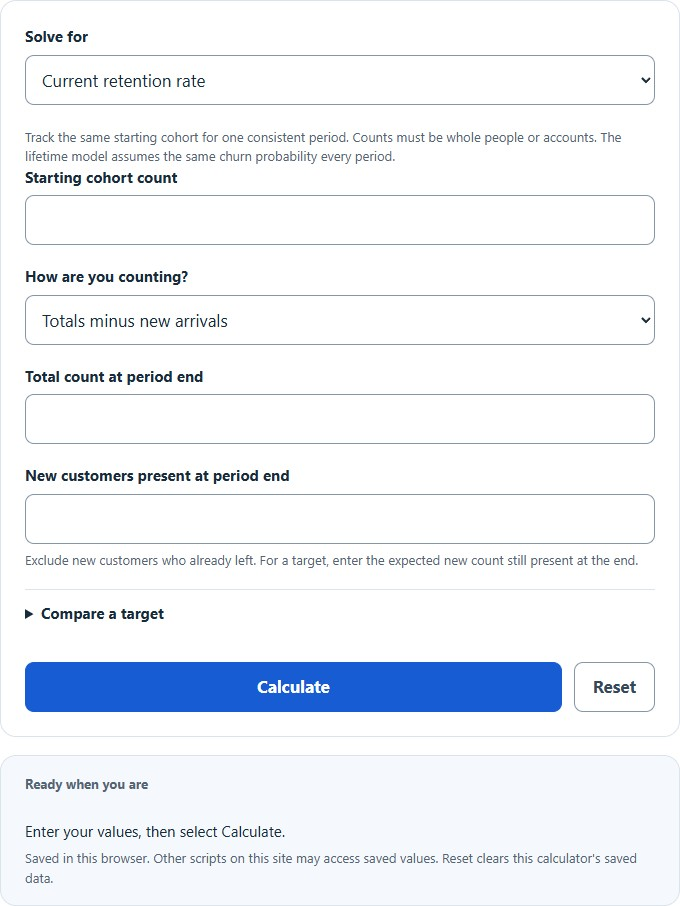
Calculate customer retention, churn, losses, net growth, and implied lifetime, or find the ending customer count needed to reach a target retention rate.
Related Calculators
- Length of Service Calculator
- Employment Duration Calculator
- Tenure Calculator
- Attrition Calculator
- Absence Rate Calculator
- Annualized Turnover Calculator
- All Business Calculators
Retention Rate Guide
Retention rate measures the percentage of employees from the beginning of a period who are still employed at the end of that same period. Choose direct cohort counting for employees, students or members, or ending total minus new customers still present at the end for customer counts. Both methods track the same starting group; new arrivals do not replace losses from that group.
Retention Rate Formula
| Variable | Meaning |
|---|---|
| RTR | Retention rate as a percentage |
| ES | Employees who stayed through the full period |
| TE | Total employees at the start of the period |
Use a clearly defined time window such as one month, one quarter, or one year. For clean comparisons, keep the period length and counting rules consistent every time.
Rearranged Forms
These algebraic rearrangements describe the same cohort ratio. The target mode rounds required retained people up to meet at least the target percentage, then adds the expected new customers still present at the end:
How to Calculate Retention Rate
- Choose the period you want to measure.
- Count how many employees were on staff at the start of that period.
- Count how many of that same starting group were still employed at the end.
- Choose direct cohort counting and enter the starting count and retained starting members to find the retention rate.
What to Count
| Employee Group | Include in TE? | Include in ES? | Notes |
|---|---|---|---|
| Employees on staff at the start of the period | Yes | Yes, if still employed at the end | This is the original group being tracked. |
| New hires during the period | No | No | They were not part of the starting group. |
| Employees who left during the period | Yes | No | They began in the group but did not remain through the end. |
| Internal transfers | Usually yes | Usually yes | Apply a consistent rule based on your reporting scope. |
| Employees on leave | Depends | Depends | Use the same HR policy definition every period. |
| Contractors or temporary workers | Depends | Depends | Only include them if your workforce definition includes them at both dates. |
Quick Validation Checks
- TE should be greater than 0.
- ES should be 0 or more.
- ES should not exceed TE when you are tracking the original starting group.
- The result will normally fall between 0% and 100%.
Examples
Example 1: A company starts the quarter with 60 employees, and 48 of those same employees are still employed at the end.
Example 2: A department starts with 150 employees and has a retention rate of 92%. Find how many stayed.
Example 3: A team retained 171 employees and reported a 95% retention rate. Find the starting headcount.
How to Interpret the Result
| Result | Interpretation |
|---|---|
| 100% | Every employee in the starting group remained through the end of the period. |
| Less than 100% | Some portion of the starting group left before the period ended. |
| Higher than prior periods | Retention improved for the same type of employee group and timeframe. |
| Lower than prior periods | Retention weakened and may justify a closer review by role, location, manager, or tenure band. |
Common Mistakes
| Mistake | Why It Causes Problems |
|---|---|
| Counting new hires in the numerator | Retention tracks the original starting group, not replacement hiring. |
| Using average headcount instead of starting headcount | That changes the definition and makes comparison less consistent. |
| Comparing different period lengths directly | A monthly rate and annual rate are not directly equivalent. |
| Changing who is included each period | Inconsistent rules distort the trend. |
| Confusing retention with turnover | Retention measures who stayed from the starting group; turnover measures departures and may use a different denominator. |
For the most useful reporting, calculate retention the same way each time, compare like-for-like periods, and segment results by team, location, or tenure when you want to identify where improvement is needed most. The optional implied lifetime is 1 / cohort churn fraction under a constant-churn geometric model, in the same reporting periods including the current period; it is not an observed lifetime. Zero churn has no finite mean in that model. Net total-count growth includes new customers and is separate from cohort retention.