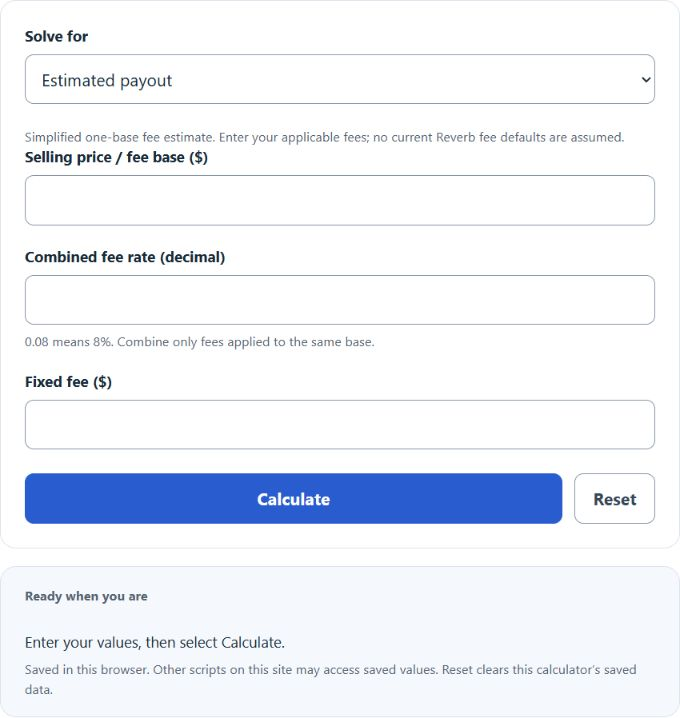
Select the amount to solve, then enter the three requested inputs. This is a simplified one-base estimate using your applicable fee assumptions, not an official Reverb payout.
Related Calculators
- Finder’s Fee Calculator
- Net Price Factor Calculator
- Final Price Calculator
- Revenue Share (revshare) Calculator
- All Business Calculators
Simplified Reverb Payout Formula
This calculator estimates the net amount a seller receives after a percentage-based fee and a fixed transaction fee are deducted from the fee base. It is most useful for quick pricing decisions, payout estimates, and reverse calculations when you want to hit a target net amount.
In this model:
| Variable | Meaning | How to Enter It |
|---|---|---|
| RP | Estimated payout you receive after fees | Dollar amount |
| P | Fee base amount the percentage fee applies to | Usually the selling price or fee-applicable order total |
| r | Total percentage fee rate | Enter as a decimal, such as 0.08 for 8% |
| F | Fixed transaction fee | Dollar amount |
The most important input rule is consistency: the fee base P and the fee rate r must describe the same chargeable amount. If your percentage fee applies to item price plus shipping, then P should reflect that same total. If the percentage fee applies only to the item price, use only the item price.
How the Calculator Works
- Start with the fee base amount.
- Multiply that amount by the combined percentage fee rate.
- Subtract the percentage-based fee from the fee base.
- Subtract the fixed transaction fee.
- The result is the estimated payout.
This model combines percentage fees only when they apply to the same base. Reverb’s selling-fee base excludes sales tax, while payment processing can include it; caps, minimums, payment method, region and other charges can also matter. Use the applicable transaction breakdown rather than assuming one universal rate.
Reverse Formulas
The calculator solves the selected variable from the other three. The base and fixed fee must be nonnegative and the decimal rate must be at least 0 and below 1. The net estimate may be negative when modeled fees exceed the base. At a zero base the rate inverse is nonunique or impossible; inconsistent negative fees or rates are rejected.
Find the required fee base when you want a specific payout:
Find the effective fee rate when payout, fee base, and fixed fee are known:
Find the fixed fee when payout, fee base, and rate are known:
Example
For an illustrative rate (not a statement of current Reverb fees), if the fee base is $500, the combined percentage fee rate is 0.08, and the fixed transaction fee is $0.49, then the estimated payout is:
If instead you want to receive a net payout of $250 after fees, with a rate of 0.08 and a fixed fee of $0.49, the required fee base would be:
This is especially helpful when deciding what minimum listing price is needed to achieve a target payout.
When to Use the Selling Price vs. Order Total
- Use the selling price if the percentage fee is applied only to the item price.
- Use the order total if the percentage fee is applied to the broader chargeable amount.
- If you are combining multiple percentage fees into one rate, make sure every fee in that combined rate applies to the same base amount.
Common Input Mistakes
- Entering the fee rate as a whole percent instead of a decimal. For example, 8% should be entered as 0.08, not 8.
- Using inconsistent fee assumptions. If the rate applies to one amount and the fee base uses another, the estimate will be distorted.
- Forgetting the fixed fee. Small flat fees matter more on lower-priced sales.
- Using a rate above 1. Since the fee rate is entered as a decimal, this model requires 0 ≤ r < 1.
- Ignoring additional adjustments. Refunds, credits, shipping labels, taxes, or other deductions can cause the actual payout to differ from the simplified estimate.
Practical Uses
- Estimate net proceeds before listing an item.
- Compare payout outcomes at different sale prices.
- Back into a minimum acceptable price based on your target net.
- Measure how much an effective fee rate impacts lower-priced versus higher-priced items.
- Quickly test whether a price drop still leaves enough payout after fees.
Interpretation Tips
- A higher r reduces payout proportionally as price increases.
- A higher F has the biggest effect on lower-priced sales because flat fees consume a larger share of the total.
- If your goal is a target net payout, solving for P is often more useful than solving directly for RP.
- The simplified model is illustrative; confirm the applicable fee bases and all adjustments against the final transaction breakdown.
Frequently Asked Questions
What does the payout represent?
The payout is the estimated net amount left after subtracting the percentage-based fee and fixed transaction fee from the fee base.
Why does the calculator use a decimal fee rate?
Decimals make the formula directly usable. A rate entered as 0.10 means 10% of the fee base is deducted.
Can I combine multiple percentage fees into one number?
Yes. If several percentage-based charges apply to the same fee base, you can add them together and enter the total as one decimal rate.
Why might my actual payout differ from the estimate?
This calculator uses a simplified structure. Real transactions may include additional adjustments or exclusions that are not represented by a single percentage rate and fixed fee.