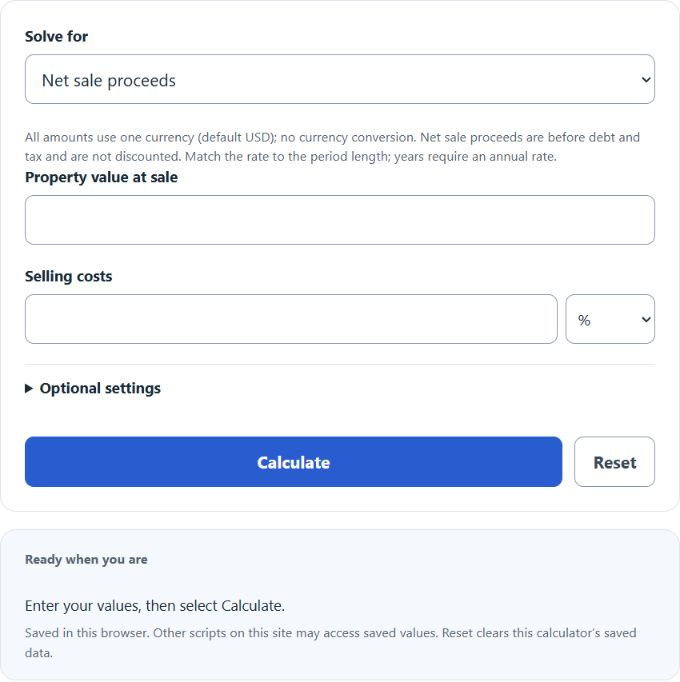
Choose the value to solve for: net sale proceeds, sale price, selling costs, a factored reversion amount, or a discount factor. Use one selected currency for all monetary amounts; the currency selector does not perform exchange-rate conversion.
Related Calculators
- Comp Sales Calculator
- Occupancy Rate Index Calculator
- Proprietary Ratio Calculator
- Solvency Ratio Calculator
- All Business Calculators
Reversion Value Formula
The reversion value is the value produced when a future reversion amount is adjusted by a reversion factor. In finance, appraisal, and investment analysis, the reversion is often the lump-sum amount expected at the end of a holding period, while the factor converts that amount into the value used in the analysis.
Where:
- RV = Reversion Value
- R = Total Reversion
- RF = Reversion Factor
Choose the relevant factor-method mode and enter the two known values to solve for the third. Sale-proceeds modes separately use net proceeds = sale price × (1 − selling-cost fraction), before debt repayment and taxes. Those proceeds are an amount at the sale date, not a present value. A discount factor can then be applied in a factor-method mode.
Rearranged Formulas
If you need to solve for a different variable, use these equivalent forms:
How to Calculate Reversion Value
- Determine the total reversion, which is the future amount expected at the end of the period.
- Determine the reversion factor that applies to that amount.
- Multiply the total reversion by the reversion factor.
- Review the result to make sure the timing, units, and decimal format are consistent.
Tip: Match the unit selector to the entered factor: 67% is 0.67 in decimal mode or 67 in percent mode. Selling costs use the same distinction.
Example
If the total reversion is $100,000 and the reversion factor is 0.67, the reversion value is:
So, the reversion value is $67,000.
How the Reversion Factor Is Commonly Built
In many valuation models, the reversion factor is based on discounting a future amount back to the present. A common present-value form is:
Where i is the discount rate per period and n is the number of periods. If your model already provides a reversion factor, use that number directly in the calculator. The discount modes build the factor alone or apply it when solving for the future amount or discounted value. Enter a rate above −100% and a nonnegative period count; an annual rate requires a count in years.
Input Guide
| Input | Meaning | Practical Check |
|---|---|---|
| Total Reversion | The future lump-sum amount expected at the end of the analysis period. | Make sure it reflects the correct future amount, not an already discounted value. |
| Reversion Factor | The multiplier used to convert the total reversion into the value used for the calculation. | Match the decimal or percent selector and confirm the factor uses the same time horizon as the reversion. |
| Reversion Value | The resulting value after applying the factor to the total reversion. | Check that the result is reasonable relative to both the future amount and the factor used. |
When This Calculator Is Useful
- Estimating the value of a future terminal or resale amount
- Separating periodic cash flows from an end-of-hold lump sum
- Comparing different holding periods or discount assumptions
- Supporting appraisal, investment, and discounted cash flow analysis
- Solving backward for an implied reversion factor or total reversion
How to Interpret the Result
A larger total reversion increases the reversion value. A larger reversion factor also increases the reversion value. If the factor gets smaller, the reversion value falls, which usually means the future amount is being discounted more heavily because of time, risk, or return requirements.
Common Mistakes
- Entering a factor or selling-cost percentage in a format that does not match its unit selector
- Using a factor that does not match the same number of periods as the reversion
- Mixing future amounts with already discounted present values
- Using inconsistent sign conventions for inflows and outflows
- Forgetting that a very small factor can materially reduce the final value
Frequently Asked Questions
What is a reversion?
A reversion is typically the amount expected at the end of the analysis period, such as a terminal sale amount, residual value, or recovered principal.
Why is the reversion factor often less than 1?
Because future money is commonly discounted to reflect the time value of money. When that happens, the present-value factor is usually less than 1.
Can this calculator solve for the missing factor?
Yes. If you know the total reversion and the reversion value, you can solve for the reversion factor using the rearranged formula shown above.