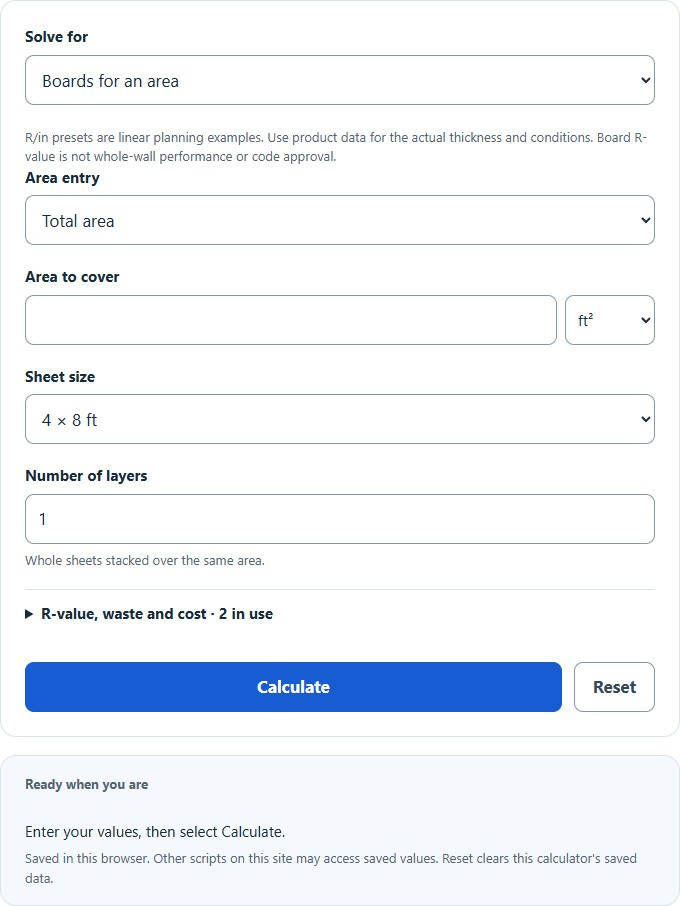
Estimate rigid foam sheet quantities, material R-value and whole layers for a target R. Preset rates are linear planning examples; enter product-rated or supported design data for the actual thickness and conditions.
Rigid Foam Board Formula
The calculator works in three directions. To find how many boards cover an area, it adds a waste factor, divides by the area of one board, and rounds up to a whole sheet:
Sheets = ceil( A * (1 + W) / B )
To find the R-value of a foam layer, it multiplies the total thickness by the R-value per inch of the foam type:
R = T * Rpi
To find the thickness needed to reach a target R-value, it rearranges the same relationship and then converts that thickness into whole board layers:
T = R_target / Rpi
 Layers = ceil( T / t_board )
Variables:
- A is the area to cover, in square feet
- W is the waste factor as a decimal, so 10 percent is 0.10
- B is the area of one board in square feet, such as 32 for a 4 by 8 ft sheet
- Sheets is the number of boards, always rounded up to a whole board
- R is the total thermal resistance, or R-value, of the layer
- T is the total insulation thickness, in inches
- Rpi is the R-value per inch of the foam type
- R_target is the R-value you want to reach
- t_board is the thickness of one board, in inches
- Layers is the number of stacked boards, rounded up
Choose boards, R-value or target thickness. Quantity mode accepts area or dimensions, standard or custom sheet size, whole layers, waste and optional price. The thermal tasks use a stated planning/product rate or an explicitly entered design R-value per inch. US R-values are not metric RSI values. For a specific board, divide its documented total R by that board’s thickness in inches before entering its product rate.
Published ratings may already include conditioning or long-term thermal-resistance testing. Actual performance depends on the product, thickness, facing, temperature and application. No universal aging/cold reduction is applied here. Use current product documentation or a supported project-specific design value; board material R is not a whole-wall or roof rating.
Rigid Foam R-Value by Type
Ratings are commonly reported at a specified mean test temperature, often 75°F. This table summarizes approximate planning ranges, not guarantees. The calculator’s EPS4, XPS5 and polyiso6.5 R/in examples are assumptions, and a product table can be nonlinear with thickness. Product-specific approval governs below-grade and other applications.
| Foam type | Approximate R per inch | Design R per inch | Below grade |
|---|---|---|---|
| EPS (white beadboard) | 3.6 to 4.2 | Use supported product data | Check product approval |
| XPS (pink or blue) | about 5.0 | Use supported product data | Check product approval |
| Polyiso (foil faced) | 6.0 to 6.8 | Use supported product data | Check product approval |
This second table is linear arithmetic using the example rates EPS4, XPS5 and polyiso6.5 R/in, rounded to one decimal. It is not a product-label table. Use the actual board’s documented R at its purchased thickness; two thinner boards need not have the same combined rating as one thicker board.
| Thickness | EPS | XPS | Polyiso |
|---|---|---|---|
| 0.5 in | R-2.0 | R-2.5 | R-3.3 |
| 1 in | R-4.0 | R-5.0 | R-6.5 |
| 1.5 in | R-6.0 | R-7.5 | R-9.8 |
| 2 in | R-8.0 | R-10.0 | R-13.0 |
| 3 in | R-12.0 | R-15.0 | R-19.5 |
Example Problems
Example 1: Boards for a basement wall.
For a32ft by8ft wall, the area is256ft². With10% waste, allow281.6ft²; ceil(281.6/32)=9 sheets of4×8ft material per layer. At the assumed XPS5 R/in, a2in sheet estimates R-10. That rate does not establish installation or below-grade suitability.
Example 2: Thickness for a target R-value.
With the illustrative polyiso6.5 R/in, targetR13 has a linear equivalent thickness13/6.5=2in and needs two1in sheets. For a specific1in board documented asR6, enter6R/in instead: ceil(13/6)=3 layers, totaling3in and modeledR18. Select a supported design rate when needed; no automatic extra layer is prescribed merely because the climate is cold.
Frequently Asked Questions
How many rigid foam boards do I need?
Measure the area to cover in square feet, add a waste factor for cuts and offcuts, then divide by the area of one board and round up. A 4 by 8 ft sheet covers 32 sq ft, so 640 sq ft with 10 percent waste needs ceil(704 / 32) = 22 sheets. Odd shapes and many openings raise the waste factor, so 10 to 15 percent is common.
Which rigid foam board has the highest R-value?
Foil-faced polyiso commonly has a high nominal R-value per inch, but compare actual product, thickness and design-condition data. Rated values may already include aging. Temperature effects vary: a single family-wide “effective” value cannot represent all EPS, XPS or polyiso products.
Can I stack two layers of foam board?
Compatible material R-values add for layers in series under the same rating/design basis. Equal total thickness does not universally imply the same rating: the Johns Manville AP Foil guide lists1in asR6 and2in asR13, so two listed1in layers sum toR12. Follow the selected product’s seam, fastening, moisture, fire-protection and covering instructions.