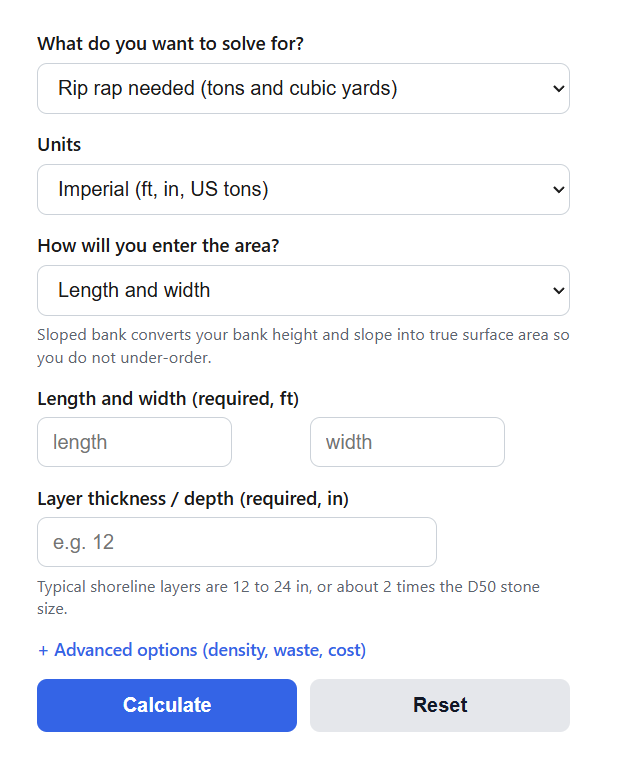
Calculate how many tons and cubic yards of rip rap you need from area and depth, plus the right D50 stone size for your water velocity.
Rip Rap Formula
Tons = (L * W * (T/12) / 27) * d * (1 + w/100)
- L is the length of the area to be armored (ft)
- W is the width of the area (ft)
- T is the rip rap layer thickness (in)
- d is the placed density of the stone (tons per cubic yard, typically 1.4 to 1.6)
- w is the waste and settling allowance (%)
For a sloped bank, the true surface length replaces a simple width measurement. With a bank of vertical height R and a slope of H horizontal units per 1 vertical unit, the slope surface length is:
SL = R * sqrt(1 + H^2)
To size the stone itself, the calculator uses the Isbash equation to find the median stone diameter D50 from the water velocity:
D50 = V^2 / (2 * g * C^2 * (S - 1))
- V is the average water velocity at the rip rap (ft/s or m/s)
- g is gravitational acceleration (32.17 ft/s² or 9.806 m/s²)
- C is the Isbash constant (1.20 for low turbulence, 0.86 for high turbulence)
- S is the specific gravity of the stone (typically 2.5 to 3.0)
The calculator has three modes built on these formulas. The quantity mode converts your area and layer thickness into cubic yards and tons, adds your waste allowance, and estimates cost if you enter a price per ton. The stone size mode solves the Isbash equation for D50 and reports the matching layer thickness of 1.5 to 2 times D50. The coverage mode works the quantity formula backward, telling you how much area a tonnage you already have will cover at a chosen depth. If you use the sloped bank option, the slope length formula computes the true surface area from bank height and slope ratio so the quantity is not underestimated.
Coverage Per Ton and Slope Multipliers
The first table shows roughly how many square feet one ton of rip rap covers at common layer depths, assuming a placed density of 1.5 tons per cubic yard.
| Layer depth | Coverage per ton | Typical use |
|---|---|---|
| 6 in | 36 sq ft | Decorative borders, light drainage |
| 9 in | 24 sq ft | Ditches, swales |
| 12 in | 18 sq ft | Standard shoreline layer |
| 18 in | 12 sq ft | Exposed banks, moderate current |
| 24 in | 9 sq ft | High-energy shorelines, large stone |
The second table is the slope surface multiplier. A common mistake is measuring a bank on a map or from the top of the slope and ordering off that flat footprint. The true rock-covered surface is longer than the horizontal footprint, and the steeper the bank, the bigger the shortfall. Multiply the flat plan-view area by the factor below for your slope to get the real surface area.
| Bank slope (H:V) | Surface multiplier | Extra rock needed |
|---|---|---|
| 4:1 (very gentle) | 1.03 | +3% |
| 3:1 (gentle) | 1.05 | +5% |
| 2:1 (common shoreline) | 1.12 | +12% |
| 1.5:1 (steep) | 1.20 | +20% |
| 1:1 (very steep) | 1.41 | +41% |
Example Problems
Example 1: shoreline quantity. You want to armor a 50 ft stretch of shoreline 12 ft wide with a 12 in layer of rip rap. The area is 50 * 12 = 600 sq ft. The volume is 600 * 1 ft = 600 cubic feet, which is 600 / 27 = 22.2 cubic yards. At 1.5 tons per cubic yard, the base weight is 22.2 * 1.5 = 33.3 tons. Adding a 10% waste allowance gives 33.3 * 1.10 = 36.7 tons, so you would order about 37 tons.
Example 2: stone size. A straight drainage channel carries water at 8 ft/s with low turbulence, and the local quarry stone has a specific gravity of 2.65. Using the Isbash equation, D50 = 8² / (2 * 32.17 * 1.20² * (2.65 – 1)) = 64 / 152.9 = 0.419 ft, or about 5 in. A layer 2 times D50 thick means placing the stone about 10 in deep, which rounds up to a standard 12 in layer of R-4 class rock.
Rip Rap Calculator FAQs
How many square feet does a ton of rip rap cover? At a typical placed density of 1.5 tons per cubic yard, one ton covers about 18 square feet at a 12-inch depth. Halve the depth and coverage doubles to about 36 square feet; double the depth to 24 inches and coverage drops to about 9 square feet. Actual coverage varies with stone size and how tightly the rock packs, so quarries quote anywhere from 15 to 25 square feet per ton at 12 inches.
Do I need fabric under rip rap? In most cases yes. A non-woven geotextile filter fabric or a granular bedding layer keeps the soil beneath the rock from washing out through the voids, which is the most common reason rip rap slopes fail. The fabric goes directly on the graded bank, and the rock is placed on top of it. Skipping it on an active shoreline usually means the bank erodes out from under the stone within a few seasons.
What size rip rap should I use? Size follows water velocity, not looks. Gentle flows under about 6 ft/s are handled by 3 to 6 inch stone, typical shorelines and channels in the 6 to 10 ft/s range need roughly 5 to 14 inch (R-4 to R-5) stone, and fast or turbulent water above that calls for 18 inch and larger rock. Use the stone size mode of the calculator with your design velocity, then make the layer at least 1.5 to 2 times the D50 it returns.