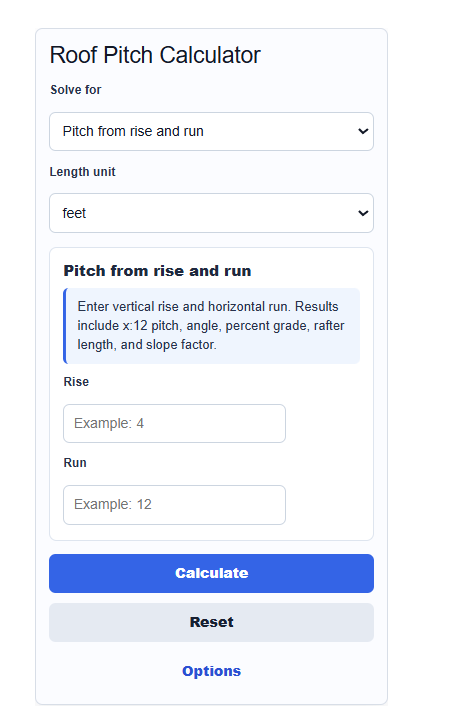
Calculate roof pitch from the rise and run of your roof, and convert that pitch into an angle, a percent grade, a rafter length, and a slope factor.
Roof Pitch Formula
Roof pitch is the steepness of a roof expressed as the vertical rise for every 12 inches of horizontal run. The calculator solves for pitch, rise, run, rafter length, or roof area depending on the mode you choose.
Pitch = (Rise / Run) * 12
Angle = arctan(Rise / Run)
Percent Grade = (Rise / Run) * 100
Rafter Length = sqrt(Rise^2 + Run^2)
Slope Factor = sqrt((Rise / Run)^2 + 1)
Roof Area = Plan Area * Slope Factor
Where:
- Rise is the vertical height the roof gains over the run.
- Run is the horizontal distance from the outside wall to the point directly below the ridge, which is half the building span for a common gable.
- Pitch is the rise stated per 12 units of run, written in the x:12 form such as 6:12.
- Angle is the slope measured in degrees from horizontal.
- Percent Grade is the rise divided by the run, written as a percentage.
- Rafter Length is the straight-line distance along the slope from the wall to the ridge, before any overhang or ridge thickness adjustment.
- Slope Factor is the multiplier that converts a flat plan area into the actual sloped surface area.
- Plan Area is the flat footprint area covered by the roof, measured as if looking straight down.
When you solve for pitch, you enter rise and run and the calculator returns the x:12 pitch along with the angle, percent grade, rafter length, and slope factor. When you solve for rise or run, you supply the run or rise plus the pitch in any of three forms (x:12, degrees, or percent), and the calculator works the missing length out from the same relationship. The rafter mode applies the Pythagorean theorem to give the sloped length from either rise and run or pitch and run. The roof area mode multiplies the flat plan area by the slope factor to estimate the true surface area you need to cover with material.
Common Roof Pitches and Their Conversions
The table below lists standard x:12 pitches with their matching angle, percent grade, and slope factor. Use the slope factor to convert a flat plan area into actual roof surface area.
| Pitch (x:12) | Angle (degrees) | Percent Grade | Slope Factor |
|---|---|---|---|
| 1:12 | 4.76 | 8.3% | 1.003 |
| 3:12 | 14.04 | 25.0% | 1.031 |
| 4:12 | 18.43 | 33.3% | 1.054 |
| 6:12 | 26.57 | 50.0% | 1.118 |
| 8:12 | 33.69 | 66.7% | 1.202 |
| 10:12 | 39.81 | 83.3% | 1.302 |
| 12:12 | 45.00 | 100.0% | 1.414 |
The next table groups pitches into the categories roofers use to talk about how a roof behaves and what materials suit it.
| Category | Pitch Range | Notes |
|---|---|---|
| Flat | Below 2:12 | Needs membrane or built-up roofing, not standard shingles. |
| Low slope | 2:12 to 4:12 | Shingles allowed with extra underlayment. |
| Conventional | 4:12 to 9:12 | Most common range, easy to walk and shingle. |
| Steep slope | 9:12 and above | Requires fall protection and adds surface area. |
Example Problems
Example 1. A roof rises 4 feet over a run of 12 feet. The pitch is (4 / 12) * 12, which is 4:12. The angle is arctan(4 / 12), which is 18.43 degrees. The percent grade is (4 / 12) * 100, which is 33.3%. The rafter length is sqrt(4^2 + 12^2), which is sqrt(160), or about 12.65 feet.
Example 2. You know a roof has a 6:12 pitch and a run of 15 feet, and you want the rise. Rise is (Pitch / 12) * Run, which is (6 / 12) * 15, or 7.5 feet. To convert a 1,000 square foot flat plan area at this pitch into roof surface area, multiply by the slope factor of 1.118, giving about 1,118 square feet of material.
Frequently Asked Questions
What is the difference between pitch and slope? Slope is the ratio of rise to run, usually written as x:12, and it describes the same steepness that pitch does in everyday use. Strictly, pitch is the ratio of rise to the full span of the building while slope is the ratio of rise to the run, but most roofers and most calculators treat the x:12 value as the pitch. This calculator reports the x:12 value.
How do I measure roof pitch without climbing on the roof? Hold a level horizontally against the underside of a rafter in the attic, mark 12 inches along the level, then measure straight down from that 12 inch mark to the rafter. That vertical measurement in inches is the rise, and it gives you the pitch directly as that number to 12.
Why does a steeper roof need more material? A steeper roof covers more sloped surface over the same flat footprint. The slope factor captures this. A 12:12 roof has a slope factor of 1.414, so it needs about 41 percent more roofing material than a flat area of the same footprint, while a gentle 3:12 roof only adds about 3 percent.