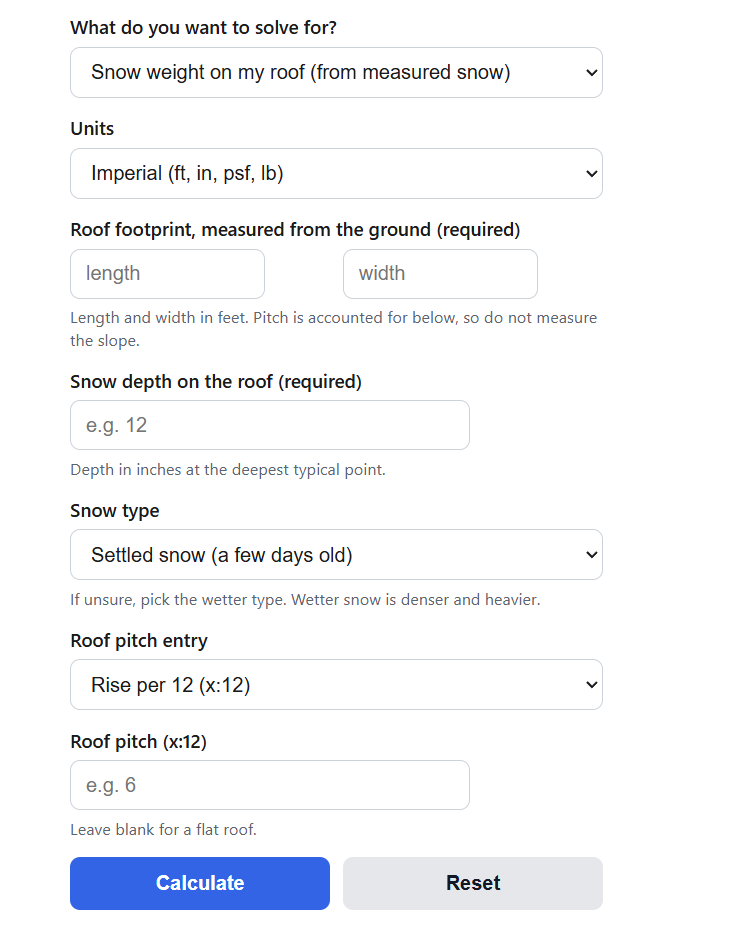
Calculate roof snow load from snow depth, type, and pitch, including total snow weight, ASCE 7 design loads, and the safe snow depth for your roof.
Roof Snow Load Formula
The snow load from measured snow is the depth of the snow multiplied by its density:
SL = (d / 12) * D
The total weight of snow on the roof accounts for the pitch, since a sloped roof holds more surface area than its footprint:
W = (L * Wd / cos(P)) * SL
For the design load mode, the calculator uses the ASCE 7 balanced snow load method:
pf = 0.7 * Ce * Ct * Is * pg
ps = Cs * pf
- SL is the snow load, or pressure from the snow, in pounds per square foot (psf)
- d is the snow depth in inches and D is the snow density in pounds per cubic foot
- W is the total snow weight in pounds, L and Wd are the roof footprint length and width in feet, and P is the roof pitch angle
- pg is the ground snow load for your location in psf
- Ce is the exposure factor, Ct is the thermal factor, and Is is the importance factor from the building risk category
- pf is the flat roof snow load and ps is the sloped roof snow load, both in psf
- Cs is the slope factor, which reduces the load on steeper and slipperier roofs
The calculator has three modes built on these formulas. The snow weight mode uses the first two equations to turn a measured snow depth and snow type into a pressure and a total weight. The design load mode uses the ASCE 7 equations to convert a ground snow load into the flat and sloped roof design loads. The safe depth mode inverts the first equation: it divides your roof capacity by the density of the chosen snow type to find the maximum depth the roof should carry, and how many more inches of margin remain at the current depth.
Snow Weight Per Inch of Depth
The same depth of snow can weigh over ten times more depending on its type. The table below shows the density of each snow type, how much load each inch of depth adds, and roughly how deep each type gets before it reaches 20 psf, a common design roof snow load for houses in moderate snow regions.
| Snow type | Density (lb/cu ft) | Load per inch of depth (psf) | Depth that equals 20 psf |
|---|---|---|---|
| Fresh snow | 3.75 | 0.31 | about 64 in |
| Damp fresh snow | 6.87 | 0.57 | about 35 in |
| Settled snow | 15.61 | 1.30 | about 15 in |
| Wind-packed snow | 23.41 | 1.95 | about 10 in |
| Very wet snow | 46.82 | 3.90 | about 5 in |
| Ice | 57.25 | 4.77 | about 4 in |
The last column is the fastest way to interpret a result. Five feet of fresh powder and five inches of slush weigh about the same, and a four inch layer of ice by itself can use up the entire design allowance on a typical roof.
ASCE 7 Snow Load Factors
The design load mode multiplies the ground snow load by three adjustment factors, then applies a slope reduction. Typical values are summarized below.
| Factor | Condition | Value |
|---|---|---|
| Importance (Is) | Risk category I / II / III / IV | 0.8 / 1.0 / 1.1 / 1.2 |
| Exposure (Ce) | Fully exposed / partially exposed / sheltered | 0.9 / 1.0 / 1.2 |
| Thermal (Ct) | Heated / just above freezing / unheated / heated greenhouse | 1.0 / 1.1 / 1.2 / 0.85 |
| Slope (Cs) | 1.0 at low slopes, falling to 0 at 70 degrees; slippery roofs reduce sooner | 0 to 1.0 |
Example Problems
Example 1: Weight of snow on a roof. A house has a roof footprint of 40 ft by 30 ft measured from the ground, a 6:12 pitch, and 12 inches of settled snow. The pitch angle is atan(6/12) = 26.57 degrees. The snow load is (12 / 12) * 15.61 = 15.61 psf. The sloped surface area is (40 * 30) / cos(26.57) = 1,342 sq ft. The total weight is 1,342 * 15.61 = about 20,950 lb, or roughly 10.5 tons of snow.
Example 2: ASCE 7 design load. A heated house (Ct = 1.0, risk category II so Is = 1.0) sits in a partially exposed suburb (Ce = 1.0) where the ground snow load is 30 psf. The flat roof snow load is pf = 0.7 * 1.0 * 1.0 * 1.0 * 30 = 21 psf. With a slippery metal roof at a 6:12 pitch (26.57 degrees), the slope factor is Cs = 1 – (26.57 – 5) / 65 = 0.67, so the sloped roof design load is ps = 0.67 * 21 = about 14 psf.
Frequently Asked Questions
How many inches of snow is too much for a roof?
It depends almost entirely on the snow type and your roof design load. Using a common 20 psf residential capacity, a roof can hold roughly 5 feet of fresh powder, about 15 inches of settled snow, about 10 inches of wind-packed snow, about 5 inches of very wet snow, or only about 4 inches of solid ice. Use the safe depth mode with your actual capacity, and act sooner if snow is layered with ice or rain is forecast, since rain absorbed into snowpack adds weight very quickly.
Is ground snow load the same as roof snow load?
No. The ground snow load (pg) is a mapped 50 year statistical value for your location, and the roof snow load is derived from it. For most roofs the flat roof value is 70 percent of the ground value after exposure, thermal, and importance adjustments, because wind removes some snow and roofs shed heat. Steep or slippery roofs are reduced further by the slope factor, though building codes also set minimum loads for low slope roofs.
What are the warning signs that a roof is overloaded?
Sagging ceilings or ridge lines, new cracks in drywall or masonry, doors and windows that suddenly stick, and creaking or popping sounds are all signs of an overstressed structure. If you see them, do not go on the roof; leave the building and contact a structural engineer. Ice buildup and icicles also deserve prompt attention because ice is roughly 15 times denser than fresh snow.