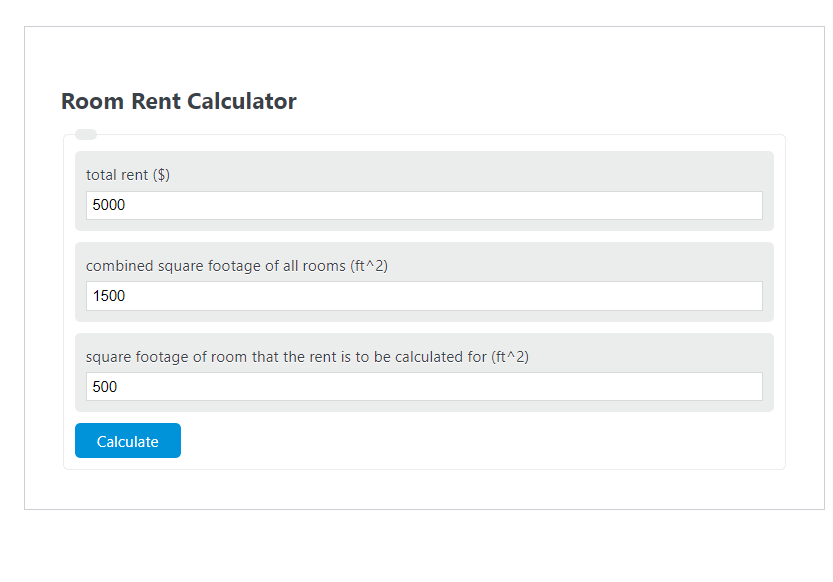
Calculate room rent by splitting equally, by room size, or prorating a partial month for roommates with move-in and move-out dates.
Room Rent Formula
Room rent is commonly allocated in proportion to room size. This calculator uses an area-based method: first find the rent per unit of area, then multiply that rate by the size of the room being priced.
| Symbol | Meaning | Typical Unit |
|---|---|---|
RR |
Room rent for the room being evaluated | Dollars per rent period |
TR |
Total rent for the property | Dollars per rent period |
CA |
Combined area used in the split | ft², m², or yd² |
RA |
Area of the specific room | ft², m², or yd² |
If you prefer to think in terms of a rental rate per square foot, the calculation can be split into two simpler steps:
Because the calculator can solve for a missing value, these rearranged forms are also useful:
How to Calculate Room Rent
- Determine the total rent for the same period you want to analyze, such as monthly rent.
- Measure the combined area included in the split.
- Measure the area of the room whose rent you want to calculate.
- Divide total rent by combined area to get the rent per unit area.
- Multiply that rate by the room area to get the room’s rent share.
Important: use the same area unit for both measurements. If the combined area is in square feet, the room area must also be in square feet. The same rule applies to square meters or square yards.
Example 1
Assume the monthly rent is $2,400, the combined rentable area is 1,200 ft², and the room being evaluated is 300 ft².
The room rent is $600 per month.
Example 2
If a room’s rent share is $525, the combined area is 900 ft², and the room area is 210 ft², you can solve for total rent:
The total rent is $2,250 per month.
Choosing the Right Combined Area
The most important decision in this method is what to include in CA. The calculator works as long as the scope is consistent, but households often use one of these approaches:
- Private-room method: only bedrooms or private spaces are included in the combined area.
- Whole-unit method: all rooms are included and every room share is based on total usable area.
- Hybrid method: common areas are split evenly, while private-room differences are adjusted by square footage.
For most roommate situations, the private-room or hybrid method produces a result that feels more reasonable than using bedroom size alone or splitting the entire rent evenly.
When an Area-Only Split May Not Be Enough
Square footage is a strong starting point, but equal area does not always mean equal value. Two rooms with the same size can still differ because of layout or amenities. Consider additional adjustments when one room includes:
- Private bathroom or ensuite
- Walk-in closet or extra storage
- Balcony, patio access, or better view
- Dedicated parking space
- Furnishings included with the room
- Better privacy, quieter location, or significantly better natural light
A common approach is to assign a fixed premium to special features and then split the remaining rent by area.
In this form, P_i is the premium assigned to roommate i, and A_i is that roommate’s room area. This keeps the math transparent while allowing for feature-based adjustments.
Common Mistakes to Avoid
- Using different area units for the combined area and room area.
- Including some shared spaces for one roommate but not for others.
- Forgetting to use the same rent period for every number.
- Rounding too early instead of rounding only the final rent share.
- Assuming square footage alone captures every difference between rooms.
Frequently Asked Questions
Should common areas be included?
They can be, but the key is consistency. Many roommate groups either split common-area value evenly or exclude it from the area comparison and only compare private rooms.
Can I use square meters or square yards?
Yes. The formula works with any area unit as long as both the combined area and room area use the same one.
Does this method work for weekly or annual rent?
Yes. The formula is independent of time period. Just make sure all rent values refer to the same period.
What if two rooms have the same size?
Under a pure area-based split, they would have the same base rent. If one room has better features, you can add a premium adjustment.
Are utilities included?
Usually not. Utilities are often split separately, either evenly or by usage, while rent is split by room value or area.