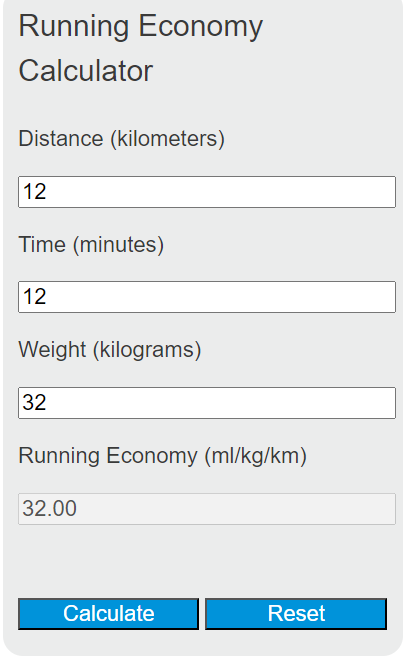
Calculate running economy, VO₂, pace, race time, METs, and calories from distance, time, incline, VO₂max, pace, and weight for runners.
Running Economy Formula
The following formula can be used to calculate running economy when you know the oxygen consumption (VO₂) at a steady pace:
Variables:
- RE is the running economy (ml/kg/km)
- VO₂ is the oxygen consumption at the running pace (ml/kg/min)
- T is the time spent running at that pace (minutes)
- D is the distance covered at that pace (kilometers)
Because speed v = D/T, this is equivalent to RE = VO₂ / v (with v in km/min). In practice, VO₂ is typically measured in a lab; the calculator above estimates VO₂ from speed and incline using a standard running metabolic equation.
| Running economy | Speed | Calculated oxygen use | Interpretation at the same pace |
|---|---|---|---|
| 190 ml/kg/km | 0.20 km/min | 38.0 ml/kg/min | Lowest oxygen cost of these examples |
| 210 ml/kg/km | 0.20 km/min | 42.0 ml/kg/min | Middle oxygen cost |
| 230 ml/kg/km | 0.20 km/min | 46.0 ml/kg/min | Highest oxygen cost of these examples |
Economy comparisons are most meaningful when pace, grade, surface, and measurement method are held constant. At the same speed, a lower oxygen cost indicates better running economy.
What is Running Economy?
Running economy is a measure of efficiency, indicating how much oxygen a person consumes while running at a certain pace. It is often measured in milliliters of oxygen consumed per kilogram of body weight per kilometer (ml/kg/km). A lower value indicates better economy, meaning the runner can maintain a given speed while using less oxygen, which is advantageous for endurance performance.
How to Calculate Running Economy?
The following steps outline how to calculate Running Economy.
- First, determine the distance run (D) in kilometers.
- Next, determine the time taken to run the distance (T) in minutes.
- Next, measure VO₂ at that pace (ml/kg/min) or estimate it using a metabolic equation (often using speed and incline).
- Next, gather the formula from above: RE = (VO₂ × T) / D.
- Finally, calculate the Running Economy (RE) in ml/kg/km (lower values indicate better economy at that pace/grade).
- After inserting the variables and calculating the result, check your answer with the calculator above.
Example Problem:
Use the following variables as an example problem to test your knowledge.
Distance run (D) = 10 kilometers
Time taken to run the distance (T) = 50 minutes
Speed v = D/T = 0.2 km/min (12 km/h). On level ground (0% incline), an estimate is VO₂ ≈ 3.5 + 0.2 × 200 = 43.5 ml/kg/min (since 12 km/h = 200 m/min), so RE = (VO₂ × T) / D ≈ (43.5 × 50) / 10 = 217.5 ml/kg/km.