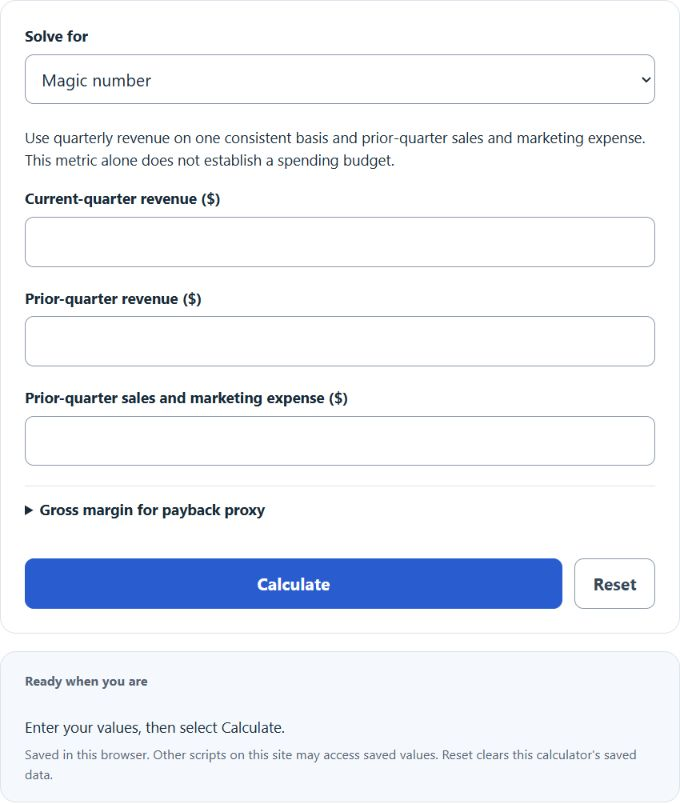
Calculate your SaaS magic number from quarterly revenue growth and sales and marketing spend, with contextual reference bands, recovery-period proxies, and target expense or growth modes.
SaaS Magic Number Formula
MN = ((Q2 - Q1) * 4) / SM1
- MN is the SaaS magic number
- Q2 is the current quarter GAAP revenue ($), measured consistently
- Q1 is the prior quarter GAAP revenue ($), on the same basis
- SM1 is the prior quarter sales and marketing spend ($)
The calculator's default mode applies this formula directly: it annualizes your quarterly revenue growth by multiplying by 4, then divides by the sales and marketing spend from the quarter before the growth occurred. The spend is lagged one quarter because money spent on sales and marketing typically takes a quarter or more to show up as closed revenue.
The two target modes rearrange the same formula. To find the maximum spend that keeps you at a target magic number:
Max SM1 = ((Q2 - Q1) * 4) / Target MN
To find the quarterly revenue growth required to hit a target magic number on a given spend:
Required Growth = (Target MN * SM1) / 4
The optional gross-margin input adds a recovery-period proxy based on net revenue growth. It assumes a stable incremental revenue run rate and margin; it is not measured customer-cohort CAC payback. Enter gross margin as a percentage, such as 80 for 80%:
Recovery proxy (months) = 12 / (MN * (Gross Margin % / 100))
Magic Number Reference Bands and Recovery Proxies
The magic number answers one question: for each dollar of sales and marketing spend, how much annualized recurring revenue growth did you get back? The bands below are historical reference guides associated with sales-efficiency discussions, not universal ratings or instructions to change budgets. Scale Venture Partners distinguishes GAAP-based magic number from ARR-based sales-efficiency metrics.
| Magic Number | Rating | Typical action |
|---|---|---|
| Below 0.5 | Inefficient | Review revenue quality, churn, margins and acquisition costs |
| 0.5 to below 0.75 | Below benchmark | Compare consistent periods and relevant company cohorts |
| 0.75 to below 1.0 | Efficient | Assess alongside retention, margin and sales-cycle timing |
| 1.0 or higher | Very efficient | Investigate persistence, one-time revenue and budget constraints |
For a positive magic number, 12 / MN is a revenue-based recovery proxy. Dividing again by the gross-margin fraction gives a gross-profit proxy, assuming the incremental revenue run rate and margin remain stable. The table shows these proxies, not observed cohort CAC payback. At MN = 0.75 and an 80% margin, the proxy is 20 months, so 0.75 does not itself guarantee recovery within 18 months.
| Magic Number | 70% margin | 80% margin | 90% margin |
|---|---|---|---|
| 0.5 | 34.3 months | 30.0 months | 26.7 months |
| 0.75 | 22.9 months | 20.0 months | 17.8 months |
| 1.0 | 17.1 months | 15.0 months | 13.3 months |
| 1.5 | 11.4 months | 10.0 months | 8.9 months |
Example Problems
Example 1: A SaaS company reports $200,000 of recurring revenue in Q1 and $225,000 in Q2, and it spent $125,000 on sales and marketing in Q1. Quarterly growth is $25,000, which annualizes to $100,000. Dividing by the $125,000 spend gives a magic number of 0.8, which lands in the efficient range. When you add an 80% gross margin in the optional gross-margin section, the recovery proxy is 12 / (0.8 * 0.8) = 18.75 months.
Example 2: A company is growing revenue by $50,000 per quarter and wants to know the most it can spend on sales and marketing while keeping a magic number of at least 1.0. Using the max spend mode: ($50,000 * 4) / 1.0 = $200,000 per quarter. Spending above that level at the same growth rate would push the magic number below 1.0.
FAQ
Why is revenue growth multiplied by 4 and compared to the prior quarter's spend?
Multiplying the change in quarterly revenue by 4 annualizes that change; it does not forecast realized future receipts. The conventional formula uses expense from the earlier quarter to allow for a sales lag. Actual sales cycles, revenue recognition and seasonality can differ, so the lag does not establish which expense caused the growth.
Should I use GAAP revenue or net new ARR in the formula?
The original Scale Venture Partners version uses GAAP revenue because it is the only figure reliably available for public companies, which makes benchmarking possible. Net sales efficiency instead divides net new ARR (new ARR plus expansion minus churn and downgrades) by the applicable sales and marketing expense. ARR is already annualized: do not apply the factor 4 again or enter it into this calculator's quarterly-revenue fields. The timing conventions also differ; label and use each metric consistently.
Is a very high magic number always good?
Not necessarily. A high magic number can reflect several revenue and expense conditions; it does not by itself prove underinvestment. It can also be inflated temporarily by a large one-time deal, a price increase, or seasonally strong bookings. Check the number over several quarters, and pair it with churn, gross margin, and CAC payback before changing budgets.