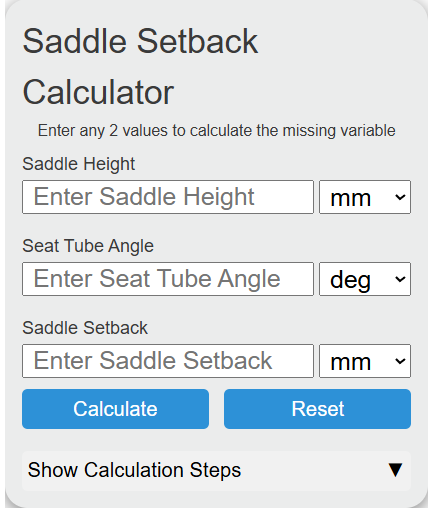
Calculate bicycle saddle setback, saddle height, or seat-tube angle in mm, cm, or inches with an explicit geometry convention and optional rail offset.
Saddle Setback Formula
The saddle setback calculation uses simple right-triangle geometry. Saddle height is treated as the distance along the seat tube line, and saddle setback is the horizontal distance created by the seat tube angle.
- SS = saddle setback
- SH = saddle height
- STA = seat tube angle
- cos = cosine of the seat tube angle
- arccos = inverse cosine, used to solve for the angle
If you enter saddle height and seat tube angle, the calculator finds saddle setback.
If you enter saddle setback and seat tube angle, it finds saddle height.
If you enter saddle height and saddle setback, it finds the seat tube angle. For this mode, saddle setback must be less than or equal to saddle height.
The calculator converts inches to millimeters before calculating, then converts the result back to your selected output unit.
Seat Tube Angle Reference Values
These values show how much horizontal setback is produced for each 100 mm of saddle height along the seat tube line.
| Seat Tube Angle | cos(angle) | Setback per 100 mm Saddle Height |
|---|---|---|
| 70° | 0.342 | 34.2 mm |
| 72° | 0.309 | 30.9 mm |
| 73° | 0.292 | 29.2 mm |
| 74° | 0.276 | 27.6 mm |
| 76° | 0.242 | 24.2 mm |
A steeper seat tube angle gives less calculated setback for the same saddle height. A slacker seat tube angle gives more calculated setback.
Length Unit Conversions
| Conversion | Value |
|---|---|
| 1 inch to millimeters | 25.4 mm |
| 1 millimeter to inches | 0.0393701 in |
| 10 mm to inches | 0.3937 in |
| 1 inch to centimeters | 2.54 cm |
Example Problems
Example 1: Calculate saddle setback
You have a saddle height of 720 mm and a seat tube angle of 73°.
The saddle setback is about 210.5 mm.
Example 2: Calculate seat tube angle
You have a saddle height of 700 mm and a saddle setback of 200 mm.
The seat tube angle is about 73.4°.
FAQ
What is saddle setback?
Saddle setback is the horizontal distance between the bottom bracket area and the saddle position along the seat tube line. In this calculator, it is based on saddle height and seat tube angle only. It does not include saddle rail adjustment, seatpost offset, saddle shape, or where you sit on the saddle.
Why must the seat tube angle be less than 90 degrees?
The formula uses the cosine of the seat tube angle to calculate the horizontal component of saddle height. At 90 degrees, the cosine is zero, so the calculated setback would be zero. Angles above 90 degrees would not match the normal rearward setback geometry used by this calculator.
Why can saddle setback not be greater than saddle height?
When solving for seat tube angle, the calculator uses SS / SH inside an inverse cosine function. That ratio must be between 0 and 1. If saddle setback is greater than saddle height, the ratio is above 1, so there is no valid angle for this geometry.