Estimate bicycle crank length from leg, tibia, or inseam measurements, compare research and fit formulas, round to stock sizes, and check your current cranks.
Crank Length Formula
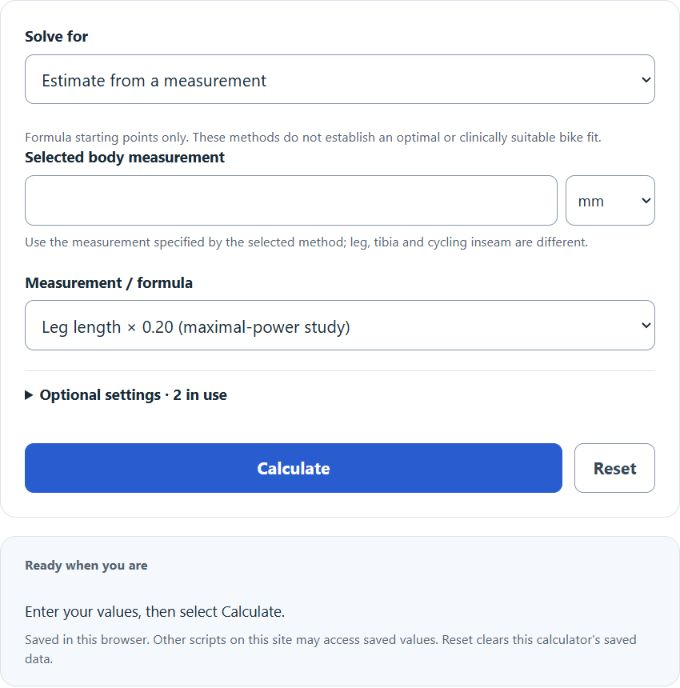
Choose among four formula starting points: 20% of leg length, 41% of tibia length, 0.216 × cycling inseam, or the retained Machine Head heuristic (1.25 × inseam in cm + 65). Leg/tibia relationships concern maximal-power research; inseam rules are fit heuristics.
By Leg Length (maximal-power study):
By Inseam:
- Leg length / tibia length — use the distinct measurement required by the selected research method, not standing height.
- Inseam — cycling inseam measured from floor to crotch in bare feet, converted to millimeters.
- Crank Length — distance from the bottom bracket spindle to the pedal axle, in millimeters.
The result is a starting point, not a hard rule. Cranks come in fixed sizes (most commonly 165, 170, 172.5, and 175 mm), so round to the nearest available length. Riding style, flexibility, and bike fit history can justify going shorter or longer than the formula suggests.
Reference Tables
These retained historical tables are illustrative ranges, not validated prescriptions, formula outputs or proof of actual stock availability. Individual fit and component clearance remain controlling.
| Inseam (cm) | Inseam (in) | Illustrative Crank Range (mm) |
|---|---|---|
| Under 76 | Under 30 | 160 – 165 |
| 76 – 81 | 30 – 32 | 165 – 170 |
| 81 – 86 | 32 – 34 | 170 – 172.5 |
| 86 – 91 | 34 – 36 | 172.5 – 175 |
| Over 91 | Over 36 | 175 – 180 |
| Discipline | Typical Range | Notes |
|---|---|---|
| Road | 165 – 175 mm | Availability varies by manufacturer and crank model. |
| Time Trial / Tri | 160 – 170 mm | Shorter cranks open the hip angle in aero position. |
| Mountain | 165 – 175 mm | Shorter cranks improve pedal-strike clearance. |
| Track | 165 – 170 mm | Shorter for cornering clearance and high cadence. |
Example and FAQ
Example: With an 82 cm cycling inseam, 820 × 0.216 = 177.12 mm; rounding to 2.5 mm gives 177.5 mm. This is a heuristic starting point, not proof that this length is suitable or available.
Does crank length really matter? The maximal-power study does not establish universal comfort, joint-clearance or injury outcomes. Individual fit needs separate assessment.
Should I go shorter than the formula suggests? A qualified fit assessment can justify another length. The optional ±5 mm setting is an explicit user scenario, not a recommendation.
Height or inseam — which is more accurate? Use the precise measurement required by the selected method. This calculator does not use standing height; leg length, tibia length and cycling inseam are distinct.
Can I switch crank length without other changes? Crank changes can affect saddle position, pedal clearance and joint motion. Reassess the full bike fit instead of applying a universal saddle-height adjustment.