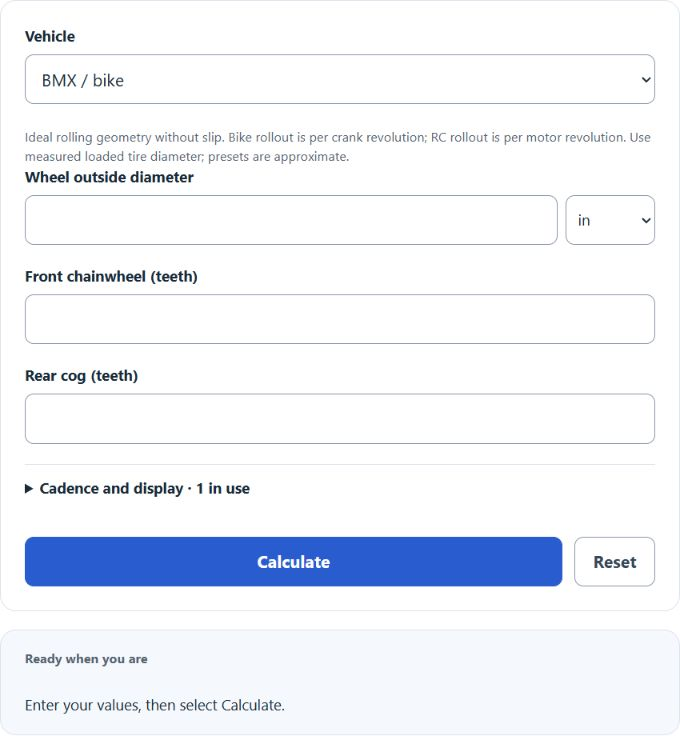
Calculate BMX bike or RC car rollout and gearing from wheel diameter, tire size, tooth counts, cadence, and internal ratio, with speed at cadence.
Rollout Formula
Rollout is the distance a vehicle travels for each single revolution of the engine or motor after tire size and total gearing are accounted for. It is a useful way to compare setups because it combines tire diameter, pinion size, spur size, and internal ratio into one measurement.
- RO = rollout, measured as distance per revolution
- D = tire diameter
- P = pinion gear tooth count
- S = spur gear tooth count
- IR = internal gear ratio
The rollout unit follows the tire diameter unit. If diameter is entered in inches, the result is in inches per revolution. If diameter is entered in millimeters, the result is in millimeters per revolution.
What the Formula Means
The tire circumference determines how far the vehicle moves for one wheel revolution, while the gearing determines how many motor or engine revolutions are required to turn the wheel once. A higher rollout means more distance is covered per revolution. A lower rollout means less distance is covered per revolution.
| Change | Effect on Rollout | Practical Result |
|---|---|---|
| Larger tire diameter | Increases rollout | More distance traveled per revolution |
| Larger pinion | Increases rollout | Taller overall gearing |
| Larger spur | Decreases rollout | Shorter overall gearing |
| Larger internal ratio | Decreases rollout | More reduction through the drivetrain |
How to Calculate Rollout
- Measure or look up the tire diameter.
- Enter the spur gear tooth count.
- Enter the pinion gear tooth count.
- Enter the internal gear ratio as a number. For example, a 4:1 internal ratio should be entered as 4.
- Apply the formula to find the distance traveled per revolution.
If you want to think about the gearing first, it can also be helpful to calculate the overall drive reduction and then compare that to tire circumference.
Rearranged Rollout Equations
These algebraic rearrangements are useful when one variable is unknown. The RC calculator compares current and new setups and finds an ideal pinion for a supplied target rollout.
Solve for Tire Diameter
Solve for Pinion
Solve for Spur
Solve for Internal Gear Ratio
Example Calculation
Suppose the tire diameter is 20 inches, the spur gear has 75 teeth, the pinion has 16 teeth, and the internal ratio is 4. The rollout is found by substituting those values into the formula.
This means the vehicle travels about 3.35 inches for every one revolution of the motor or engine.
Why Rollout Matters
Rollout is often more useful than looking at gears alone because it reflects both gearing and tire size at the same time. Two setups with different gears can behave similarly if their rollout values are close. This makes rollout valuable when:
- comparing setups that use different tire diameters,
- tracking setup changes over time,
- compensating for tire wear,
- tuning for acceleration versus higher speed potential,
- matching a known setup from one vehicle to another.
Common Input Mistakes
- Using radius instead of diameter: the formula requires full tire diameter.
- Entering the ratio incorrectly: if the internal ratio is written as 4:1, enter 4.
- Mixing units: select the correct unit for each quantity; the calculator converts units independently.
- Ignoring real tire size: worn or loaded tires can reduce effective rollout.
Using the Calculator Effectively
For a target RC rollout, enter the optional target to find the ideal pinion with the current spur. The comparison grid highlights the closest displayed setup; check available integer gears, fit and manufacturer limits. In bike mode, rollout is distance per crank revolution, using wheel diameter × π × front teeth ÷ rear teeth. Optional cadence gives speed.
Frequently Asked Questions
Is a higher rollout always better?
No. A higher rollout increases the distance traveled per revolution, but the best value depends on the vehicle, surface, power, and the balance you want between acceleration and speed potential.
Does tire wear change rollout?
Yes. As tire diameter decreases, rollout also decreases. Even if the gears stay the same, a smaller tire changes the final setup.
Why use rollout instead of gear ratio alone?
Gear ratio only describes the mechanical reduction. Rollout shows the actual distance traveled per revolution, which makes it easier to compare setups using different tire sizes.