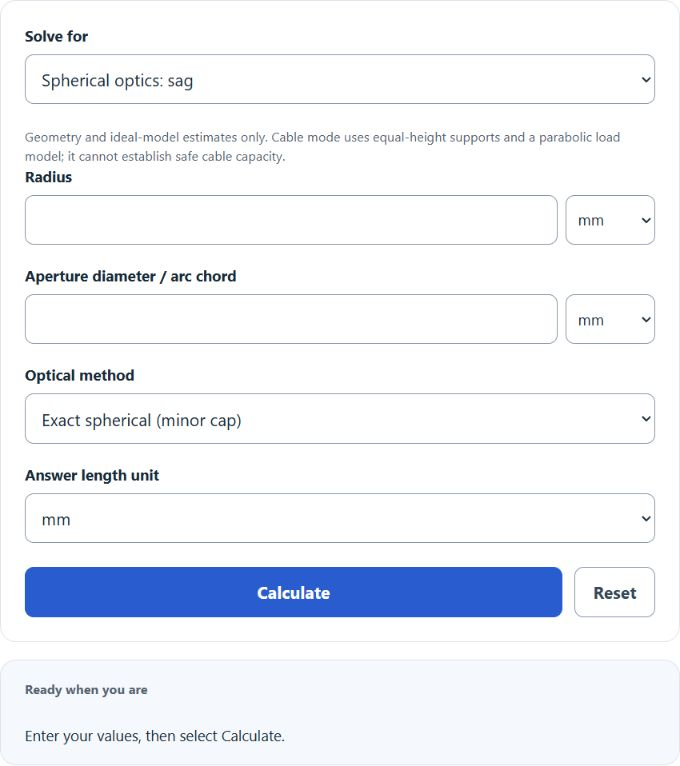
Calculate sag for spherical or conic lens surfaces, circular arcs and hanging cables, or find radius or chord from a known sag, plus suspension sag.
- Arc Height (sagitta) Calculator
- All Construction Calculators
- Mirror Equation Calculator
- Focal Ratio Calculator
Calculator Functions
| Function | What it does | What it requires |
|---|---|---|
| Spherical optics: sag | Finds the sag of a spherical lens or mirror surface | Requires the radius of curvature, the aperture diameter and the optical method (exact or paraxial) |
| Spherical optics: radius | Finds the radius of curvature from a measured sag | Requires the aperture diameter, the sag and the optical method |
| Spherical optics: diameter | Finds the aperture diameter that gives a set sag | Requires the radius of curvature, the sag and the optical method |
| Conic optics: sag | Finds the sag of a conic surface such as a parabola, ellipse or hyperbola | Requires the signed vertex radius, the aperture diameter and the conic constant K (a blank counts as 0) |
| Circular arc: rise | Finds the rise of a circular arc above its chord | Requires the radius, the chord and the arc segment (minor or major) |
| Circular arc: radius | Finds the radius of an arc from its chord and rise | Requires the chord and the rise |
| Circular arc: chord | Finds the chord of an arc from its radius and rise | Requires the radius and the rise |
| Cable: parabolic sag | Finds the midspan sag of a cable under a uniform load | Requires the horizontal span, the load per horizontal length (N/m, N/ft, lbf/ft or lbf/in) and the horizontal tension (N or lbf) |
| Suspension: target sag | Finds the sag distance that matches a target percentage | Requires the fork travel or rear shock stroke (mm or in) and the manufacturer target sag in percent |
Lengths can be entered in mm, cm, m, in or ft, and the answer length unit is chosen separately. The arc functions also show the central angle, arc length and segment area. The cable function shows the tension at the supports and the sag as a share of the span. The suspension function takes an optional measured sag and reports it as a percentage.
SAG Formulas
| S | Sag, the depth of the curve below its edge |
| R | Radius of curvature |
| D | Aperture diameter, or the chord of an arc |
The radius, half the diameter and the distance from the center of curvature to the chord form a right triangle, and the sag is what is left of the radius. It is the conic sag equation with the conic constant at zero [1].
Spherical optics: sag
The exact method uses the main formula. A surface with a 100 mm radius and a 25 mm aperture has a sag of 0.784326 mm. The paraxial method uses the shorter form below, which gives 0.78125 mm for the same surface and is close only while the aperture is small next to the radius.
Spherical optics: radius
The main formula solved for the radius. A 25 mm aperture with a sag of 0.784326 mm has a 100 mm radius. The paraxial method drops the S ÷ 2 term. With the exact method the sag may not exceed the radius, which is a full hemisphere.
Spherical optics: diameter
The main formula solved for the diameter. A 100 mm radius and a sag of 0.784326 mm give a 25 mm aperture. The paraxial method uses D = √(8 × R × S).
Conic optics: sag
Q = 1 − (1 + K) × (r ÷ R)²
r is half the aperture diameter, R the vertex radius and K the conic constant. K = 0 is a sphere, K = −1 a parabola, K above −1 an ellipse and K below −1 a hyperbola [1]. With R = 100 mm and D = 25 mm, K = −1 gives 0.78125 mm and K = 0 gives the spherical 0.784326 mm. A negative radius gives a negative sag, and a combination that makes Q negative has no real surface at that aperture.
Circular arc: rise
The main formula with the chord as D gives the rise of the minor segment. An arc of radius 10 over a chord of 12 rises 2. The major segment on the same chord rises 2 × R − S, which is 18. The central angle is θ = 2 × atan((D ÷ 2) ÷ (R − S)), the arc length is R × θ and the segment area is R² × (θ − sin θ) ÷ 2, with θ in radians.
Circular arc: radius
The same rearrangement as for a spherical surface: R = D² ÷ (8 × S) + S ÷ 2. A chord of 12 with a rise of 2 lies on a circle of radius 10. A rise larger than the radius means the arc is a major segment.
Circular arc: chord
D = 2 × √(S × (2 × R − S)). A radius of 10 and a rise of 2 give a chord of 12. The rise may not exceed twice the radius.
Cable: parabolic sag
w is the load per unit of horizontal length, L the span and H the horizontal tension. This is the first term of the catenary equation, which is the equation of a parabola [2]. A 30 m span carrying 10 N/m at 2,000 N of horizontal tension sags 0.5625 m. Each support carries half the load vertically, so the tension there is T = √(H² + (w × L ÷ 2)²), which is 2,005.6 N in this case.
Suspension: target sag
Sag is the amount a fork or shock compresses under the rider, stated as a share of its available travel [3]. A 150 mm fork at 25% should sag 37.5 mm, and a measured 45 mm on that fork is 30%. FOX gives 25% of available travel as a starting point [3]. A rear shock is measured against its stroke, not against the travel of the rear wheel.
Limits of This Estimate
- The paraxial method is an approximation. It is within about 0.4% for the 25 mm aperture on a 100 mm radius above, and the error grows quickly as the aperture approaches the radius.
- Conic optics: sag covers a pure conic. Aspheres defined with higher-order coefficients add terms that are not included [1].
- The cable function assumes supports at equal height and a load spread evenly along the horizontal. A cable hanging under its own weight follows a catenary, which sags slightly more; the parabola is adequate for spans up to about 1,000 ft (300 m) with small sags [2]. It leaves out wind, ice, stretch and temperature, and is not a design approval.
- The suspension target comes from the fork, shock or bike maker. No percentage suits every model.
Sources
- Edmund Optics, All About Aspheric Lenses: the sag equation of a conic surface, the surface each conic constant gives, and the higher-order aspheric terms
- USDA Rural Utilities Service, Bulletin 1724E-152, The Mechanics of Overhead Distribution Line Conductors: the parabolic sag equation as the first term of the catenary, adequate for spans up to about 1,000 ft, for supports at equal height
- FOX Factory, Owner's Manual: Measuring and Setting Sag: sag as the measured compression divided by the available travel of the fork or shock, with 25% as a starting point